Learn Languages with AI: Practice Speaking, Memorize Vocab & Write Essays from Scratch

Learning a foreign language often hits three walls: no environment, no conversation partner, and difficulty staying consistent. Today's AI tools can effectively solve all three — they can practice speaking with you, help you memorize vocabulary, correct your writing, and serve as your reading assistant. The best part? Most of these features are free or very low cost.
In this guide, we'll walk you through using AI to supercharge your language learning efficiency.
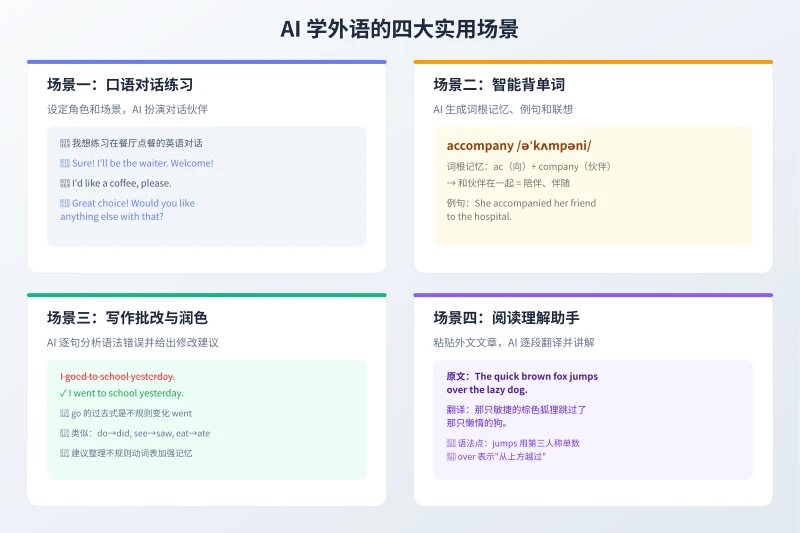
Scenario 1: AI as Your Speaking Partner
The biggest challenge in speaking practice is finding someone to talk to. AI chatbots like ChatGPT, Claude, or similar tools can role-play as conversation partners anytime — and they won't judge your pronunciation or grammar.
Step-by-Step Guide
Step 1: Set up the role and scenario
Open your AI chat tool and enter a prompt like this:
I want to practice English speaking. Please play the role of a coffee shop barista, and I'll be the customer ordering. Use simple English and correct my mistakes at the end of each reply.
Step 2: Start the conversation
The AI will automatically enter character and chat with you in English. Just respond naturally. Making mistakes is fine — the AI will help correct them after the conversation.
Step 3: Request feedback and summary
After a few rounds, you can say:
Please summarize the grammar mistakes I made and provide corrections.
Advanced tip: Ask the AI to switch difficulty levels. Start with simple sentences, then progress to complex ones. You can also set different scenarios — airport, hospital, job interview, business meeting — to cover various real-life needs.
Scenario 2: AI-Powered Vocabulary Building
Rote memorization is the least efficient way to learn words. AI can use root-based memory, association techniques, and contextual learning to help you truly understand and remember vocabulary.
Step-by-Step Guide
Step 1: Ask AI to explain words using roots
Send the words you want to learn:
Please help me understand these words using root-based memory: accomplish, unprecedented, sophisticated, comprehensive, simultaneously. For each word, provide root breakdown, memory association, and a practical example sentence.
AI will return something like:
- accomplish → ac (to) + com (together) + plish (fill) → fill together = complete
- unprecedented → un (not) + pre (before) + cedent (go) + ed → never gone before = unprecedented
Step 2: Generate vocabulary tests
After learning a set of words, ask AI to quiz you:
Create 5 fill-in-the-blank exercises using these 5 words. Give me a sentence with a blank for each word.
Step 3: Spaced repetition
Mark the words you tend to forget and ask AI to create new exercises the next day. AI can even adjust review frequency based on your error rate.
Scenario 3: AI Writing Correction & Feedback
Writing is the best way to test language skills, but without feedback, it's wasted effort. AI can analyze your writing sentence by sentence, pointing out grammar errors, inappropriate word choices, and unnatural expressions.
Step-by-Step Guide
Step 1: Write a short passage
Write 100-200 words on any topic — "My Weekend," "My Hometown," or "My Dream."
Step 2: Submit to AI for correction
Please correct the following English essay: 1. Check grammar errors sentence by sentence 2. Mark inappropriate word choices 3. Suggest more natural alternatives 4. Give an overall score (out of 10) and improvement tips My essay: [paste your essay]
Step 3: Learn from the feedback
AI will return detailed corrections. Focus on:
- Red marks: grammar errors that must be fixed
- Yellow marks: expressions that could be improved
- Green marks: better alternative expressions
Advanced tip: After writing, ask AI to simulate an IELTS examiner scoring your essay across four dimensions: Task Response, Coherence, Lexical Resource, and Grammar.
Scenario 4: AI as Your Reading Assistant
Encountering new words and complex sentences while reading foreign texts is normal. AI can translate paragraphs, explain grammar, and highlight vocabulary to make reading effortless.
Step-by-Step Guide
Step 1: Paste the article paragraph
Send the foreign text you want to read:
Here's an excerpt from an English news article. Please: 1. Translate it to Chinese 2. Highlight and explain all difficult vocabulary 3. Analyze the sentence structure of complex sentences [paste the English paragraph]
Step 2: Ask follow-up questions
If you don't understand a sentence, just ask:
Please explain the grammar structure of the second sentence, especially the "which" clause.
Step 3: Build a vocabulary list
Ask AI to organize the new words from your reading:
Please organize the new words from the article into a table with: word, phonetics, part of speech, Chinese meaning, and an example sentence.

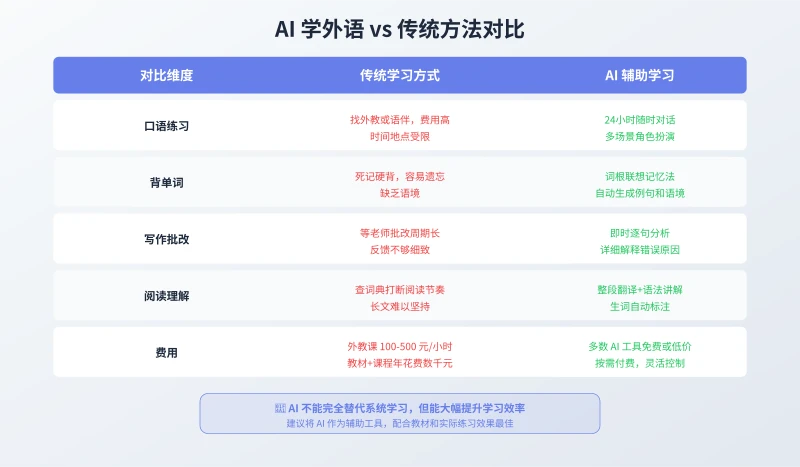
AI Language Learning vs Traditional Methods

As shown above, AI has clear advantages across all four dimensions: speaking practice, vocabulary building, writing correction, and reading comprehension. However, note that AI cannot fully replace systematic learning — it works best as a supplement alongside textbooks and real-world practice.
Recommended AI Tools for Language Learning
Here are some AI tools perfect for learning foreign languages:
- ChatGPT / Claude: All-rounders that handle speaking, writing, and reading
- DeepL: Exceptional translation quality, great for reading and writing reference
- Anki + AI: Classic flashcard app, pair with AI-generated content for double efficiency
- Google Gemini: Strong multilingual support, good for conversation practice
FAQ
Q: Can AI accurately correct pronunciation?
In text-based chat, AI can only correct spelling and grammar. For pronunciation correction, use voice mode (like ChatGPT voice chat) or dedicated pronunciation apps.
Q: Can AI replace a human tutor?
AI can handle about 70% of daily speaking practice scenarios. However, emotional connection and cultural understanding in real conversations are things AI can't fully replicate yet. The best approach is to combine both.
Q: How long should I practice each day?
Aim for 15-30 minutes daily. Consistency matters more than duration. The advantage of AI is that it's always available — you can practice during any spare moment.
Final Thoughts
Learning a foreign language has never been easy, but AI makes it much more sustainable. Starting today, open an AI tool, set up a scenario, and begin your first foreign language conversation.
Related Articles
AI 帮你写简历:从零到专业,五步搞定求职利器
不管你是应届生还是职场转行,AI 都能帮你把简历从"凑合能用"变成"眼前一亮"。本文用五个步骤,手把手教你用 AI 生成、修改、优化出一份真正能拿面试的专业简历。
AI 语音转文字:零基础实操指南,三步把说话变成文字
还在打字到手指发酸?还在为会议记录发愁?AI 语音转文字技术已经非常成熟,学会使用它,可以帮你把说话直接变成文字,效率提升数倍。本文将手把手教你选择工具、完成转写、导出使用,让 AI 成为你的打字替身。
Tech FrontierAI 提问技巧入门:让 AI 回答更准确的 7 个实用方法
明明 AI 功能强大,但每次提问得到的回答都差强人意?其实问题往往不在 AI,而在于你提问的方式。本文用最直观的方式教你 7 个让 AI 回答更准确的实用技巧,包括四要素公式、精准提问、背景信息、拆分任务、追问迭代、万能模板和常见错误,小白也能立即上手。
Comments are not yet available, stay tuned