AI Prompt Tips for Beginners: How to Get the Answers You Want

Ever asked an AI a question and gotten a long, vague answer that completely misses the point? Then you rephrased, got a slightly better result, but it still was not quite right? The quality of AI responses depends heavily on how you ask. This article teaches you a simple, practical prompt-building framework so you get reliable answers every single time.
Why How You Ask Matters
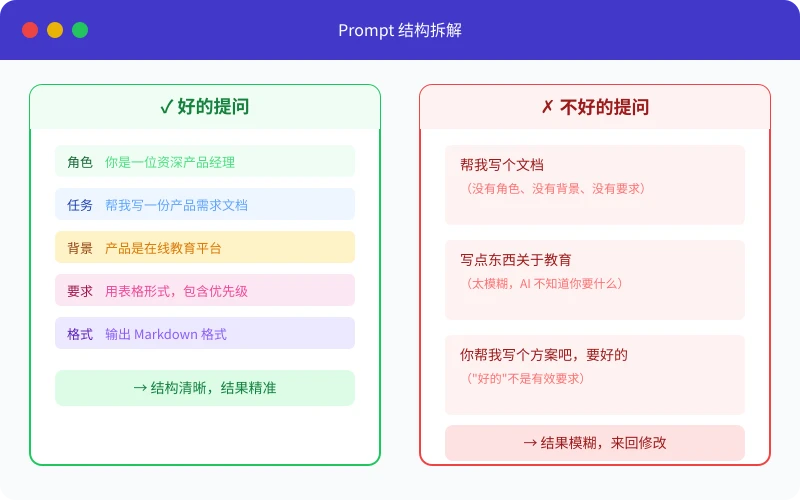
AI is like a brilliant intern who knows everything — but you need to give clear instructions. Say "help me write a document" and AI has no idea what document, for whom, how long, or what tone. But say "You are a senior product manager. Help me write a PRD for an online education platform. Use a table to list feature requirements and priorities" and the result will be completely different.
In short: the more specific your input, the more precise the output.

The Universal Framework: Five Elements
Remember a simple mnemonic: Role, Task, Context, Requirements, Format. Every time you write a prompt, organize it around these five elements and you will see immediate improvement.
1. Role
Tell the AI what role to play. This affects the expertise level and tone of the response.
Examples: "You are a frontend engineer with 10 years of experience," "You are a Xiaohongshu copywriting expert," "You are an elementary school teacher."
2. Task
Clearly state what you want the AI to do. The more specific, the better.
Good examples: "Help me write a resignation letter," "Analyze this data and give me recommendations," "Translate this paragraph into formal English."
Bad examples: "Write something," "Help me with this," "Do whatever you think is best."
3. Context
Provide the necessary background. AI does not know your situation — you have to tell it.
Examples: "This is a math lesson plan for high school students," "The company is doing layoffs and needs an internal notice," "I am preparing for the IELTS speaking exam."
4. Requirements
State your specific requirements and constraints.
Examples: "Keep it under 500 words," "Use a table format," "Keep the tone humorous and casual," "Avoid technical jargon."
5. Format
Specify the output format to match your use case.
Examples: "Output in Markdown," "List as numbered steps," "Use bullet points," "Create a comparison table."
Template: You are a [role]. Please help me [task]. The context is: [provide background] Requirements: [list specific requirements] Format: [specify output format] Example: You are a senior HR specialist. Help me write a job description for a Product Manager. The company is a 50-person startup building B2B SaaS. Requirements: Emphasize data skills; salary range 20-35K. Format: Split into "Responsibilities," "Requirements," and "Nice to Have."
Three Practical Prompting Techniques

Technique 1: Give Examples (Few-shot)
If you are not sure how to describe the style or format you want, just give AI an example. AI is excellent at mimicking patterns you provide.
Example: "Write 3 Xiaohongshu titles in this style: 'Everyone is asking for this meal prep recipe! Lost 5 lbs in 7 days without rebounding.' Topic: AI learning."
Technique 2: Step-by-Step Guidance (Chain of Thought)
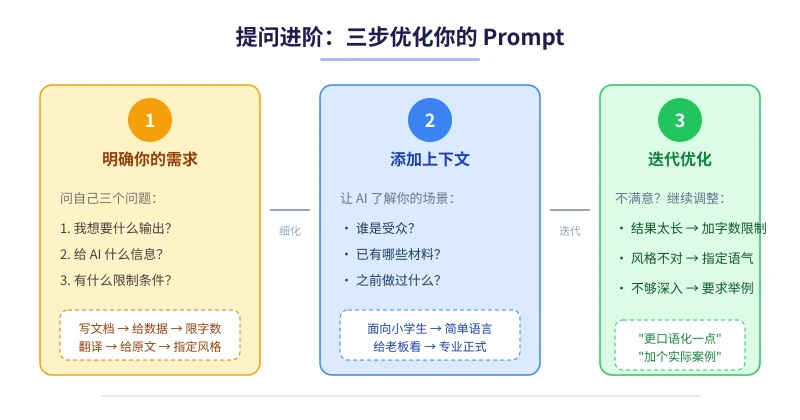
For complex tasks, do not dump everything at once. Ask the AI to work step by step. Each step produces more accurate results and lets you adjust direction midway.
Example: Instead of "Help me make a marketing plan," say: "Step 1: Analyze the target user profile for this product. Step 2: List 5 viable marketing channels based on the profile. Step 3: Design a specific promotion plan for each channel."
Technique 3: Follow-Up Iteration
First answer not good enough? Do not start over — just follow up and refine. AI remembers the context; you only need to tell it what needs improvement.
Follow-up examples: "Too long, shorten it to under 200 words," "Tone is too formal, switch to a casual friend-like conversation," "Add a specific data point here," "Expand on the second point."
Five Common Mistakes
Mistake 1: Too vague
"Help me write a plan" — AI does not know what plan, for whom, or what requirements. Fix: specify the topic, audience, and format.
Mistake 2: Too many requirements at once
Cramming 10 requirements into one paragraph — AI may miss some. Fix: break it into shorter prompts and complete them step by step.
Mistake 3: No context provided
Without context, AI can only give generic answers. Fix: tell AI about your specific situation.
Mistake 4: Not following up
Many people give up after a mediocre first answer. A simple follow-up often fixes it. Fix: tell AI what needs improvement and ask it to revise.
Mistake 5: Not specifying format
Without format guidance, AI may dump a wall of text. Fix: explicitly request tables, lists, or structured sections.
Five Ready-to-Use Templates
Here are 5 high-frequency scenario templates you can copy and use right away:
Scenario 1: Weekly Report
You are a workplace writing expert. Help me write a weekly report. This week I completed: user system optimization, new payment feature, fixed 3 bugs. Requirements: Split into "Completed This Week," "Plan Next Week," and "Assistance Needed." Tone: Professional and formal. Each item no more than 2 lines.
Scenario 2: Translation and Polishing
You are a bilingual Chinese-English translation expert. Please translate the following Chinese into English. Requirements: Use formal business tone. Keep technical terms accurate. If a word has multiple translations, note them. Source text: [paste your text]
Scenario 3: Study Tutoring
You are a patient high school physics teacher. Please explain "Newton's Third Law." Requirements: Use everyday life examples. Avoid formulas. Start with a one-sentence summary, then elaborate, then give 3 examples.
Scenario 4: Content Creation
You are a Xiaohongshu viral copywriter. Help me write 3 titles about "AI Learning." Reference style: [paste a title you like] Requirements: Include numbers, emotional words, keep under 20 characters.
Scenario 5: Decision Support
You are a career planning consultant. I am considering switching to AI-related work. My background: [your major/work experience] Please analyze from three angles: "Income Prospects," "Learning Cost," "Market Demand." Finally give your recommendation with reasoning.
Summary
Good prompting is not a talent — it is a skill you can practice. Remember the Role, Task, Context, Requirements, Format framework, plus the three techniques of giving examples, step-by-step guidance, and follow-up iteration, and you will get the answers you want from AI every time.
I recommend you try it today: pick any AI tool, ask it a question using one of the templates above. You will find that the same AI produces completely different results with a different prompt. Once you master prompting, AI truly becomes your capable assistant.
Related Articles
AI 帮你写简历:从零到专业,五步搞定求职利器
不管你是应届生还是职场转行,AI 都能帮你把简历从"凑合能用"变成"眼前一亮"。本文用五个步骤,手把手教你用 AI 生成、修改、优化出一份真正能拿面试的专业简历。
AI 语音转文字:零基础实操指南,三步把说话变成文字
还在打字到手指发酸?还在为会议记录发愁?AI 语音转文字技术已经非常成熟,学会使用它,可以帮你把说话直接变成文字,效率提升数倍。本文将手把手教你选择工具、完成转写、导出使用,让 AI 成为你的打字替身。
Tech FrontierAI 提问技巧入门:让 AI 回答更准确的 7 个实用方法
明明 AI 功能强大,但每次提问得到的回答都差强人意?其实问题往往不在 AI,而在于你提问的方式。本文用最直观的方式教你 7 个让 AI 回答更准确的实用技巧,包括四要素公式、精准提问、背景信息、拆分任务、追问迭代、万能模板和常见错误,小白也能立即上手。
Comments are not yet available, stay tuned