AI-Powered Competitive Analysis: Quickly Understand Your Industry and Competitors

Why Do You Need Competitive Analysis?
Whether you're starting a business, building a product, or running a business unit, understanding your competitors is fundamental. But traditional competitive analysis often means: scouring competitor websites, mining app store reviews, searching industry reports, organizing Excel spreadsheets... the whole process can take days.
AI tools have completely changed this. You just need to tell AI what you want to analyze and which dimensions to focus on, and it can help you put together a well-structured competitive comparison report in minutes. All you need to do is review the content and fill in the details.
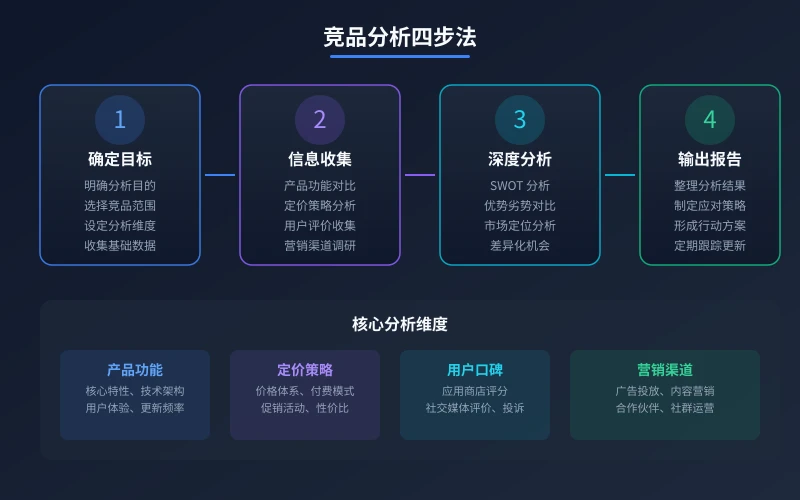
This guide walks you through a four-step process to complete a professional competitive analysis, requiring zero prior experience.
What Do You Need?
- An AI chat tool: ChatGPT, Claude, DeepSeek, or any similar tool
- A clear analysis goal: What do you want to learn? Product features? Pricing? User reviews?
- A competitor list: Identify 2-5 competitors you want to compare
- 5-15 minutes: That's really all it takes
Step 1: Define Your Analysis Goals and Scope
Before you start, think through three key questions:
Question 1: Why am I doing this analysis?
Different purposes determine the depth and direction of your analysis:
- Product planning: Focus on competitor features and user experience
- Pricing decisions: Compare competitor pricing models and billing structures
- Market entry: Need a comprehensive view of industry landscape and competition
- Fundraising: Need to demonstrate market opportunity and differentiation
Question 2: Who are my competitors?
Competitors come in three types — aim to cover all of them:
- Direct competitors: Products doing the same thing as you
- Indirect competitors: Solving the same need differently
- Potential competitors: Big players who might enter your space
Question 3: Which dimensions should I analyze?
You don't need to cover everything. Choose 3-5 core dimensions based on your purpose:
- Product features and technical architecture
- Pricing strategy and payment models
- User scale and growth trends
- User reviews and reputation
- Marketing channels and customer acquisition
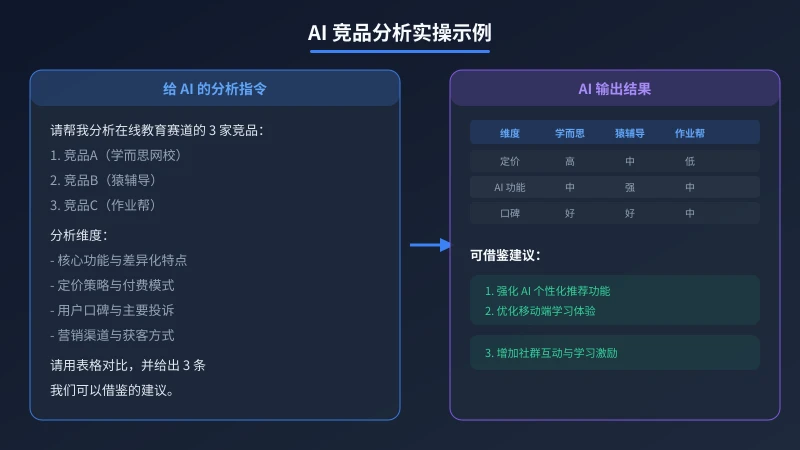
Step 2: Give AI Your Analysis Instructions
This is the most critical step. You need to clearly communicate your analysis requirements to AI.
Advanced Tip: Ask in Multiple Steps
If your analysis is complex, have multiple conversations with AI, going deeper each time:
- Round 1: Have AI outline the industry landscape and key players
- Round 2: Deep-dive analysis of each competitor individually
- Round 3: Have AI do a cross-comparison to find differentiation opportunities
- Round 4: Based on the analysis, have AI provide actionable recommendations
Step 3: Supplement with Real Data
AI's knowledge has a cutoff date. You'll need to supplement with real data for time-sensitive information.
Which Data Needs Manual Verification?
- Latest pricing: Competitors may adjust pricing at any time
- User metrics: Downloads, MAU from app stores or third-party platforms
- Recent developments: Latest updates, funding, partnerships
- Real user reviews: Latest comments from app stores and social media
Step 4: Output the Analysis Report
Once the data analysis is complete, have AI organize it into a structured report.
Format 1: Comparison Table
Best for intuitive side-by-side comparison across key dimensions.
Format 2: SWOT Analysis
Best for comprehensive assessment of your product and each competitor.
Format 3: Strategy Recommendations
Best for decision support with specific action recommendations and priorities.
Practical Use Cases
Case 1: Market Research Before Starting a Business
- Have AI analyze main players and market share in your target industry
- Compare positioning and core features across platforms
- Find market gaps and differentiation opportunities
- Assess entry barriers and required resources
Case 2: Product Feature Planning
- Have AI list competitors' core feature sets
- Compare implementation approaches and user feedback
- Identify common vs. differentiating features
- Recommend which to adopt and which to differentiate
Case 3: Pricing Strategy Development
- Have AI compare pricing systems and billing models
- Analyze market acceptance at each price tier
- Find pricing gaps in the market
- Recommend your pricing strategy with reasoning
FAQ
Is AI-provided information accurate?
Most information from AI is accurate, but there may be timeliness issues. Use AI output as a starting point and verify key data yourself.
How many competitors should I analyze?
3-5 is ideal. Too few lacks comparative value; too many makes the analysis unwieldy.
What if I have no industry experience?
That's exactly where AI shines. Mention you're a beginner and have AI explain the industry background first.
Summary
Competitive analysis is no longer a time-consuming professional task. With AI tools, you can complete a well-structured, comprehensive analysis report in a short time. The keys are: clear goals, precise prompts, supplementary data, and structured output.
Related Articles
AI 帮你写简历:从零到专业,五步搞定求职利器
不管你是应届生还是职场转行,AI 都能帮你把简历从"凑合能用"变成"眼前一亮"。本文用五个步骤,手把手教你用 AI 生成、修改、优化出一份真正能拿面试的专业简历。
AI 语音转文字:零基础实操指南,三步把说话变成文字
还在打字到手指发酸?还在为会议记录发愁?AI 语音转文字技术已经非常成熟,学会使用它,可以帮你把说话直接变成文字,效率提升数倍。本文将手把手教你选择工具、完成转写、导出使用,让 AI 成为你的打字替身。
Tech FrontierAI 提问技巧入门:让 AI 回答更准确的 7 个实用方法
明明 AI 功能强大,但每次提问得到的回答都差强人意?其实问题往往不在 AI,而在于你提问的方式。本文用最直观的方式教你 7 个让 AI 回答更准确的实用技巧,包括四要素公式、精准提问、背景信息、拆分任务、追问迭代、万能模板和常见错误,小白也能立即上手。
Comments are not yet available, stay tuned