The Ultimate Guide to AI Prompting: 5 Ways to Boost AI Response Quality by 10x
Why Are Your AI Answers Always Unsatisfactory?
Have you ever encountered this: you ask AI a question, and the answer is either too vague, off-topic, or not what you wanted at all? Then you think, "AI is not that great after all."
The truth is: It's not that AI is dumb, it's that your question isn't well-framed.
AI is like a super-capable assistant without mind-reading powers. The more accurate the information you give it, the better the results you get. It's like ordering food at a restaurant — "Just bring me something" versus "I'd like a medium-rare peppered steak with pasta" leads to vastly different outcomes.
In this article, I'll teach you 5 easy-to-learn questioning techniques that deliver immediate results.
Tip 1: Clarify Your Background and Purpose
AI doesn't know who you are or what you want to do. So the first step is to tell it your background and purpose.
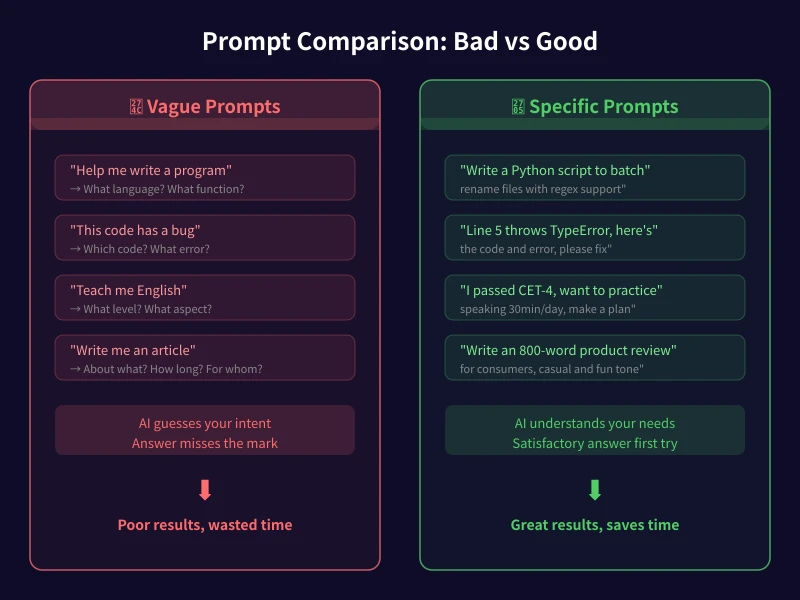
Poor Question
"Write a self-introduction for me."
Good Question
"I'm a front-end engineer with 3 years of experience, preparing for a job interview. Write a 1-minute self-introduction for me, focusing on project experience and tech stack."
What's the Difference?
- Identity: 3-year front-end engineer (AI knows your level)
- Scenario: Job interview (AI knows the tone and focus)
- Requirements: 1 minute, highlight project experience (AI knows length and direction)
For the same need, adding background and purpose completely transforms the quality of the answer.
Tip 2: Provide Specific Requirements and Constraints
What AI fears most is "anything goes." The vaguer you are, the vaguer it gets. So always give specific constraints.
Dimensions You Can Specify
- Word count: Under 200 words / Around 500 words / No more than 1000 words
- Format: Use lists / Use tables / Break into paragraphs / Use Markdown
- Tone: Formal / Casual / Professional / Humorous
- Audience: For the boss / For clients / For beginners
- Language: Chinese / English / Bilingual
Example
No constraints: "Write a product description for me."
With constraints: "Write a product description for a smart desk lamp, under 300 words, targeting young white-collar workers aged 25-35, in a light and lively tone, highlighting eye care and smart dimming features."
The latter can be used directly.
Tip 3: Use the "Role-Playing" Method
This is the most underrated technique. Assign a role to AI, and its answers instantly become professional and targeted.
How to Assign a Role?
Start your question with: "You are a XXX," then describe your request.
Common Role Templates
- Writing: "You are a senior copywriter" — suitable for copy, promotional text, articles
- Technical: "You are a back-end engineer with 10 years of experience" — suitable for code, architecture, debugging
- Learning: "You are a patient elementary school math teacher" — suitable for explaining concepts, tutoring
- Business: "You are a product director at a startup" — suitable for product analysis, business plans
- Lifestyle: "You are a professional nutritionist" — suitable for diet advice, health planning
Why Does It Work?
Because role-setting activates AI's "professional mode." Just like going to the hospital — seeing an orthopedist versus an ophthalmologist yields completely different advice. Give AI a role, and it answers from that perspective.
Tip 4: Provide Examples and References
Sometimes you can't articulate what you want, but you can say "something like this." Show AI an example, and it instantly understands.
How to Provide Examples?
Method 1: Directly paste an example
"Write a payment reminder email for me, with a tone like this: 'Dear valued customer, according to our contract terms...'"
Method 2: Describe a style reference
"Write a product description for me, with style referencing Apple's official product page — concise, rhythmic, highlighting core selling points."
Method 3: Provide a structure template
"Write a weekly report for me following this format: 1. Completed this week 2. In progress 3. Next week's plan 4. Support needed."
Advanced Usage: Few-shot
If you need AI to output in a fixed pattern, give 2-3 examples:
"Help me convert the following sentences into a formal tone. Example:
Input: This plan is not great
Output: This plan has significant room for optimization
Input: The client says the price is too high
Output: The client feedback indicates the pricing plan exceeds their budget expectations
Now convert: This feature cannot be implemented"
The more examples you give, the better AI understands the pattern you want.
Tip 5: Ask Step by Step, Go Deeper Gradually
Don't throw complex questions at AI all at once. Do it step by step for better results.
Why Step by Step Is Better?
- AI's attention is limited; too much information dilutes the focus
- Step-by-step allows you to check and adjust direction at each stage
- Later questions can be optimized based on earlier answers
Step-by-Step Example: Writing a WeChat Public Account Article
Step 1: "I'm planning to write an article for a WeChat public account about 'remote work efficiency.' Help me list 5 possible angles."
AI provides 5 angles, you pick one.
Step 2: "I choose angle 3 'Time management for remote work.' Help me create an outline with 4-5 sections."
AI gives an outline; you confirm or adjust.
Step 3: "Based on this outline, help me write the first section, about 300 words, in a relaxed tone."
Finish each section, then move on.
Step 4: "Help me add an attractive title for this article, give 3 options."
See? By breaking it down, each step has a clear goal, and the final result is far better than a one-shot "Write an article for me."
Universal Questioning Formula
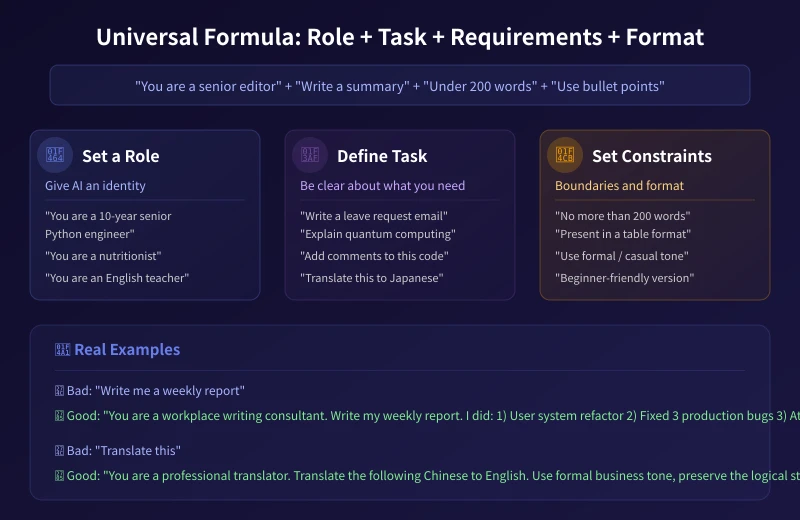
Combine the 5 tips above into one universal formula:
Role + Task + Background + Requirements + Format
Practical Examples
Scenario 1: Writing a Weekly Report
❌ "Write a weekly report for me"
✅ "You are a workplace writing consultant. Help me write this week's work report. I did three things: 1) Completed user system refactoring 2) Fixed 3 online bugs 3) Attended a requirements review meeting. Under 200 words, use bullet points, professional and concise tone."
Scenario 2: Translation
❌ "Translate this passage"
✅ "You are a professional translator. Translate the following Chinese into English. Requirements: use formal business tone, preserve the original logical structure, and ensure accurate terminology."
Scenario 3: Learning New Knowledge
❌ "Tell me about blockchain"
✅ "You are a tech blogger skilled at making complex concepts easy to understand. Explain what blockchain is in plain language, give 2 real-life analogies, and keep it under 300 words."
Common Mistakes and Corrections
Mistake 1: Question Too Broad
❌ "Write a plan for me"
✅ "Write a plan for an online book club event, target audience is working professionals aged 25-35, budget under 5000 yuan, activity format is a weekly online livestream."
Mistake 2: Asking Too Much at Once
❌ "Help me analyze competitors, write a business plan, design a logo, and create a marketing strategy"
✅ Start with one at a time: "Help me analyze the strengths and weaknesses of the top 3 competitors in the online education industry."
Mistake 3: Not Specifying the Audience
❌ "Write an email for me"
✅ "Write a payment reminder email to a client who has been a partner for 3 years. The tone should be polite but clearly state the payment deadline."
Mistake 4: Not Providing Context
❌ "There's a problem with this code"
✅ "This Python code throws an IndexError when running. The error message is xxx. The code is: [paste code]. Please help me analyze the cause and fix it."
Final Advice
Questioning is a learnable skill. At first, you may need to consciously apply the formula, but with practice it becomes intuitive.
Remember one core principle: The more precise the information you give AI, the more accurate the answer you get.
Next time you use AI, take 10 seconds to think: What exactly do I want? Then describe that question concretely. Those 10 seconds of thought can save you 10 minutes of back-and-forth revisions.
Frequently Asked Questions
Will AI get annoyed if I ask too long?
No. AI has no emotions; the more information you give it, the happier (or more accurately, the more accurate) it becomes. As long as the information is relevant, don't worry about length.
Is English questioning better than Chinese?
For most scenarios, Chinese works just as well. Only for some technical details or specific terms might English be more precise. For daily use, Chinese is perfectly sufficient.
What if I'm not satisfied with AI's answer?
Don't start over; simply add follow-up requirements. For example: "This answer is too formal, switch to a casual tone," "Too long, condense to 200 words," "Add specific numbers and examples." AI supports multi-turn conversations; just keep optimizing.
Is there a universal questioning template?
Yes, it's the formula introduced in this article: Role + Task + Background + Requirements + Format. Fill in all five elements, and you'll get satisfactory answers in 90% of scenarios.
Related Articles
AI Speech to Text: Beginner's Guide to Convert Voice to Text in 3 Steps
Learn how to convert speech to text using AI tools. Perfect for meeting notes, content creation, and video subtitles. Three practical scenarios with step-by-step instructions.
TutorialsAI Local Deployment Guide: Run Large Models in 3 Steps for Free
Learn how to deploy AI models locally in just 3 steps. No coding experience needed, completely free, and your data stays private on your own computer.
TutorialsAI Shopping Decision Guide: From Price Comparison to Avoiding Pitfalls
Learn how to use AI for shopping decisions. From price comparison to avoiding pitfalls - make smarter purchasing choices with AI assistance.
Comments are not yet available, stay tuned