AI Home Emergency Preparedness: A Practical Guide from First Aid to Safety Checks
Where do you hide during an earthquake? What emergency supplies should you keep at home? What's the first thing to do when your child gets scalded? Most people never think about these questions until they're in the middle of a crisis. But you can spend just 20 minutes now to have AI create a complete home emergency preparedness plan for you — being prepared is the greatest responsibility you can have for your family.
Why Do You Need Home Emergency Preparedness?
Many people think "disasters won't happen to me," but statistics tell us: natural disasters in China cause over 300 billion yuan in direct economic losses annually, and there are more than 250,000 household fires each year. Even more common are everyday accidents — cutting your hand while cooking, a child falling off the bed, an elderly person suddenly feeling chest tightness. In these situations, advance preparation and on-the-spot response ability determine the outcome.
AI's value in this scenario lies in:
- Personalized advice: Based on your family members (elderly, children, pets), residential area, and housing type, it provides targeted preparation plans
- Knowledge dissemination: It explains professional first aid and disaster prevention knowledge in language you can understand
- List generation: It helps you create shopping lists, checklists, and emergency contact cards from scratch
- Regular reminders: It helps you set check cycles to ensure emergency supplies don't expire
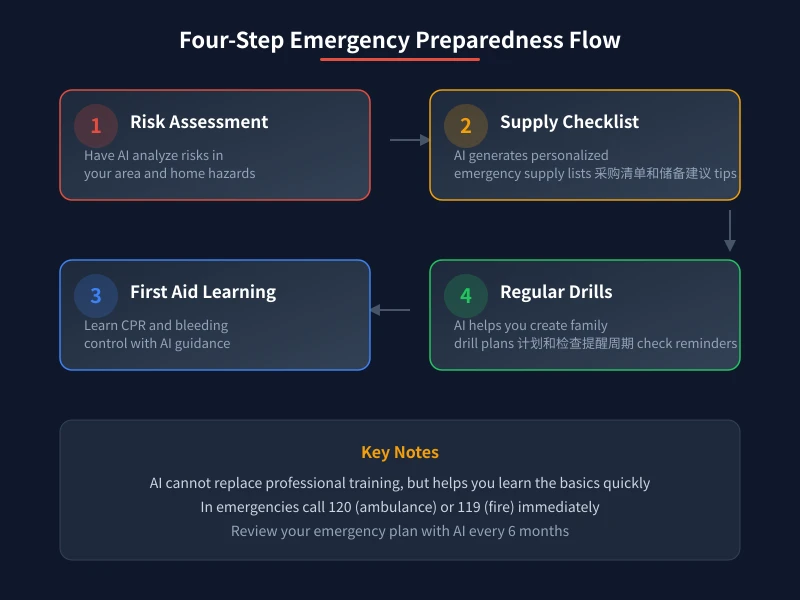
Step 1: Have AI Assess Your Home's Risks
Different regions and housing types face completely different risks. Living in Sichuan means preparing for earthquakes, coastal areas for typhoons, high-rises for fire evacuation difficulties, and ground floors for flooding. You need to let AI understand your basic situation first.
Information to Provide to AI
Open any AI chat tool (ChatGPT, DeepSeek, Claude, Gemini, etc.) and enter the following:
I live in [city], on the [floor] floor, [area] sqm, [X-bedroom-X-living room] layout.
My family includes [members: elderly/children/pets, etc.].
Please analyze the main safety risks facing this family and rank them by priority.
What AI Will Give You
Based on your information, it will list 5-8 risks your family is most likely to encounter, such as:
- High-rise fire evacuation difficulty (Priority: High)
- Furniture tipping during earthquakes (Priority: Medium)
- Kitchen gas leak (Priority: High)
- Bathroom slip and fall (Priority: Medium)
- Child electrical shock risk (Priority: High, if children present)
Each item will come with specific prevention measures and response plans.
Step 2: Generate Emergency Supply List
There are many emergency supply lists online, but they're either too vague ("prepare a first aid kit") or too extreme (telling you to buy a complete outdoor survival kit). AI can generate a "just right" list based on your actual situation.
Prompt Template
Please generate a family emergency supply list for me.
Family situation: [X] people, including [elderly/children/pets].
Location: [city], [high-rise/low-rise/standalone house].
Budget: within [amount] dollars.
Please rank by priority, with approximate prices and purchasing suggestions for each item.
Sample List Generated by AI (Family of 3, High-Rise)
Essential Supplies (about $30):
- First aid kit (band-aids, iodophor, gauze, medical tape, tourniquet) — about $8, Amazon/Walmart
- Fire extinguisher (dry powder 1kg) — about $6, hardware store or Amazon
- Smoke masks (3 pcs) — about $10, essential for high-rises
- Flashlight (rechargeable, high-lumen) — about $5
- Whistles (3 pcs) — about $3, for calling for help when trapped
Recommended Stockpile (about $20):
- Bottled water (1 gallon × 3 bottles) — about $5, enough for 3 people for 2 days
- Energy bars/crackers — about $5, long shelf life
- Common medications (fever reducer, anti-diarrhea, band-aids, iodophor) — about $5
- Power bank (20000mAh) — about $5
High-Rise Specific Suggestions:
- Emergency escape ladder — about $30, for floors 2-6
- Fire blanket — about $5
Step 3: Learn Key First Aid Skills
Having supplies isn't enough — you need to know what to do when it matters. Have AI teach you the most critical first aid skills in the simplest way.
Heimlich Maneuver (Choking)
Ask AI: "Please teach me the Heimlich maneuver in the simplest way, with adult and infant versions."
AI will tell you:
- Adult version: Stand behind the patient, place hands between the navel and breastbone, make a fist with one hand, cover it with the other, and thrust inward and upward firmly
- Infant version: Place the infant face-down on your forearm, use the heel of your hand to deliver 5 blows between the shoulder blades, then flip over and give 5 chest compressions on the lower half of the sternum, alternating
Cardiopulmonary Resuscitation (CPR)
Ask AI: "Please teach me the CPR procedure step by step, I have no medical background."
AI will explain in plain language: Check consciousness → Call 911 → Chest compressions (center of chest between nipples, depth 5-6cm, rate 100-120 per minute) → Rescue breaths (30:2 ratio).
Burn and Scald Treatment
Ask AI: "My child was scalded by boiling water, what should I do first?"
AI will emphasize: Cool (run cold water for 15-20 minutes) → Remove (take off clothing) → Soak (continue cold water immersion) → Cover (with clean gauze) → Seek medical help. Remember the mnemonic: "Cool, Remove, Soak, Cover, Seek."
Step 4: Create Family Emergency Contact Card
Have AI generate a "Family Emergency Contact Card" that you can print out and stick on the fridge or put in your first aid kit.
Prompt
Please create a family emergency contact card with the following:
1. Emergency numbers: 911 (general), local fire department, local police
2. Family member info: [name], [blood type], [drug allergies]
3. Nearest hospital: [hospital name and address]
4. Building management / landlord phone: [number]
5. Emergency contacts: [name and phone number]
Please format as a clean table, suitable for printing.
Output
AI will give you a cleanly formatted table that you can copy into Word or a text editor for printing. Print 3 copies: one on the fridge, one in the first aid kit, one in your wallet.
Step 5: Plan Home Evacuation Routes
Fire evacuation routes are especially important for high-rise residents. Have AI help you analyze the best evacuation plan.
Prompt Template
I live at [address], on the [floor] floor.
My building has [X] units per floor and [X] emergency exits.
Please create a home fire evacuation plan, including:
1. Primary and backup evacuation routes
2. Roles for each family member
3. Precautions during evacuation
4. Self-rescue methods if evacuation is impossible
AI will provide specific evacuation advice based on your floor and layout. For example:
- Low floors (1-3): Take the stairs, never use the elevator
- Mid floors (4-10): Take the stairs down; if smoky, cover mouth with wet towel and crouch low
- High floors (10+): If stairwell is filled with smoke, return to room, close door, seal gaps with wet cloth, wave bright items at window for help
Home Safety Inspection Checklist
Have AI generate a monthly safety inspection checklist to build a regular checking habit:
- Monthly: Fire extinguisher pressure gauge in green zone, first aid kit items complete, emergency flashlight battery
- Quarterly: Emergency food and water expiration dates, medication expiry dates, power bank charge level
- Semi-annually: Update family emergency contact card, conduct evacuation drill with family
- Annually: Check gas pipes and valves, inspect wiring for aging, update emergency supplies
Tips and Precautions
What AI Can Do
- Generate personalized emergency supply lists
- Explain first aid steps in plain language
- Create evacuation routes and emergency plans
- Generate printable emergency contact cards
- Set up regular inspection reminders
What AI Cannot Replace
- Professional first aid training: AI teaches theory; consider taking a Red Cross first aid certification course annually
- Actual drills: Reading isn't enough — conduct evacuation drills with your family every six months
- Real emergency judgment: In a true emergency, call 911 immediately; don't rely solely on AI
Recommended AI Chat Tools
- ChatGPT: Excellent at generating detailed lists and plans, strong reasoning ability
- Claude: Very thorough and safety-conscious, great for first aid guidance
- DeepSeek: Strong Chinese comprehension, good for users who prefer Chinese interaction
Home emergency preparedness isn't something you accomplish overnight, but with AI's help, you can build a solid foundation plan in the shortest time. The key is: start today. Open an AI chat tool, enter your family's basic information, and let AI create a personalized emergency preparedness plan for you. Then follow the checklist to purchase supplies, learn first aid knowledge, and practice with your family. Being prepared is the greatest responsibility you can have for your loved ones.
Related Articles
AI Speech to Text: Beginner's Guide to Convert Voice to Text in 3 Steps
Learn how to convert speech to text using AI tools. Perfect for meeting notes, content creation, and video subtitles. Three practical scenarios with step-by-step instructions.
TutorialsAI Local Deployment Guide: Run Large Models in 3 Steps for Free
Learn how to deploy AI models locally in just 3 steps. No coding experience needed, completely free, and your data stays private on your own computer.
TutorialsAI Shopping Decision Guide: From Price Comparison to Avoiding Pitfalls
Learn how to use AI for shopping decisions. From price comparison to avoiding pitfalls - make smarter purchasing choices with AI assistance.
Comments are not yet available, stay tuned