AI Interview Prep Guide: Question Prediction, Answer Refinement & Mock Interviews in 3 Steps
Why You Need an AI Interview Prep Assistant
You have definitely experienced pre-interview anxiety: not knowing what the interviewer will ask, unsure how to organize your answers persuasively, and practicing countless times only to still stumble from nervousness. Traditional preparation means browsing interview experiences and asking friends to help mock, but those experiences are scattered and friends may not always be available.
AI can serve as your "personal interview coach" — helping you analyze job requirements, predict high-frequency questions, organize answers using the STAR method, and even simulate a real interview conversation. This article walks you through 4 common interview prep scenarios, showing you step by step how to use AI to confidently handle every interview.
Preparation
You need an AI chat tool. Here are some recommendations:
- ChatGPT (OpenAI): The most popular AI chat tool, free tier available, excels at structured output
- Claude (Anthropic): Excels at long-form analysis and deep reasoning, more nuanced answer organization
- Tongyi Qianwen / Wenxin Yiyan: Chinese LLMs with strong Chinese understanding, more familiar with the domestic job market
- Ciyuano Platform: Aggregates multiple models, one-click switching, great for comparing different answer styles
Pick any one to get started. Desktop use is recommended for easier saving and organizing of interview materials.
Scenario 1: Let AI Optimize Your Resume
Your resume is the gateway to interviews. Many people send dozens of resumes with no response — the problem is often a mismatch between the resume and job requirements. AI can help you optimize your resume content against the JD (Job Description) line by line.
Steps
- Open your AI tool and paste your resume content into the chat
- Also paste the target job's JD (Job Description)
- Ask AI to compare your resume with the JD, identifying matches and gaps
- Based on AI's suggestions, reorganize your experience descriptions to highlight skills and achievements relevant to the position
Example prompt:
Here is my resume content and a target job's JD. Please: 1) Analyze the match between my resume and this position; 2) Identify key keywords missing from my resume; 3) Reorganize my 3 core experiences using the STAR method to better align with the job requirements; 4) Provide specific revision suggestions.
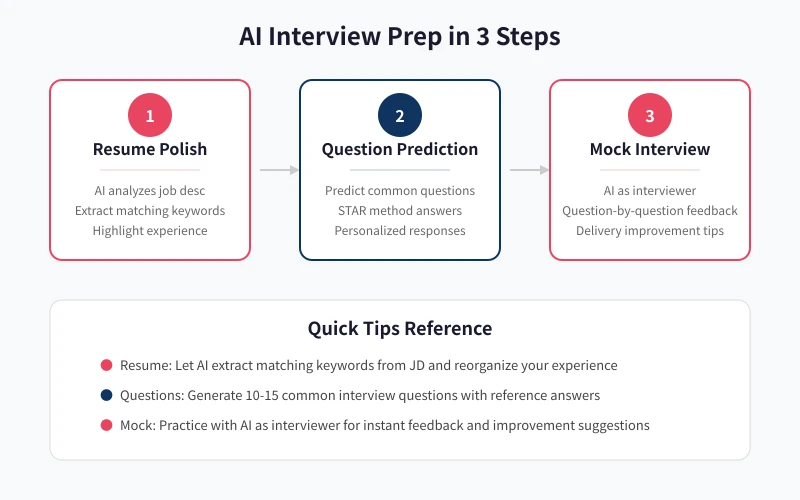
AI will compare your resume with the JD line by line, telling you which experiences need rephrasing, which keywords to add, and which achievements need quantifying with data. Just follow the suggestions to significantly boost your resume pass rate.
Advanced Tips
- Ask AI to generate both a "concise" and "detailed" version of your resume for the same position — use the concise one for online applications and the detailed one for interviews
- Tell AI your real experiences (even small ones) and let it package them into professional job descriptions
- If the JD contains unfamiliar terms, ask AI to explain them and tell you how to demonstrate related abilities in your resume
Scenario 2: Let AI Predict High-Frequency Interview Questions
Every position has a set of high-frequency interview questions. Preparing answers for these in advance lets you stay calm during the interview. AI can accurately predict the questions interviewers are most likely to ask based on your job type and background.
Steps
- Tell AI the position you're interviewing for and the company type (big tech / foreign company / startup)
- Specify the interview round: HR screen, technical interview, or hiring manager interview — questions differ significantly by round
- Attach your resume content so AI can generate personalized questions based on your background
- AI will generate 10-15 high-frequency questions, categorized by "Self-introduction", "Project Experience", "Scenario Handling", and "Career Planning"
Example prompt:
I have an interview next week for a Product Manager position at an internet company. The second round is with the business director. Here is my resume. Please predict the 12 most likely interview questions, grouped by category, and provide a reference answer framework for each (using the STAR method).
AI will generate a structured question list, such as:
- Self-introduction: Please introduce yourself in 3 minutes / Why did you choose product management
- Project experience: Describe a project you led from 0 to 1 / What was the biggest challenge you faced and how did you solve it
- Scenario handling: What would you do if developers say a requirement can't be done / How do you handle disagreements in cross-functional collaboration
- Career planning: What is your 3-year career plan / Why do you want to join our company
Advanced Tips
- Ask AI to show "low-score" vs "high-score" answer comparisons for each question to understand what makes a good answer
- If interviewing for a technical role, ask AI to add algorithm and system design question predictions
- Tell AI about questions you failed in previous interviews and let it analyze why and reorganize your answers
Scenario 3: Let AI Organize Answers Using the STAR Method
Many people ramble during interviews without structure. The STAR method is the golden framework for interview answers: Situation → Task → Action → Result. AI can help you transform scattered experiences into well-structured STAR answers.
Steps
- Tell AI about a work experience or project in conversational language (doesn't need to be perfect, just share what comes to mind)
- Ask AI to reorganize this experience using the STAR method
- AI will output a clear, focused answer with specific data and quantified results
- You can ask AI to generate different length versions (30-second / 1-minute / 3-minute) for different interview scenarios
Example prompt:
I want to use the STAR method to answer "Describe a project you led." Here is my experience (conversational): Last year our team had a user growth project, and I was responsible for designing the referral program. The first version didn't work well, then I analyzed the data and found the sharing path was too long. After optimization, participation rate increased 3x. Please reorganize this using the STAR method into a 2-minute interview answer with specific data and key decision points.
AI will output something like:
- S (Situation): Last Q2, the company set a 50% user growth target, and I was responsible for designing the viral referral program
- T (Task): Need to achieve 2000+ daily new users through social sharing with a limited budget
- A (Action): The first version underperformed. I deeply analyzed the user behavior funnel and found the share-to-conversion path was 5 steps long with 80% drop-off. I redesigned a "one-click share + instant reward" solution, shortening the path to 2 steps
- R (Result): After optimization, sharing participation rate increased 3x, daily new users reached 3500, exceeding the target
Advanced Tips
- Prepare STAR versions of 5-8 core experiences covering common evaluation dimensions like "leadership", "problem-solving", "team collaboration", and "resilience"
- Ask AI to package the same experience into different angle versions for different types of interview questions
- If your experience lacks quantified data, ask AI to add reasonable estimates (you can say "approximately" during the interview)
Scenario 4: Use AI for Mock Interviews
No matter how well you prepare, not practicing out loud is pointless. AI can play the role of an interviewer and conduct a mock interview conversation with you. It will follow up, interrupt, and challenge your answers, helping you adapt to interview pressure in advance.
Steps
- Tell AI its role: You are now my interviewer for position XX, interview round XX
- Set rules: Ask one question at a time, wait for my answer before following up or moving to the next
- Start the mock interview and answer each question normally
- After the interview, ask AI for an overall score and question-by-question feedback
Example prompt:
Please play the role of a Product Manager interviewer at an internet company. This is the second round (business interview). Rules: 1) Ask one question at a time and wait for my answer; 2) Follow up or move to the next question based on my response; 3) The interview has 8 questions total; 4) After the interview, give me a score (1-10) and improvement suggestions for each question. Please begin with the first question.
AI will converse with you like a real interviewer, asking one question and waiting for your response, then deciding whether to follow up or switch topics based on your answer. The entire experience closely mimics a real interview.
Post-Mock Interview Review
After the mock interview, ask AI to help you review. You can say:
For the mock interview we just did, please do a complete review: 1) Score and improvement suggestions for each of my answers; 2) Overall performance evaluation; 3) Which answers need to be reorganized; 4) If we could redo it, what would be the best answer for each question.
AI will provide detailed feedback for each question, telling you what you did well, what needs improvement, and what a better answer would look like. This is the most efficient way to improve interview performance.
Important Notes for AI Interview Preparation
While AI is a great interview assistant, there are a few things to keep in mind:
- Don't memorize AI-generated answers word for word: Interviewers can easily tell when you're reciting. Use AI to understand the framework, then express it in your own words.
- AI-generated answers need personalization: Add your own real experiences and feelings to make answers more natural.
- Practice mock interviews out loud: Don't just think in your head — actually speak. Oral expression and mental rehearsal are completely different.
- Multiple rounds of practice are needed for improvement: Do at least 3-5 mock interviews, reviewing and improving each time for noticeable results.
- Review key answers before the interview: Print out the STAR answers AI helped you organize and do a quick scan 30 minutes before the interview.
Conclusion
The core value of AI interview preparation lies in being "systematic" and "personalized." Traditional preparation relies on scattered interview experiences and limited mock opportunities, while AI can provide a customized interview prep plan based on your specific background and target position.
Start today by using AI to prepare for your next interview. Begin with "help me optimize my resume," then move to "predict interview questions" and "mock interviews." After these three steps, you'll find your interview anxiety significantly reduced and your confidence noticeably boosted.
Related Articles
AI Speech to Text: Beginner's Guide to Convert Voice to Text in 3 Steps
Learn how to convert speech to text using AI tools. Perfect for meeting notes, content creation, and video subtitles. Three practical scenarios with step-by-step instructions.
TutorialsAI Local Deployment Guide: Run Large Models in 3 Steps for Free
Learn how to deploy AI models locally in just 3 steps. No coding experience needed, completely free, and your data stays private on your own computer.
TutorialsAI Shopping Decision Guide: From Price Comparison to Avoiding Pitfalls
Learn how to use AI for shopping decisions. From price comparison to avoiding pitfalls - make smarter purchasing choices with AI assistance.
Comments are not yet available, stay tuned