Personal Finance with AI: A Complete Beginner Guide to Managing Your Money
Why Use AI for Personal Finance?
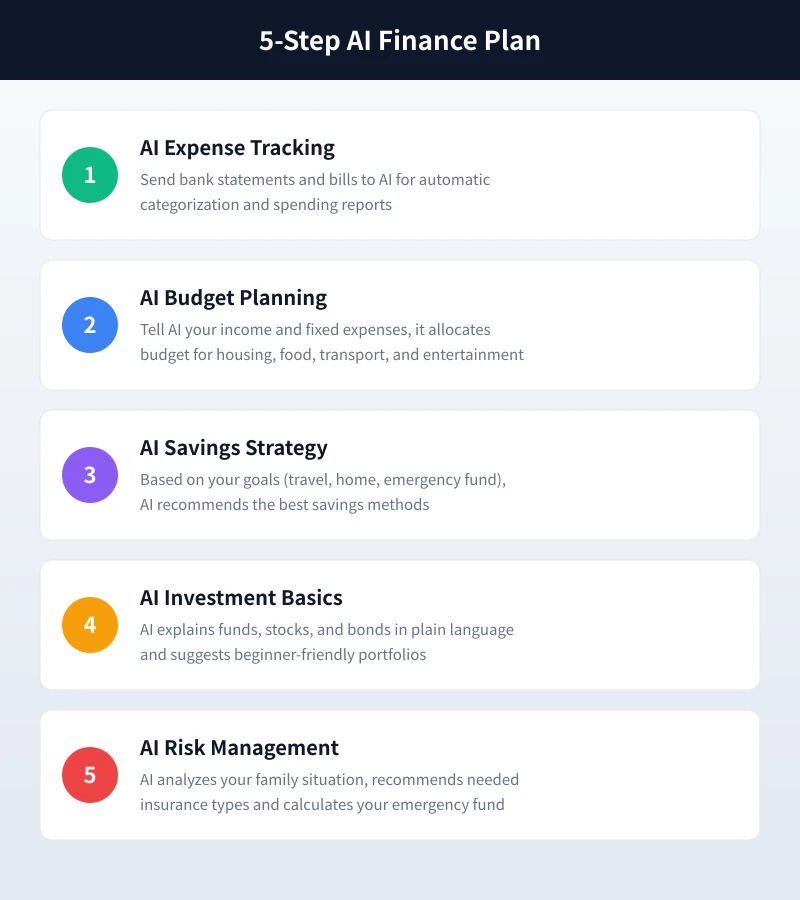
Many people find "finance" intimidating — tracking expenses is tedious, budgeting feels complicated, investing seems risky, and choosing insurance is confusing. But personal finance doesn't have to be that hard. What you really need is someone to explain things in plain language. AI can serve as your "personal financial advisor," ready to answer questions, analyze data, and create plans anytime.
This article covers the 5 most common financial scenarios and teaches you step-by-step how to manage your money with AI. Even if you know nothing about finance, you can start taking action immediately after reading.
Getting Started
You need an AI chat tool. Here are some recommendations:
- ChatGPT (OpenAI): The most popular AI chat tool, free tier available
- Claude (Anthropic): Excels at long-form analysis and natural explanations
- Gemini / Qwen: Strong Chinese language understanding, generous free quotas
- Ciyuano Platform: Aggregates multiple models, one-click switching
Pick any one to get started. Desktop is recommended for easy copy-pasting of billing data.
Scenario 1: Let AI Analyze Your Spending Habits
Don't know where your money goes? Send your transaction records to AI and it will automatically categorize and summarize them, helping you find the "invisible killers" in your budget.
Step-by-Step
- Export your spending records: Alipay "Bills" → Export; WeChat "Wallet" → Bills → Export; or copy your bank app transaction history
- Paste the spending data into the AI chat
- Ask AI to summarize by category (dining, transport, shopping, entertainment, etc.)
- AI will generate a spending report, pointing out which areas are too high and where you can save
Sample Prompt:
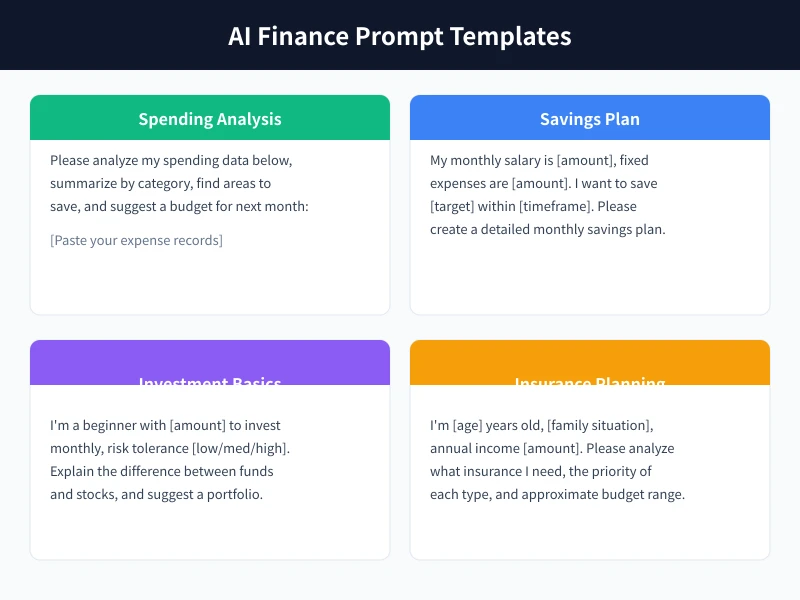
Please analyze my spending data below, summarize by category, find areas to save, and suggest a budget for next month. Requirements: 1) Rank categories from highest to lowest; 2) Flag unusually high expenses; 3) Provide specific saving suggestions.
AI will generate a clear categorized summary table, telling you things like "This month's dining expenses were 2,800 yuan, 35% of income — consider keeping it under 20%."
Pro Tips
- Send your bills to AI monthly to build a "monthly spending review" habit
- Ask AI to compare spending trends across multiple months
- Try "If I save 500 yuan on dining each month, how much can I save in a year?" — use numbers to motivate yourself
Scenario 2: Let AI Create a Budget for You
With spending analysis done, the next step is creating a realistic budget. AI can tailor a budget plan based on your income and lifestyle.
Step-by-Step
- Tell AI your monthly income and fixed expenses (rent, utilities, transport, etc.)
- Explain your financial goals (saving, loan repayment, travel, etc.)
- AI will allocate budgets across categories using reasonable ratios
- Adjust the ratios based on your actual situation
Sample Prompt:
My monthly salary is 8,000 yuan. Fixed expenses: rent 2,000, utilities 200, transport 300. I want to save at least 1,500 per month. Please create a detailed monthly budget including dining, shopping, entertainment, and learning categories with amounts and percentages.
AI typically recommends frameworks like the "50/30/20 rule" (50% necessities, 30% personal spending, 20% savings) and adjusts based on your specific situation.
Scenario 3: Let AI Help You Build a Savings Strategy
The hardest part of saving is "sticking with it." AI can help you create a practical savings plan and offer multiple methods to choose from.
Step-by-Step
- Tell AI your savings goal (amount and timeline)
- State your available monthly amount
- AI will recommend suitable saving methods
- Pick a plan you find feasible and start executing
Sample Prompt:
I want to save 20,000 yuan for a travel fund within 1 year. I have about 3,000 yuan available monthly. Please recommend several saving methods, compare their pros and cons, and create a specific execution plan.
AI might suggest these methods:
- 52-Week Challenge: Save 10 yuan week 1, 20 yuan week 2... increasing each week
- 365-Day Method: Save an amount matching a number from 1-365 each day
- Auto-Transfer: Set up automatic transfer to savings on payday
- Envelope Method: Allocate budget into envelopes, stop when empty
Scenario 4: Let AI Teach You Investment Basics
Investing is a key part of finance, but many people are afraid to start because they "don't understand it." AI can explain various investment tools in plain language.
Step-by-Step
- Tell AI your investment experience (beginner / some / experienced)
- State your risk tolerance (conservative / moderate / aggressive)
- Ask AI to explain investment tools in simple terms
- Based on AI's guidance, choose an investment approach that suits you
Sample Prompt:
I'm a complete beginner with no investment knowledge. I have 1,000 yuan monthly to invest, with a conservative risk tolerance. Please explain in plain language: 1) What are funds, stocks, and bonds? How do they differ? 2) What should a beginner start with? 3) Suggest a simple starter portfolio.
AI will use everyday analogies to help you understand, like "A fund is like everyone pooling money to hire a professional chef, while stocks are like buying groceries and cooking yourself." The key is that AI won't make investment decisions for you, but will help you build a basic understanding framework.
Important Reminders
- AI is not a licensed financial advisor: AI provides educational information, not investment advice
- Don't blindly trust specific product recommendations: AI's information may not be current
- Learn first, invest later: Use AI to understand concepts, then combine with your own research
- Diversify: Don't put all your eggs in one basket
Scenario 5: Let AI Help You Plan Insurance
Insurance is an important risk management tool, but the variety of products makes it hard to choose. AI can help you analyze what insurance you need and prioritize.
Step-by-Step
- Tell AI your basic info: age, family status, income, debts
- Mention any existing insurance you have
- AI will analyze your main risks and recommend insurance types
- Based on priority and budget, configure insurance step by step
Sample Prompt:
I'm 28, unmarried, annual income 120,000 yuan, no insurance, with a 500,000 yuan mortgage. Please analyze: 1) What are my main risks? 2) What insurance should I prioritize? 3) Approximate budget for each type? 4) What should I watch out for when buying?
AI typically follows the "protection first, then growth" principle, recommending: Medical insurance (a few hundred/year) → Accident insurance (a few hundred/year) → Term life insurance (covering mortgage) → Critical illness insurance (based on budget).
Important Notes for AI Finance
AI is a great financial learning assistant, but keep these in mind:
- AI is not a professional financial advisor: AI provides general guidance; complex planning should involve professionals
- Protect your privacy: Spending data may contain sensitive info — use reputable platforms
- Think independently: AI's suggestions are references; final decisions should fit your situation
- Keep learning: Finance is a long-term journey — use AI for continuous learning and optimization
- Save first, spend later: Whatever tools you use, "Income - Savings = Expenses" never changes
Conclusion
The core value of AI in finance is "lowering barriers" and "instant guidance." In traditional finance learning, you'd need to read an entire book before taking action. Now you can ask AI and practice simultaneously.
Starting today, try sending last month's spending records to AI for an analysis. This simple step is the first move in personal finance — understanding where your money goes. Once you have a clear picture of your financial situation, saving, budgeting, and investing will all fall into place naturally.
Related Articles
AI Speech to Text: Beginner's Guide to Convert Voice to Text in 3 Steps
Learn how to convert speech to text using AI tools. Perfect for meeting notes, content creation, and video subtitles. Three practical scenarios with step-by-step instructions.
TutorialsAI Local Deployment Guide: Run Large Models in 3 Steps for Free
Learn how to deploy AI models locally in just 3 steps. No coding experience needed, completely free, and your data stays private on your own computer.
TutorialsAI Shopping Decision Guide: From Price Comparison to Avoiding Pitfalls
Learn how to use AI for shopping decisions. From price comparison to avoiding pitfalls - make smarter purchasing choices with AI assistance.
Comments are not yet available, stay tuned