AI Fashion Styling Guide: Smart Outfit Suggestions from Casual to Formal
Every morning, you open your wardrobe full of clothes yet feel like you have nothing to wear—this "full closet, nothing to wear" dilemma is something almost everyone experiences. Different occasions call for different styles, and figuring out color coordination and outfit combinations can be frustrating. The good news is, AI can serve as your personal stylist, offering professional outfit suggestions tailored to your needs.
Why Use AI for Fashion Styling
Using AI for outfit suggestions is more practical than you might think:
- Save Time and Effort: No need to scroll through Instagram or fashion blogger posts—AI gives you suggestions directly
- Personalized Recommendations: Tell AI what's in your closet, and it will create combinations from items you already own
- Occasion-Specific Matching: Interviews, dates, business dinners, friend gatherings—different occasions, different solutions
- Professional Color Coordination: AI is well-versed in color theory and can suggest harmonious palettes
- Unbiased by Brand Preferences: AI doesn't push brands—it focuses purely on the soundness of the outfit itself
You don't need to be a fashion expert or know about "Morandi colors" or "structured silhouettes." Just follow the steps below.
4-Step Process Overview
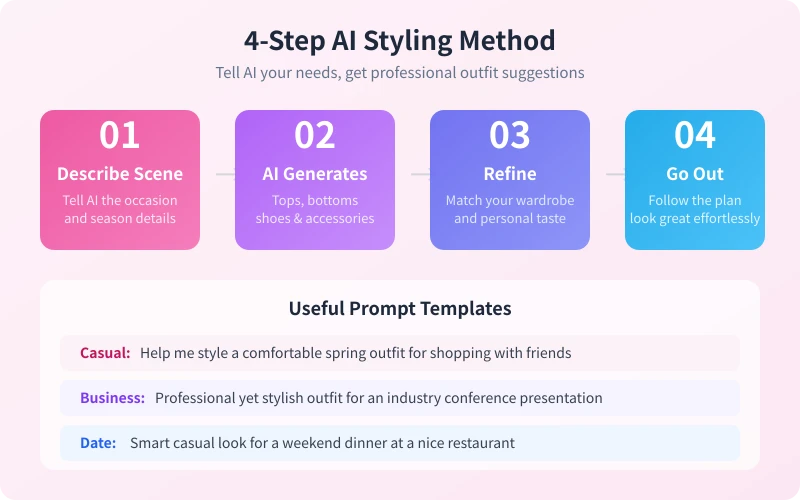
The entire process is straightforward:
- Describe the Scene: Tell AI the occasion, season, and weather
- AI Generates a Plan: AI provides a complete outfit including top, bottom, shoes, and accessories
- Refine and Adjust: Tweak based on your actual situation (existing wardrobe, personal preferences)
- Step Out with Confidence: Just follow the plan—effortlessly stylish
Let's walk through each step in detail.
Step 1: Describe Your Styling Needs
This step is crucial. The more specific information you give AI, the better the outfit suggestions will match your situation. Include the following:
- What's the occasion? (work, date, interview, party, travel, exercise)
- What season/weather? (spring, summer, fall, winter, rainy, hot)
- Any special requirements? (more formal, casual and comfortable, slimming, height-enhancing)
- What's in your closet? (optional: list your existing pieces for AI to work with)
Once you have this information ready, you can start communicating with AI.
Step 2: Use Prompts to Generate Outfit Suggestions
The key to communicating with AI is giving clear instructions. Here are some practical prompt templates:
Scenario 1: Daily Commute Outfit
I'm a product manager at an internet company with a casual dress code. It's spring, 15-22°C. Help me style an outfit for work that looks professional but not too formal, prioritizing comfort. My wardrobe includes: white T-shirt, black casual pants, gray hoodie, white sneakers, black leather shoes.
Scenario 2: Business Formal
Next week I'm attending an industry conference as a keynote speaker. I need a business formal outfit that looks professional and tasteful, but not too old-fashioned. I'm male, 175cm tall, slim build. Please recommend a complete outfit including suit color, shirt, tie, dress shoes, and some detail tips.
Scenario 3: Date Night Outfit
I have a dinner date at a nice restaurant this weekend with my girlfriend. The atmosphere is upscale. I want to look put-together but not stiff—something with a little charm without trying too hard. I'm female, 25 years old, prefer minimalist style. Please suggest a complete outfit including clothes, shoes, bag, and accessories.
Scenario 4: Travel Outfit
I'm going to Yunnan for 5 days next week, visiting Dali Old Town, Erhai Lake, and Jade Dragon Snow Mountain. Weather forecast shows 20-25°C during the day and around 10°C in the morning/evening. Help me plan outfits for 5 days that look great in photos, are comfortable for walking, and allow layering for temperature changes. Luggage space is limited, so use minimal pieces to create different styles.
Step 3: Optimize and Personalize
AI-generated outfit suggestions are usually pretty good, but spending 1-2 minutes on the following adjustments can make them better fit your actual situation:
Optimization Checklist
- Check Your Closet: Do you have the recommended items? If not, ask AI for alternatives
- Consider Body Type: Tell AI your height, weight, and body shape for adjusted recommendations
- Confirm Colors: If you don't like the suggested colors, tell AI your skin tone and color preferences
- Budget Range: If you need to buy new items, tell AI your budget for cost-effective recommendations
Follow-Up Tips
Not satisfied with AI's response? Try these follow-up approaches:
Can you change the color scheme? I'm not a fan of black.Can you suggest more affordable alternatives? Budget under $70.I have thicker thighs—any bottom recommendations that are more slimming?Tell me more about accessories—what watch and necklace would work?
Key Styling Principles by Occasion
Here are the core principles for common occasions. Share these with AI for more targeted suggestions:
- Better to be slightly overdressed than too casual
- Stick to neutral colors (black, white, gray, navy, khaki)
- Pay attention to details: clothes should be pressed, shoes should be clean
- Show your personal style without overdoing it
- Add one or two standout pieces (scarf, watch, necklace)
- Comfort matters—don't sacrifice comfort for looks
- Comfort first—choose sneakers for lots of walking
- Layer up to handle temperature changes
- Choose wrinkle-resistant fabrics
Advanced Tips
Use these techniques to take your AI styling to the next level:
1. Let AI Organize Your Closet
Take a photo of your wardrobe and send it to AI. Ask it to analyze how many different outfits you can create from your existing pieces. No need to buy new clothes—just fresh combinations.
2. Reference Outfit Photos
Found an outfit you like? Send it to AI and say, "I want a similar style, but I don't have this exact piece—help me find alternatives." AI will suggest based on the style's key characteristics.
3. Build a Personal Style Profile
Have AI remember your preferences: "Remember my style preferences: I like minimalist style, don't like flashy colors, 170cm tall, slim build, medium budget. Use these as defaults for future outfit suggestions."
4. Seasonal Wardrobe Planning
When seasons change, have AI plan ahead: "I'm transitioning from summer to fall. Help me create a shopping list of essential pieces, budget $300, prioritizing versatile basics."
Common Mistakes
Watch out for these common pitfalls when using AI for outfit suggestions:
- Don't Follow Blindly: AI's suggestions are references—always adjust based on your actual situation
- Don't Ignore Fit: AI doesn't know if your clothes fit properly—good fit is the foundation of style
- Don't Stack Brands: Style is about harmonious coordination, not brand accumulation
- Don't Miss the Occasion: Even the best outfit looks awkward if worn to the wrong event
Conclusion
AI fashion styling boils down to four steps: describe the occasion, get suggestions, refine, and step out confidently. You don't need to be a fashion expert—just clearly communicate your needs, and AI will provide professional outfit recommendations.
Start using AI to solve your outfit dilemmas today. Sleep in an extra 10 minutes each morning and never stress about "what to wear" again.
Related Articles
AI Speech to Text: Beginner's Guide to Convert Voice to Text in 3 Steps
Learn how to convert speech to text using AI tools. Perfect for meeting notes, content creation, and video subtitles. Three practical scenarios with step-by-step instructions.
TutorialsAI Local Deployment Guide: Run Large Models in 3 Steps for Free
Learn how to deploy AI models locally in just 3 steps. No coding experience needed, completely free, and your data stays private on your own computer.
TutorialsAI Shopping Decision Guide: From Price Comparison to Avoiding Pitfalls
Learn how to use AI for shopping decisions. From price comparison to avoiding pitfalls - make smarter purchasing choices with AI assistance.
Comments are not yet available, stay tuned