AI Personal Brand Building: From Positioning to Content — An Influence Guide
Have you ever wondered why some people are memorable online? They may not be the most skilled or talented, but they understand one thing — building a personal brand. Personal branding isn't just for celebrities; ordinary people can also build influence in their area of expertise through systematic effort. The problem is, most people don't know where to start. Unclear positioning, inability to write content, not knowing which platforms to use — these concerns stop most people at the "just thinking about it" stage. The good news is, AI can help you solve all these challenges, from positioning to content creation.
What Is a Personal Brand
Simply put, a personal brand is "the impression that comes to mind when someone mentions you." It's not who you think you are — it's who others think you are. A good personal brand should have three characteristics:
- Clear: Others can describe what you do in one sentence
- Unique: You have a distinct difference from others in the same field
- Consistent: The message you convey across different platforms and content is unified
For example, "a product manager who teaches beginners how to boost productivity with AI tools" is a clear personal brand positioning. "An internet professional who knows a bit of everything" is too vague.
Four-Step Process Overview
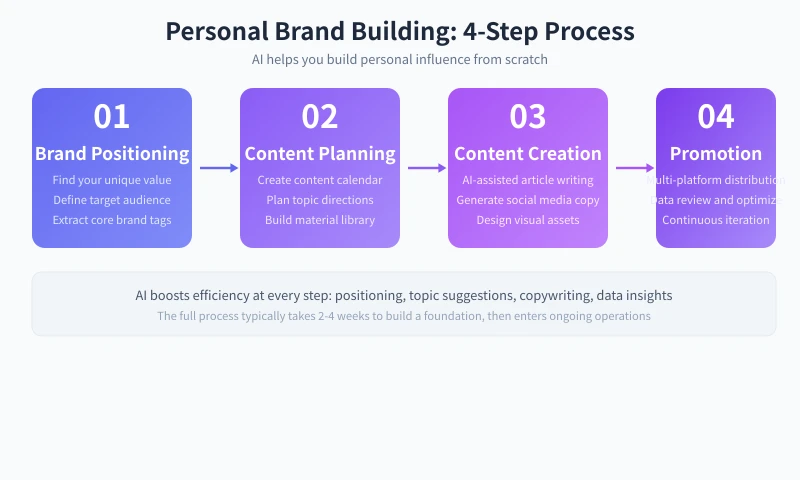
The entire personal branding process is divided into four stages:
- Brand Positioning: Find your unique value and target audience
- Content Planning: Determine output direction and publishing rhythm
- Content Creation: Use AI to efficiently produce quality content
- Promotion: Distribute across multiple platforms and continuously optimize
Below is a detailed breakdown of each step, with specific methods and AI prompt templates.
Step 1: Brand Positioning — Find Your Direction
Brand positioning is the most critical step. Get it wrong, and all subsequent efforts are wasted. You need to answer three core questions:
1. What Are You Good At?
Make a list of all your skills, experience, and hobbies. They don't need to be "world-class" — just knowing more than most people is enough. For example:
- You've done project management at your company for 5 years
- You're a baking enthusiast who constantly experiments with new recipes
- You're proficient in Excel — colleagues come to you when they have problems
- You've been working out for 3 years and built a great physique from scratch
Use AI to help you sort through these:
My background is [your profession/experience], I'm good at [your skills], and I'm passionate about [your interest area]. Please help me analyze which of these abilities and experiences are suitable for developing into a personal brand direction. Give me 3 specific brand positioning suggestions, each including: positioning description, target audience, and differentiation advantage.
2. Who Do You Want to Influence?
The more specific your target audience, the better. "Everyone" is not a target audience. You need to imagine a specific person:
- How old are they?
- What do they do for work?
- What are their pain points?
- Where do they usually get information?
Use AI to help you refine the audience profile:
I want to build a personal brand in the [your direction] field. My target audience is [your audience]. Please help me describe a detailed audience profile, including: age range, career background, daily pain points, information channels, and what content they'd be willing to pay for. Give me a specific "user persona."
3. What Are Your Core Tags?
A good personal brand can be summarized in 2-3 tags. These tags serve as both your memorable identifier and the boundaries for your content creation. For example:
- "AI Tools + Beginner Tutorials + Productivity"
- "Project Management + Career Growth + Real Experience"
- "Home Baking + Simple Recipes + Beginner Friendly"
Let AI help you extract your tags:
My personal brand positioning is [your positioning], and my target audience is [your audience]. Please help me extract 3 core tags that are: concise and powerful, easy to remember, and reflect differentiation. Also give me a personal bio within 15 words.
Step 2: Content Planning — Know What to Write
With positioning done, the next challenge is "what to write." Many people get stuck here — not because they have nothing to say, but because they don't know what content would help build their brand.
Build a Topic Matrix
A good topic matrix covers four dimensions:
- Professional Knowledge: Insights and expertise in your field (40%)
- Personal Stories: Your experiences, lessons learned, growth reflections (25%)
- Practical Tutorials: Step-by-step guides to solve specific problems (25%)
- Trend Commentary: Views and analysis on industry developments (10%)
Use AI to generate a monthly topic plan:
My personal brand direction is [your direction], and my target audience is [your audience]. Please help me create a 30-day content topic plan with 12 topics distributed across four dimensions: Professional Knowledge (5), Personal Stories (3), Practical Tutorials (3), Trend Commentary (1). For each topic, provide: title, one-sentence summary, and which platform it's best suited for.
Set a Publishing Rhythm
You don't need to post every day, but you need a consistent rhythm. Here's a recommended starting frequency for beginners:
- WeChat Blog: 1-2 in-depth articles per week
- Xiaohongshu: 3-5 visual notes per week
- Zhihu: Answer 2-3 relevant questions per week
- Douyin/TikTok: 2-3 short videos per week
Key principle: Better to post less than to break your streak. 8 high-quality pieces per month will outperform 30 mediocre ones.
Step 3: Content Creation — Use AI for Efficient Output
This is where AI truly shines. Content creation is no longer about "sitting at your computer for two hours struggling to write an article" — it's about "telling AI what you want to express, letting it write a draft, then refining it."
Writing a Blog Article
Using a "sharing a practical tip" article as an example:
Step 1: Give AI a framework:
Please help me write a blog article. The topic is [specific topic]. Requirements:
1. Open with a specific scenario to create reader resonance
2. Body should have 3-4 key points, each with specific steps
3. End with a summary and call to action
4. Word count: 1500-2000 words
5. Tone: relaxed and professional, avoid excessive exclamation marks
Step 2: Review and personalize:
AI-generated content is a "60-70 point" first draft. You need to do three things:
- Add your real experiences and cases (AI can't fabricate your stories)
- Adjust expressions that don't match your personal style
- Supplement the latest information or industry details that AI doesn't know
Writing Social Media Posts
Each platform has a completely different content style. When using AI, always specify the platform characteristics:
Please help me write a social media post. Topic: [specific topic]. Requirements:
1. Title uses "number + pain point" format
2. Use short paragraphs, no more than 3 lines each
3. Add appropriate emoji for readability
4. End with engagement prompts and hashtags
5. Total word count: 300-500 words
Content Strategy by Platform
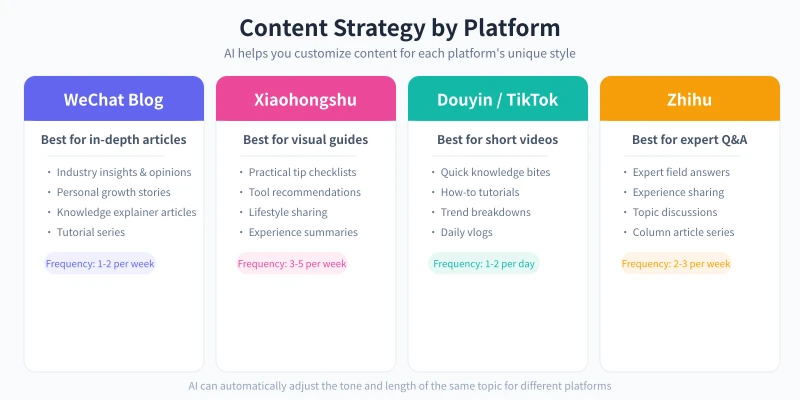
Each platform has different user habits and content preferences. When using AI, adjust your content style according to platform characteristics:
- WeChat Blog: Best for in-depth articles, tutorial series, industry insights. Readers expect a complete knowledge system.
- Xiaohongshu: Best for visual notes, tool recommendations, practical checklists. Readers love "use it right away" content.
- Zhihu: Best for expert Q&A, experience sharing, deep analysis. Readers value professionalism and logic.
- Douyin/TikTok: Best for short videos, quick tutorials, trend breakdowns. Viewers have limited attention — grab them in the first 3 seconds.
An efficient strategy is "one fish, many dishes" — take one core topic and use AI to adapt it for different platforms. You only need to write the core content once, and AI helps you adjust for each platform's style and word count requirements.
Step 4: Promotion — Get More Eyes on Your Content
Great content doesn't automatically equal traffic. You need to actively promote and continuously optimize.
Multi-Platform Distribution
After using AI to adapt one piece of content for multiple platforms, publish to different platforms within the same time window. Benefits include:
- Maximizing exposure for each piece of content
- Different platform audiences may have low overlap, reaching more people
- Creating the impression of "seeing you everywhere"
Data Review and Optimization
Spend 30 minutes each week reviewing your data:
- Which type of content has the highest engagement?
- What posting times get the best results?
- What topics do reader comments and feedback focus on?
Use AI to analyze your data:
Here's my content data from this week across platforms: [paste data]. Please analyze: which content type performed best? What patterns exist between posting time and engagement? How should I adjust my content strategy for next week?
Five Practical Tips
Tip 1: Done is better than perfect. Many people wait until they're "ready" to start. But personal branding is a learn-by-doing process. Publish your first piece of content and continuously adjust through practice.
Tip 2: Stay consistent. Whether it's visual style, tone, or publishing frequency — consistency builds trust. Use AI to help maintain a unified brand voice.
Tip 3: Authenticity beats perfection. Don't try to create a "perfect persona." Sharing real experiences, including failures and lessons, actually builds more trust. AI helps you organize content, but only you can provide your authentic stories.
Tip 4: Think long-term. Don't let short-term data fluctuations affect your mindset. Personal branding is a long-term accumulation process — it typically takes 3-6 months to see significant results. Keep producing, and time will reward you.
Tip 5: Keep learning and iterating. Periodically use AI to review your past content performance, summarize lessons learned, and adjust your strategy for the next phase. Building a personal brand is a continuous optimization process.
FAQ
Can I build a personal brand without any standout skills?
Absolutely. Personal branding doesn't require you to be "the best in the industry" — you just need to know a bit more than most people in a particular direction, or be willing to learn and share continuously. Many people have built their brand during their learning journey — "an ordinary person learning about X" is itself a great brand positioning. Your learning process, pitfalls, and lessons are valuable to those who come after you.
Will AI-generated content be too formulaic?
If you only use a vague prompt, you'll likely get formulaic content. The solution: include your own experiences, opinions, and cases in your prompts; personalize the AI draft; maintain your unique expression style. AI is your writing assistant, not your replacement. The best content is always "AI's efficiency + your personality."
Do I need to be on multiple platforms at once?
We don't recommend beginners spread across all platforms from the start. Choose 1-2 platforms that best match your target audience and go deep first. Once you have a stable content production ability and a solid follower base, gradually expand to other platforms. Trying to do everything at once leads to mediocrity — focus creates depth.
How long before I see results?
It depends on your content quality, publishing frequency, and field. Generally, you'll see initial feedback (follower growth, increased engagement, recommendations) after about 3 months of consistent effort. A 6-month to 1-year timeframe is a realistic "results horizon." The key is maintaining a steady output rhythm — don't give up just because you don't see immediate feedback.
Does personal branding cost money?
Not really in the beginning. Registering accounts on various platforms is free, and most AI tools have free versions that cover basic needs. Once you've built some influence, you might consider investing in: more professional visual assets, more powerful AI tools, attending industry events, etc. But these are "nice to haves," not necessities.
`;Related Articles
AI Speech to Text: Beginner's Guide to Convert Voice to Text in 3 Steps
Learn how to convert speech to text using AI tools. Perfect for meeting notes, content creation, and video subtitles. Three practical scenarios with step-by-step instructions.
TutorialsAI Local Deployment Guide: Run Large Models in 3 Steps for Free
Learn how to deploy AI models locally in just 3 steps. No coding experience needed, completely free, and your data stays private on your own computer.
TutorialsAI Shopping Decision Guide: From Price Comparison to Avoiding Pitfalls
Learn how to use AI for shopping decisions. From price comparison to avoiding pitfalls - make smarter purchasing choices with AI assistance.
Comments are not yet available, stay tuned