AI-Powered Reading Notes: A Complete Guide from Reading to Knowledge Mastery
Have you ever spent a week finishing a book, only to realize a month later that you barely remember anything beyond "it had some good points"? This isn't a memory problem — it's a reading method problem. Traditional "read from cover to cover" approach retains less than 10% of information. Truly effective reading requires a complete loop of "input — processing — output." The good news is, AI can help you close this loop — from book selection and reading, to note organization and review output, every step has corresponding tools and methods.
Why Most People Read Without Retaining
Before diving into methods, let's understand where the problem lies. Most people's reading workflow looks like this:
- See a recommendation, buy a book
- Start from page one, occasionally underline a few sentences
- Finish reading, close the book, put it on the shelf
- A few weeks later, forget almost everything
This workflow is missing three critical steps: preview screening (determining if the book is worth reading), active processing (re-expressing in your own words), and regular review (converting short-term memory into long-term memory). The value of AI lies in helping you cost-effectively add these three steps.
4-Step Workflow Overview
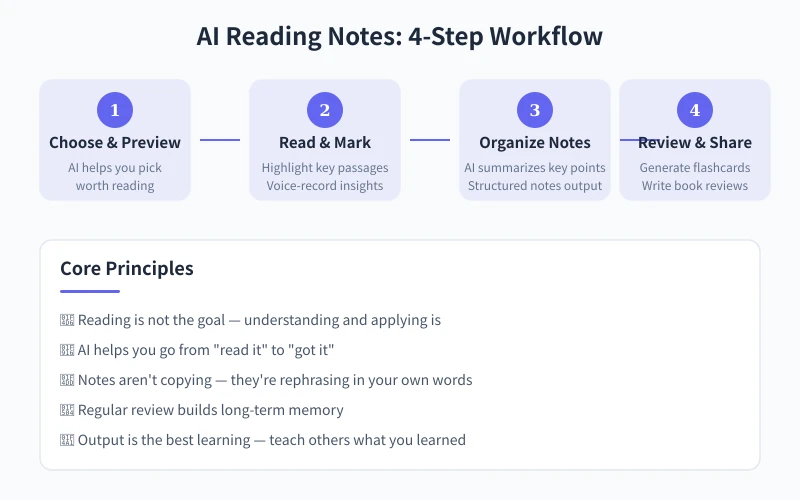
The entire process is divided into four stages, each corresponding to different AI tools and methods. Let's go through them one by one.
Step 1: Choose & Preview — Use AI to Screen Books Worth Reading
Not every book deserves a cover-to-cover read. Before formally reading, spending 10 minutes letting AI do a "preview" can save you a lot of time.
How to Do It
Open your preferred AI chat tool (ChatGPT, DeepSeek, Claude, etc.) and enter this prompt:
I want to read a book about [topic]. Please recommend 3 books best suited for [my level/needs], and for each book explain: core ideas, who it's for, estimated reading time, and which chapters are worth close reading.
For example, if you input "I want to read a book about time management. I'm an office worker who always feels like there's not enough time," AI will give you specific book recommendations and reading suggestions. After getting recommendations, you can follow up with:
Please list the detailed table of contents of "[Book Title]" and the core question of each chapter, so I can decide whether it's worth deep reading.
Pro Tips
- If you already own the book, tell AI the title and ask it to create a "reading roadmap" for you
- For practical books, many sections can be skimmed — AI will tell you which chapters to skip
- The purpose of previewing is to build a "knowledge framework" — reading with questions makes it much more efficient
Step 2: Read & Mark — Capture Your Thoughts in Real Time
The biggest mistake in reading is "passive reading" — eyes moving, brain idle. You need to develop the habit of "reading while noting." But "noting" here doesn't mean copying the book — it means recording your own thoughts.
Three Recording Methods
Method 1: Highlight + Annotate
When you encounter a passage that resonates, don't just underline it — write your own understanding in the margin. You can use phone memos, WeChat favorites, or dedicated note apps (like Flomo or Notion).
Method 2: Voice Recording
If you're commuting or doing housework and can't type, use voice memos to speak your thoughts. They don't need to be complete — the key is capturing the inspiration. Many AI tools support speech-to-text for easy later organization.
Method 3: Photo + AI Recognition
When reading physical books, take photos of important passages. Then send the photos to AI to extract text and do preliminary organization.
I photographed a passage from a book. Please extract the text and summarize its core meaning in one sentence.
Step 3: Organize Notes — Let AI Structure Your Knowledge
After finishing a chapter or the entire book, hand your scattered notes to AI to organize into structured knowledge. This is the most critical step in the entire process.
Chapter Note Organization
Paste your notes (highlights, annotations, voice-to-text all work) to AI using this prompt:
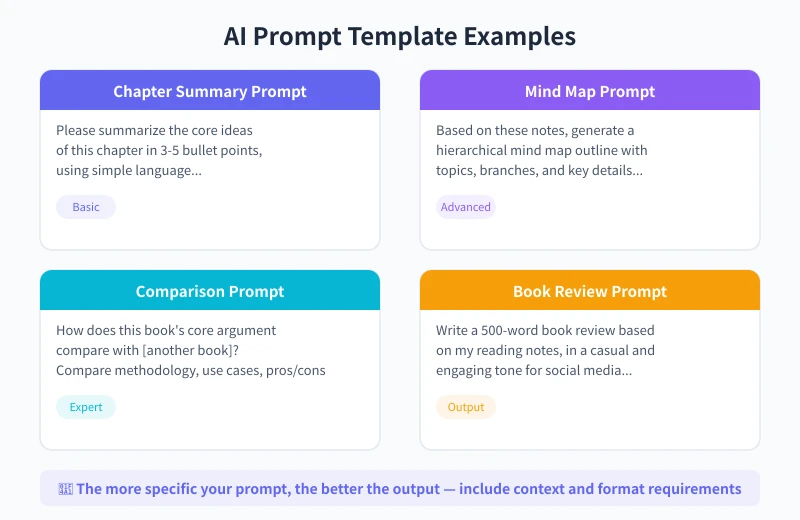
Below are my notes and annotations from reading [Book Title] Chapter [X]. Please organize them into structured notes, including: core ideas (no more than 3), my annotations organized, and actionable points I can apply to life/work.
Full Book Note Integration
After finishing the entire book, do a "full book review":
Below are all my notes from reading "[Book Title]." Please create a complete reading note including: one-sentence summary of the book, key points from each chapter, the 3 most important insights, and specific actions I can take in my life.
Mind Map Generation
If you prefer visual note-taking, ask AI to generate a mind map outline:
Based on my reading notes, generate a hierarchical mind map outline in Markdown indent format that I can paste directly into XMind or Mubu.
Step 4: Review & Output — Make Knowledge Truly Yours
Organizing notes without reviewing them is wasted effort. The Ebbinghaus forgetting curve tells us: 66% of content is forgotten within 1 day of learning. You need active review.
Generate Review Flashcards
Ask AI to convert your notes into Q&A format review cards:
Based on the following reading notes, generate 10 review flashcards (Q&A format) covering the core concepts and key knowledge points. Each card should include a question and a brief answer.
The generated cards can be imported into tools like Anki or Quizlet, using spaced repetition algorithms to automatically schedule reviews.
Write a Book Review
"Teaching is the best form of learning." Write your understanding as a book review and share it on social media or reading communities. Let AI help you draft it:
Based on my reading notes, write a 500-word book review. Use a casual and engaging style, start with an intriguing question or story, suitable for posting on social media.
Connect with Existing Knowledge
The final step, and the most valuable — connect new knowledge with what you already know:
I recently read "[Book Title]" with the core idea of [XXX]. I previously read "[Another Book]" with the idea of [YYY]. Please analyze the similarities and differences between these two books' ideas, and how they complement each other.
Tool Recommendations: Best AI Tools for Reading Notes
You don't need all of them — just pick one that suits you:
| Tool | Features | Best For |
|---|---|---|
| ChatGPT / DeepSeek | Strong conversation ability, good comprehension | Note organization, content analysis, flashcard generation |
| Notion AI | Deep integration of notes and AI | Long-term note management, knowledge base building |
| Flomo | Lightweight recording, WeChat input | Quick capture of inspiration and annotations |
| Kindle / WeChat Read | E-book reading + highlight export | Note collection while reading e-books |
FAQ
Q: Can I use this method with physical books?
Absolutely. For physical books, use "photo + AI recognition" to capture content, or manually type key passages into memos. Voice recording also works great.
Q: Do I need to take such complete notes for every book?
No. For novels and essays, simple impressions suffice. For practical and knowledge books, complete notes are worth the effort. Invest based on the book's value.
Q: Won't AI-organized notes lose my personal understanding?
No, as long as you first have your own notes as input. AI "organizes and structures" — it doesn't "think for you." The richer your annotations and thoughts, the higher quality the AI output.
Q: How often should I review?
Follow spaced repetition: review once on the day you finish, once on day 3, once on day 7, once on day 14. After that, monthly review is sufficient.
Conclusion
Effective reading isn't about "how many books you've read" — it's about "how much you've absorbed." AI won't read books for you, but it can help you turn reading into a complete knowledge management system. From selection to review, there's something AI can help with at every step. The key is: just try it. Pick a book you're currently reading, use the methods above to do one round of note organization, and you'll find the reading experience completely transformed.
Related Articles
AI Speech to Text: Beginner's Guide to Convert Voice to Text in 3 Steps
Learn how to convert speech to text using AI tools. Perfect for meeting notes, content creation, and video subtitles. Three practical scenarios with step-by-step instructions.
TutorialsAI Local Deployment Guide: Run Large Models in 3 Steps for Free
Learn how to deploy AI models locally in just 3 steps. No coding experience needed, completely free, and your data stays private on your own computer.
TutorialsAI Shopping Decision Guide: From Price Comparison to Avoiding Pitfalls
Learn how to use AI for shopping decisions. From price comparison to avoiding pitfalls - make smarter purchasing choices with AI assistance.
Comments are not yet available, stay tuned