AI Healthy Diet Management: A Practical Guide from Nutrition Analysis to Meal Planning
Why Do You Need AI to Manage Your Diet?
Many people want to eat healthier, but when it comes to questions like "how many calories should I eat per day," "am I getting enough protein," or "am I eating too many carbs," most feel lost. Checking nutrition tables is tedious, hiring a nutritionist is expensive, and guessing on your own feels unscientific.
AI tools can solve these problems: snap a photo of your food to identify calories, input your body data to calculate daily nutrition targets, and even plan a week of meals. No expertise needed — just a phone and an AI assistant.
Step 1: Create Your Diet Profile
Before AI can manage your diet, you need to share your basic information. Open ChatGPT or another AI tool and enter the following:
I'd like you to be my diet management consultant. Here is my basic information: - Gender: [Male/Female] - Age: [Your age] - Height: [cm] - Weight: [kg] - Activity level: [Sedentary / Light exercise / Moderate exercise / High intensity] - Health goal: [Fat loss / Muscle gain / Maintain weight / Improve specific health metric] - Dietary preference: [Vegetarian / Low-carb / No preference] - Food allergies or restrictions: [List if any] Please calculate my recommended daily calorie intake and macronutrient targets (protein, carbs, fat) based on this information.
The AI will use the Mifflin-St Jeor formula to calculate your basal metabolic rate, factor in your activity level to estimate total daily expenditure, and provide specific nutrition targets based on your goals.
Step 2: Use AI to Track Daily Meals
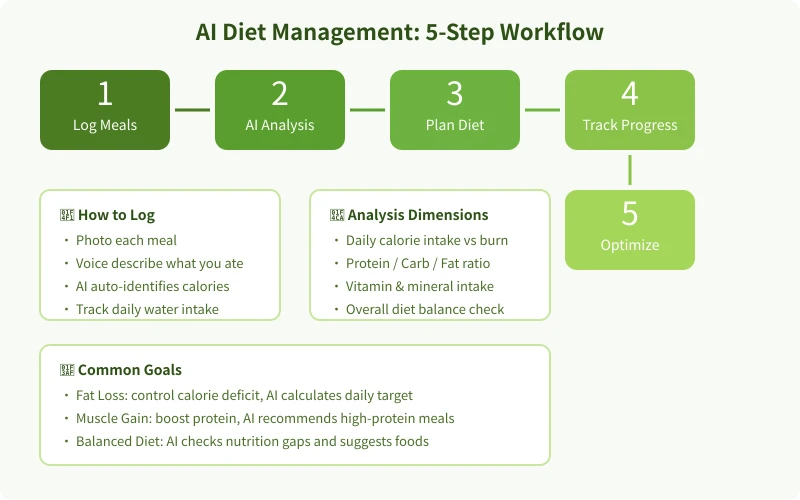
Once you have targets, the next step is recording what you eat each day. This is the most critical step — and the easiest to quit. Good news: AI makes recording incredibly simple.
Method 1: Photo Recognition
Many AI tools now support image recognition. Just:
- Take a photo of your food before eating
- Send the photo to AI to identify food types and approximate portions
- AI automatically estimates calories and nutrients
Example prompt:
Please identify the foods in this photo, estimate the weight of each item (in grams), and calculate the total calories and macronutrient content.
Method 2: Text Description
If you can't take a photo, simply tell AI what you ate:
For lunch I had a bowl of rice (~200g), tomato and egg stir-fry (one tomato, two eggs), and a bowl of seaweed egg drop soup. Please calculate the calories and nutrients for this meal.
Method 3: Voice Input
Use your phone's voice input to say "had a bowl of beef noodles with a braised egg for lunch" — AI will convert it to text and analyze the nutrition. This is much faster than typing, especially for busy professionals.
Step 3: Let AI Analyze Your Diet Structure
After 3–5 days of tracking, ask AI to do a comprehensive analysis:
Here are my diet records for the past 5 days (paste records). Please analyze: 1. What is my average daily calorie intake? How does it compare to my target? 2. Is my protein-to-carb-to-fat ratio balanced? 3. Are there any nutrients I'm significantly lacking or over-consuming? 4. What is the biggest issue with my diet? 5. Give me 3 specific improvement suggestions.
Many people are surprised to discover:
- Severe protein deficiency: Especially common for vegetarians and rice/noodle-heavy diets
- Excess carbohydrates: White rice, noodles, and bread making up too large a share
- Insufficient vegetables: Most people eat less than half the recommended daily amount
- Hidden calories overlooked: Calories in condiments, beverages, and snacks
Step 4: Let AI Customize a Weekly Meal Plan
After identifying issues, ask AI to create a practical weekly meal plan:
Based on my nutrition targets ([X] kcal/day, [X]g protein), please create a weekly meal plan. Requirements: 1. Three meals + one snack 2. Easy-to-find ingredients, simple recipes (no more than 3 steps per dish) 3. Consider meal-prep for office workers 4. Vary ingredients as much as possible each day 5. Include approximate calories for each meal Please present in a table format.
AI will generate a detailed seven-day meal plan with specific dishes and calories for each meal. You can tweak it to your taste, like "swap Wednesday's lunch chicken breast for fish" or "I don't like celery, suggest another vegetable."
Step 5: Daily Execution and Continuous Optimization
Having a plan is just the beginning — execution and adjustment are what matter.
Quick Daily Check
Spend 1 minute each evening sending your day's food log to AI:
Here is what I ate today (paste log). How does it compare to my targets? Anything I should pay attention to?
Weekly Review
Spend 5 minutes every Sunday doing a weekly review:
Here are my diet records for this week. Please give me a brief weekly report: 1. Average daily calories and macronutrients this week 2. How does it compare to last week? 3. Which days went well, which had deviations? 4. What should I focus on improving next week?
Flexible Adjustments
AI's meal plan isn't set in stone. When you encounter these situations, ask AI to adjust anytime:
- Social dinners: Tell AI "I'm having hot pot tonight" and it will calculate how to balance the other two meals
- Business trips: AI will recommend healthier options at local restaurants
- Body changes: When your weight changes, have AI recalculate nutrition targets
- Taste fatigue: Ask AI for a fresh batch of recipes when you're bored
Practical Tips
Let AI Create Shopping Lists
Based on next week's meal plan, please generate a shopping list organized by supermarket sections (produce, meat, pantry, etc.).
Let AI Read Food Labels
See a packaged food at the store and not sure if it's healthy? Snap the nutrition label and send it to AI:
Please analyze this food's nutrition label. Is it suitable during a fat-loss phase? How does it compare to similar products?
Let AI Help You Order Delivery
When you don't feel like cooking and want to order in, screenshot the menu and send it to AI:
Here is the menu from a nearby delivery restaurant. I have [X] calories and [X]g protein left in today's budget. Please recommend the most sensible order combination.
Important Notes
When using AI for diet management, keep these in mind:
- AI estimates have margins of error: Calorie and nutrition data are estimates — no need to be precise to the gram; focus on overall trends
- Don't over-restrict: The AI-suggested calorie target is a floor, not a ceiling — don't eat less for faster results
- Listen to your body: If you frequently feel tired, dizzy, or unfocused, you may be under-eating
- Consult a doctor for special conditions: People with diabetes, kidney disease, or other conditions need professional medical dietary guidance
- Consistency beats perfection: One hot pot dinner won't ruin your plan — what matters is the long game
Healthy eating habits aren't built in a day, but with AI as your diet manager, the process becomes much simpler. Start today — snap a photo of your next meal and let AI take the first step toward healthier eating.
Related Articles
AI Speech to Text: Beginner's Guide to Convert Voice to Text in 3 Steps
Learn how to convert speech to text using AI tools. Perfect for meeting notes, content creation, and video subtitles. Three practical scenarios with step-by-step instructions.
TutorialsAI Local Deployment Guide: Run Large Models in 3 Steps for Free
Learn how to deploy AI models locally in just 3 steps. No coding experience needed, completely free, and your data stays private on your own computer.
TutorialsAI Shopping Decision Guide: From Price Comparison to Avoiding Pitfalls
Learn how to use AI for shopping decisions. From price comparison to avoiding pitfalls - make smarter purchasing choices with AI assistance.
Comments are not yet available, stay tuned