AI Fitness Assistant: A Practical Guide
Why Use AI for Fitness Planning?
Many people want to get fit, but facing the overwhelming amount of training videos and contradictory advice online, they often don't know where to start. Hiring a personal trainer is expensive, and self-training risks doing exercises incorrectly and getting injured. The core value of an AI fitness assistant is: generating personalized training plans based on your specific situation and answering your questions anytime.
You don't need any fitness background. Just tell AI your body data and goals, and it can help you with a complete plan from training to nutrition.
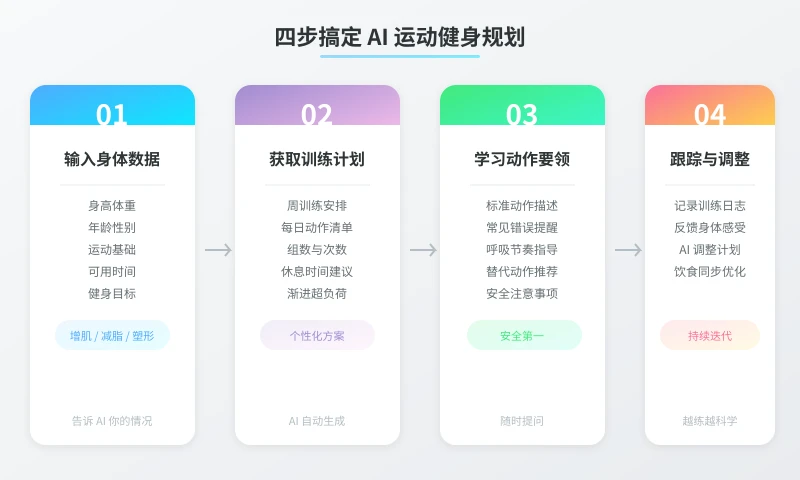
Step 1: Tell AI About Your Body
AI needs to understand your basic situation to give targeted advice. Open your preferred AI tool (ChatGPT, DeepSeek, Doubao, etc.) and start with this template:
I'm a 28-year-old male, 175cm tall, weighing 78kg, with approximately 22% body fat. I have no prior exercise experience. I can train 4 days per week, about 1 hour each session. My goal is fat loss and body shaping, and I want to see noticeable changes in 3 months. Please create a detailed training plan for me.
The more specific your information, the more precise AI's plan will be. Here's the key information you should provide:
- Basic stats: Age, gender, height, weight
- Exercise experience: Beginner / occasional exerciser / some experience
- Available time: How many days per week, how long each session
- Training goals: Muscle gain / fat loss / body shaping / general fitness
- Constraints: Any injuries, home training, available equipment
Step 2: Get Your Personalized Training Plan
AI will generate a complete weekly training plan based on your information. A good AI-generated plan typically includes:
- Weekly training schedule: What to train each day, how to arrange rest days
- Specific exercise list: Exercise names, sets, reps, and rest periods
- Warm-up and stretching: Pre-workout warm-ups and post-workout stretches
- Progressive overload guidance: When to increase weight or reps
Tip: If you don't know how to do an exercise AI recommends, just ask "What's the proper form for a barbell squat? Please describe in detail" — AI will break it down for you.
Step 3: Learn Proper Form to Avoid Injury
This is the most important step. AI can act like a virtual coach, explaining the key points of each exercise in detail. You can ask:
Please explain the correct form for a barbell squat in detail, including stance width, squat depth, knee direction, breathing rhythm, and the 3 most common mistakes beginners make.
AI typically answers from the following dimensions:
- Starting position: Stance width, toe direction, barbell placement
- Movement pattern: Squat depth, knee tracking, weight distribution
- Breathing rhythm: When to inhale and exhale
- Common mistakes: Knee valgus, rounded back, heels lifting, etc.
- Alternative exercises: If you can't do the standard version, what can you use instead
Safety Reminder: AI's advice cannot replace professional medical opinions. If you have old injuries or chronic conditions, always consult a doctor first. Stop immediately if you feel sharp pain during training.
Step 4: Let AI Design Your Workout Nutrition
Training is only half the battle — nutrition is equally important. You can ask AI to create a daily nutrition plan based on your training goals:
I'm currently in a fat-loss phase and burn about 500 calories on training days. Please create a training-day meal plan including breakfast, lunch, dinner, and pre/post-workout snacks. Keep total calories around 1800, with at least 130g of protein.
AI will provide specific recipe suggestions with food types, portions, and approximate calories. You can ask AI to adjust based on your preferences, like "I don't eat eggs — what are some alternatives?"
5 Practical Prompt Templates
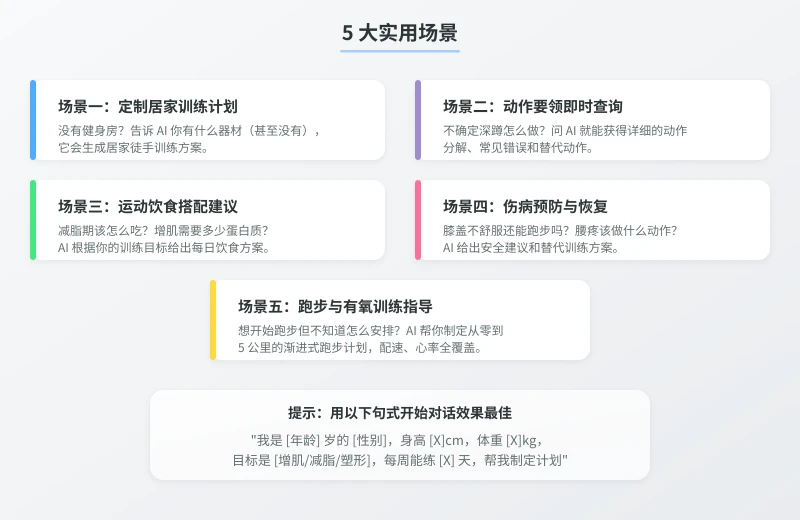
Here are 5 ready-to-use prompt templates covering the most common fitness scenarios:
Scenario 1: Home Bodyweight Training
I don't have any fitness equipment at home, and my space is limited. Please create a 4-day-per-week home bodyweight training plan. Goal: muscle gain and body shaping, 40-50 minutes per session. Ensure all exercises require no equipment, with detailed written descriptions of each movement.
Scenario 2: Beginner Running Plan
I'm a running beginner and get winded after 1 km. Please create an 8-week beginner running plan with the goal of running 5 km continuously. Include weekly training content, pace recommendations, and rest arrangements.
Scenario 3: Post-Workout Recovery
I trained legs yesterday and my thighs are extremely sore today — it's hard to walk. Is this normal? How many days should I rest? What can I do to speed up recovery? Can I train again tomorrow?
Scenario 4: Muscle Gain Nutrition
I'm a 25-year-old male weighing 65kg, and my goal is muscle gain. Please create a daily 2500-calorie meal plan with 150g of protein. List specific foods and portions, using common Chinese ingredients as much as possible.
Scenario 5: Training Around an Injury
I have a mild meniscus tear in my right knee. My doctor said no squats or running. Please design an upper body and core training plan that doesn't stress the knee, 3 days per week, 45 minutes each session.
Tips and Precautions
- Start gradually: Don't ask AI for advanced plans right away. Start with the basics.
- Provide feedback: After training, tell AI how you feel. It will help you adjust the plan.
- Ask for details: If you don't understand an exercise, always ask. AI won't get annoyed.
- Track your data: Record your weights and reps for each session, and periodically share them with AI for analysis.
- Combine with videos: When AI describes an exercise, search for related videos to cross-reference for better learning.
- Listen to your body: AI's advice is a reference. Your body's signals are the most important standard.
Summary
AI fitness assistants aren't meant to replace personal trainers. Instead, they make scientific training guidance accessible to people who can't afford a trainer. The core advantages are personalization, availability, and unlimited patience. As long as you're willing to communicate with AI, it can become your most patient fitness partner.
Remember, the best plan is one you can actually stick to. Start today — open your AI tool and enter your first fitness question.
Related Articles
AI Speech to Text: Beginner's Guide to Convert Voice to Text in 3 Steps
Learn how to convert speech to text using AI tools. Perfect for meeting notes, content creation, and video subtitles. Three practical scenarios with step-by-step instructions.
TutorialsAI Local Deployment Guide: Run Large Models in 3 Steps for Free
Learn how to deploy AI models locally in just 3 steps. No coding experience needed, completely free, and your data stays private on your own computer.
TutorialsAI Shopping Decision Guide: From Price Comparison to Avoiding Pitfalls
Learn how to use AI for shopping decisions. From price comparison to avoiding pitfalls - make smarter purchasing choices with AI assistance.
Comments are not yet available, stay tuned