AI Interview Prep Guide: Resume, Questions, Mock Interviews in 4 Steps
Anxious before interviews? No callbacks from your resume? Don't know what interviewers will ask? Use AI as your interview coach — from resume optimization and question prediction to mock interviews and salary negotiation, fully prepared for every interview.
Why You Need AI for Interview Prep
Interviews are the most critical part of job hunting, but most people are underprepared:
- Resume-job mismatch: Sending 50 resumes with fewer than 5 responses — the problem is usually that your resume isn't tailored to each role
- Unknown questions: Every company and role has different interview focuses; guessing is too inefficient
- Limited practice: It's hard to find someone for mock interviews, and practicing alone doesn't tell you if your answers are good
- No leverage in salary talks: Not knowing market rates, afraid to ask too high or settle too low
AI can help significantly in all four stages. Here's a step-by-step guide.
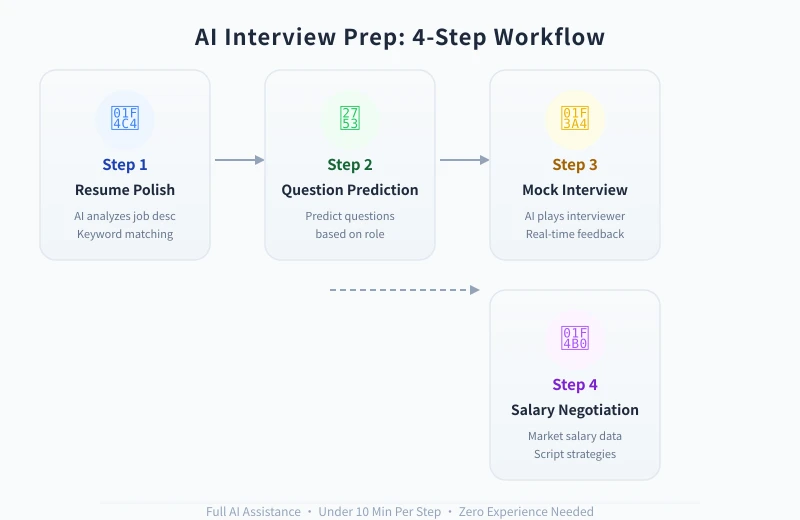
Step 1: Optimize Your Resume with AI (10 Minutes)
Your resume is the key to getting interviews. Many people use the same resume for every job — that's the biggest mistake. AI can help you tailor it precisely for each role.
How to Do It
Open an AI chat tool and enter this prompt:
I'm applying for the following position. Please optimize my resume:
Target job description:
[paste the full JD]
My current resume:
[paste your resume]
Please help me:
1. Find matches and gaps between my resume and job requirements
2. Reorganize resume content to highlight the most relevant experience
3. Replace vague terms with keywords from the job description
4. Provide the optimized complete resume
AI will compare your resume with job requirements, point out areas to adjust, and provide an optimized version.
💡 Key Tip
The core of resume optimization is "speaking their language." If the JD says "responsible for user growth," don't write "did operations" — write "led user growth strategy, achieving XX% increase." AI excels at this keyword matching.
Step 2: Predict Interview Questions with AI (10 Minutes)
Interview questions may seem random, but they follow patterns. AI can accurately predict what interviewers might ask based on the JD and your resume.
How to Do It
I have an upcoming interview for this role. Please predict interview questions:
Job title:
Job requirements:
[paste JD]
My resume:
[paste resume]
Please predict:
1. Self-introduction (write a 1-minute version)
2. 10 most likely professional questions
3. 5 behavioral interview questions (STAR type)
4. 3 potential weakness/challenge questions
5. Key points for each suggested answer
AI will give you a complete interview question bank. Focus on preparing the top 5 high-frequency questions — these come up in almost every interview.
Must-Know Interview Questions
| Question | What They're Testing | Answer Framework |
|---|---|---|
| Tell me about yourself | Communication, logic | Who I am + What I've done + Why here |
| What's your greatest strength? | Self-awareness, role fit | Strength + Specific example + Role relevance |
| Why our company? | Motivation, sincerity | Company highlights + Personal fit + Career plan |
| What's your weakness? | Self-reflection, growth | Real weakness + Improvement steps + Progress |
| Any questions for us? | Proactivity, depth | Questions about team/business/growth |
Step 3: Mock Interviews with AI (15 Minutes)
Knowing the questions and answers isn't enough — you need to practice. AI can play the interviewer and have real conversation practice with you.
How to Do It
Please play the role of an interviewer for a [job title] position.
Interview rules:
1. Ask one question at a time, wait for my answer before the next
2. Follow up on details based on my answers (like a real interviewer)
3. If my answer isn't good enough, point out issues and suggest improvements
4. After the interview, give me a comprehensive evaluation report including:
- Answer quality score (1-10)
- Comments on each question
- Areas for improvement
- Overall performance summary
Job info:
[paste JD]
My resume:
[paste resume]
Start with the self-introduction.
💡 Practice Tip
During mock interviews, try answering with voice (typing is too slow — interviews involve speaking). After answering, ask AI to score you on "clarity," "logic," and "persuasion." Focus on practicing questions that score below 7.
STAR Method: The Universal Framework for Behavioral Questions
Interviewers love asking "Give me an example of when you XXX." Use the STAR method for these:
- S (Situation): What was the context?
- T (Task): What was your goal?
- A (Action): What specifically did you do?
- R (Result): What was the outcome? (Use data)
Have AI help you frame your experiences using STAR. Prepare 3-5 core stories, and you'll be ready for any behavioral question.
Step 4: Prepare Salary Negotiation with AI (10 Minutes)
Salary negotiation is the final step and the easiest to lose out on. AI helps you do your homework so you negotiate with confidence.
How to Do It
Help me prepare for salary negotiation:
Position:
City:
Years of experience:
Current salary:
Expected salary:
Please help me:
1. Analyze the market salary range for this role in this city
2. Based on my experience, suggest a reasonable expected salary range
3. Write negotiation scripts for 3 scenarios:
- When asked about salary expectations
- After getting an offer, wanting to negotiate higher
- When they try to lowball you
4. List key tips and pitfalls in salary negotiation
Negotiation Scripts
| Scenario | Recommended Script |
|---|---|
| Asked about expectations | "I'm focused on the right opportunity. Salary-wise, I'd expect something in the XX-XX range matching market rates and my experience." |
| Want to negotiate after offer | "Thank you for the offer — I'm very interested. Given my experience and market data, could we discuss the compensation package?" |
| They lowball you | "I understand budget constraints. Beyond base salary, are there performance bonuses, equity, or other benefits we could explore?" |
| Need time to decide | "Thank you for the offer. I'd like 2-3 days to consider everything. I'll get back to you by [specific date]." |
FAQ
Is using AI to prepare for interviews cheating?
No. AI only helps you organize thoughts and practice expression. In the interview, you're speaking from your own experience and perspective. It's like using a study guide before an exam — it's a tool. The key is truly understanding the logic behind the answers, not memorizing templates.
How accurate are AI's predicted questions?
Professional questions based on the JD are usually 70%+ accurate. Common behavioral questions (like "What's your weakness?") come up nearly 100% of the time. The most unpredictable are interviewer follow-ups and spontaneous questions, which require genuine understanding of your own experiences.
How different is a mock interview from a real one?
AI mock interviews are very effective for "content preparation" but can't fully simulate real interview tension and non-verbal communication (eye contact, body language). Combine AI practice with friend mock interviews. AI for content, friends for presence.
How early should I start preparing?
Start at least 3 days before. Day 1: optimize resume and predict questions. Day 2: mock interviews. Day 3: review gaps and prepare salary negotiation. If pressed for time, spend at least 1 hour on resume optimization + mock interview.
How are different interview rounds different?
- HR screening: Focus on motivation, stability, culture fit. Prepare "Why did you leave?" and "Why us?"
- Technical/functional round: Focus on professional skills and project experience. Prepare STAR stories and technical questions
- Director/VP round: Focus on thinking style, big picture, potential. Prepare industry insights and career vision
- HR final round: Salary, start date, benefits. Come prepared for negotiation
Summary
Interview preparation comes down to four things:
- Tailored resume — Optimize each resume for the specific role; never use one resume for all jobs
- Question readiness — Predict high-frequency questions and prepare answer outlines
- Practice makes perfect — Use AI mock interviews to practice until fluent and confident
- Salary confidence — Know the market rate, prepare scripts, negotiate with dignity
AI saves significant time and improves preparation quality across all four stages. But remember: interviews are ultimately human-to-human communication — sincerity, confidence, and genuine thinking matter more than any technique.
Before your next interview, open an AI tool and follow these four steps. You'll discover that a well-prepared interview and an unprepared one are completely different experiences.
Related Articles
AI Speech to Text: Beginner's Guide to Convert Voice to Text in 3 Steps
Learn how to convert speech to text using AI tools. Perfect for meeting notes, content creation, and video subtitles. Three practical scenarios with step-by-step instructions.
TutorialsAI Local Deployment Guide: Run Large Models in 3 Steps for Free
Learn how to deploy AI models locally in just 3 steps. No coding experience needed, completely free, and your data stays private on your own computer.
TutorialsAI Shopping Decision Guide: From Price Comparison to Avoiding Pitfalls
Learn how to use AI for shopping decisions. From price comparison to avoiding pitfalls - make smarter purchasing choices with AI assistance.
Comments are not yet available, stay tuned