AI-Powered Interview Prep: A Complete Guide for Beginners
What's the most stressful part of job hunting? It's not sending out resumes — it's getting that interview invitation and having no idea how to prepare. Many people write great resumes but choke during the actual interview. The good news? With the right AI tools, you can systematically prepare for every step, from resume polishing to mock interviews.
This article walks you through using AI models on the Ciyuano platform to complete the full interview preparation process. No technical background needed — just follow the steps.
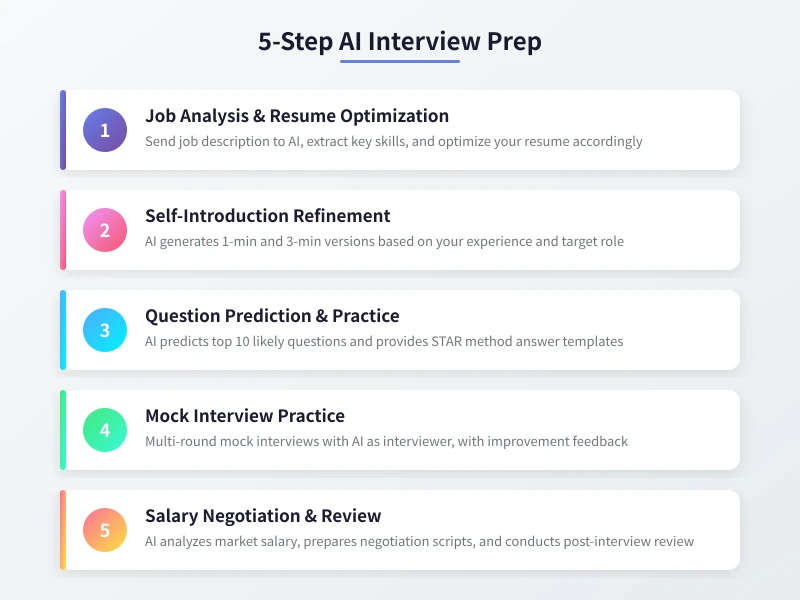
Step 1: Job Analysis & Resume Optimization
The first step in interview prep isn't memorizing answers — it's figuring out exactly what the employer is looking for.
How to do it:
1. Open the job posting and copy the full job description (JD)
2. Open Ciyuano and pick a model that handles Chinese well (DeepSeek V4 or MiMo v2.5 recommended)
3. Paste this prompt:
Please analyze the following job description and help me extract: 1) Core skill requirements (ranked by importance); 2) Nice-to-have qualifications; 3) What this role values most. Then, based on this analysis, help me optimize my resume so that my key skills and experience align with the job requirements.
[Paste the job description here]
[Paste your resume content or main experience here]
4. The AI will provide a detailed analysis and resume optimization suggestions — just follow them to revise your resume
Pro tip: If you have multiple work experiences, let the AI create tailored versions of your resume for different companies. One-size-fits-all resumes are a thing of the past.
Step 2: Craft Your Self-Introduction
Your self-introduction is the first question in any interview — and your chance to make a strong first impression. Most people either rush through it or ramble without hitting the key points.
How to do it:
1. Enter this prompt on Ciyuano:
I'm preparing for a [Job Title] interview at [Company Name]. Please help me prepare two versions of my self-introduction:
1) 1-minute version: Highlight my core strengths and how they match the role
2) 3-minute version: Expand on project experience and results, backed by data
My background: [Briefly describe your education, work experience, and core skills]
Requirements: Use natural, conversational language — don't sound like you're reading a script; clear structure with memorable points; end with something that invites the interviewer to ask about your strongest areas.
2. Read the draft out loud and mark anything that sounds unnatural
3. Have the AI refine it based on your feedback until it sounds like you're chatting with a friend
Key insight: A great self-introduction isn't a verbal resume — it's a personal narrative with a story. Let the AI help you find the hook that resonates most.
Step 3: Predict & Prepare for Common Questions
Every role has its go-to interview questions. Preparing in advance beats improvising every time.
How to do it:
1. Have the AI predict questions:
I'm about to interview for a [Job Title] position at [Company Name]. Based on this role, predict the 10 most likely interview questions, including:
- 3 behavioral questions (answerable with the STAR method)
- 3 technical/skill questions
- 2 situational scenarios
- 2 questions about the company/industry
For each question, provide an answer framework and key talking points, but don't write full answers (this feels more natural).
2. For each question, answer in your own words first, then have the AI polish it
3. Focus extra practice on the questions you struggle with
STAR Method Reminder: Situation → Task → Action → Result. This is the golden formula for behavioral questions. Have the AI help you structure your project experiences using this framework.
Step 4: Mock Interview Practice
No matter how well you prepare, it's wasted without practice. AI can play the interviewer and conduct multi-round mock interviews with you.
How to do it:
1. Set up a mock interview scenario:
Please play the role of an interviewer for the [Job Title] position at [Company Name] and conduct a mock interview with me.
Rules:
- Ask one question at a time and wait for my answer
- After each answer, point out: 1) what was good; 2) what could improve; 3) a better direction
- Then move to the next question
- If my answer is too short or off-topic, follow up with a probe
- Give an overall evaluation and improvement suggestions at the end
My background: [Brief description]
Please begin with the first question.
2. Try answering using voice input to simulate the real interview feel
3. After each round, have the AI summarize your weak areas and target them for improvement
Advanced technique: Have the AI play different interviewer styles — friendly, high-pressure, technical — to experience a variety of interview dynamics.
Step 5: Salary Negotiation & Interview Review
Getting the offer isn't the finish line — negotiating a satisfying salary matters just as much.
Salary Negotiation Prep:
1. Have the AI research market salary levels:
Please analyze salary levels for [Job Title] in [City]:
- Salary range for this role (junior/mid/senior)
- Key factors that influence salary
- Beyond base pay, what benefits can be negotiated
- If their offer is below expectations, how to counter-offer gracefully
2. Prepare your negotiation talking points and have the AI check if they're appropriate
Interview Review:
Immediately after each interview, jot down the following and send it to the AI:
I just finished interviewing for [Job Title] at [Company Name]. Please help me review:
Questions asked during the interview:
1. [Question 1] — My answer: [Brief summary]
2. [Question 2] — My answer: [Brief summary]
...
Please analyze: 1) which answers could improve; 2) the interviewer's likely impression; 3) what to watch out for next time.
This review process is incredibly valuable. Interview skills are built through practice, and AI helps you maximize the impact of every round.
Complete Process Summary
Here's the full AI-assisted interview prep workflow in five steps:
Preparation Phase (3-5 days before): Job analysis → Resume optimization → Self-introduction polish → Question prediction
Practice Phase (1-2 days before): 2-3 rounds of mock interviews, filling gaps
Final Phase (Interview day): Review key points, adjust mindset, prepare salary negotiation
Usage Tips
Pick the right model: For Chinese interview prep, DeepSeek V4 or MiMo v2.5 are recommended — they understand Chinese context better and generate more natural responses.
Don't copy AI answers verbatim: AI gives you frameworks and ideas. You need to fill them with your own language and experiences. Interviewers can tell instantly when you're reciting a script.
Iterate multiple times: First-round AI responses tend to be generic. Keep adding details and correcting direction until the answers truly reflect your real situation.
Save important conversations: Keep the self-introductions, question answers, and other AI-generated content for repeated practice.
Interviews aren't scary — going in unprepared is. Use AI well, prepare to the fullest, and leave the rest to skill and luck.
Related Articles
AI Resume Writing: From Zero to Professional in 5 Steps
Learn how to use AI to write a professional resume. Five simple steps from basic information to polished final draft. Perfect for job seekers who want to stand out.
Productivity ToolsAI Note Organization: Build a Personal Knowledge System in 5 Steps
Learn how to use AI for note organization. Build a personal knowledge system in 5 steps. Perfect for knowledge workers and students.
Productivity ToolsAI Side Hustle Planning: Find Your Second Income Source
Want to earn extra income through a side hustle but don't know where to start? AI can help you analyze your skills, match directions, make plans, and track progress. Find your ideal side hustle within a month, even with zero experience.
Comments are not yet available, stay tuned