AI-Powered Reading Notes & Knowledge Management: A Beginner's Guide to Efficient Reading
Many people buy books and download e-books but never finish them, or forget everything after reading. Reading notes get abandoned after a few pages, and knowledge management becomes a mess. AI tools can completely transform your reading efficiency — from deconstructing book structures to generating note cards and knowledge reviews, there are ready-made solutions for every step.
This article uses the simplest step-by-step instructions to teach you how to use AI models on the CiYuanO platform to build your own efficient reading system. No technical background needed — just follow along.
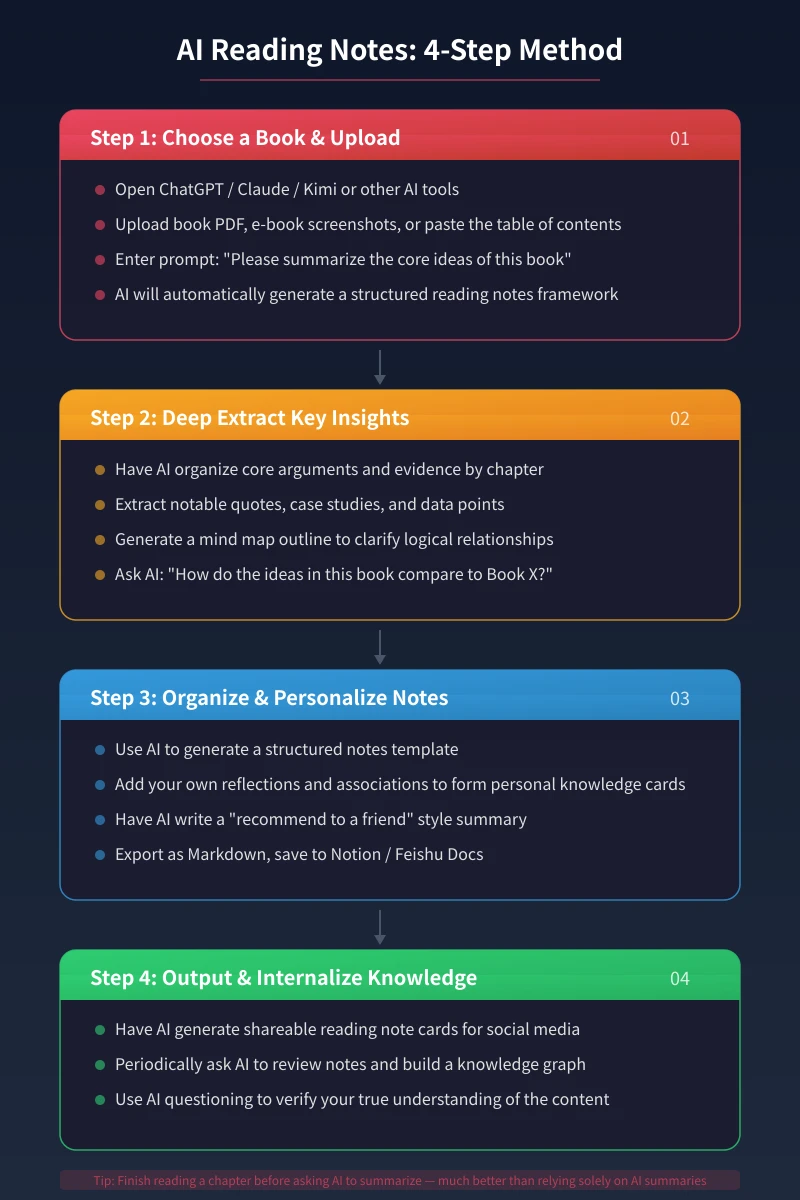
Step 1: Use AI to Deconstruct a Book's Framework
When you get a new book, don't rush to read from page one. First, let AI help you build a global perspective.
Steps:
1. Take a photo or paste the book's table of contents
2. Open CiYuanO and choose a model with strong Chinese capabilities (recommended: DeepSeek V4 or MiMo v2.5)
3. Enter the following prompt:
Please analyze this book based on the following table of contents:
1) What is the core problem this book aims to solve?
2) What is the author's argumentation logic? (From what angle, how does it develop?)
3) Which chapters are core chapters (must read carefully) and which are supplementary (can skim)?
4) After reading this book, what questions should I be able to answer?
[Paste table of contents here]
4. AI will provide a clear reading map, helping you decide where to spend your time reading carefully
Tip: If the book is thick (over 300 pages), you can ask AI to help you create a phased reading plan — read 1-2 chapters per day with note-taking tasks.
Step 2: Let AI Extract Key Points While Reading
After finishing a chapter, while your memory is fresh, immediately let AI help you organize notes.
Steps:
1. After reading a chapter, briefly summarize what it covers in your own words (even just a few sentences)
2. Send your summary along with key paragraphs from the chapter to AI:
I just finished Chapter [X] "[Chapter Title]" from [Book Title]. Here is my understanding:
[Your summary]
Here are the passages I found important:
[Paste 2-3 key paragraphs]
Please help me:
1) Add points I may have missed
2) Summarize the chapter's core idea in one sentence
3) Extract 2-3 memorable quotes
4) How does this chapter connect to previous chapters?
3. Save AI's output to your note-taking tool (Notion, Feishu, Yuque all work)
Key Principle: Think for yourself first, then let AI supplement. Having AI summarize directly is far less effective than "thinking first + AI filling gaps."
Step 3: Generate Structured Reading Note Cards
After finishing the entire book, let AI integrate your scattered chapter notes into a complete reading note.
Steps:
1. Compile your chapter notes and send them to AI:
Here are my notes from reading [Book Title] chapter by chapter. Please integrate them into a complete reading note in this format:
I. One-sentence book review (suitable for social media sharing)
II. Core ideas (3-5 key points)
III. Top 3 most inspiring insights (expanded with real-life applications)
IV. Quote collection (with brief commentary)
V. Action list (what changes can I make immediately after reading)
VI. Recommended reading (which books pair well with this one)
[Paste chapter notes here]
2. On top of AI's output, add your own reflections and associations
3. Ask AI to generate a concise version suitable for social media sharing (150-300 words)
Advanced Technique: Have AI test you using the Feynman Technique — pretend you're explaining the book to a 10-year-old. AI will point out where you can't explain clearly, revealing concepts you haven't truly understood.
Step 4: Use AI for Knowledge Review and Connection
Notes that aren't reviewed are as good as not taken. AI can help you regularly review and connect knowledge across different books.
Steps:
1. Every 5 books you read, let AI perform a knowledge integration:
I recently read these 5 books:
1. [Book 1] - Core idea: [brief]
2. [Book 2] - Core idea: [brief]
3. [Book 3] - Core idea: [brief]
4. [Book 4] - Core idea: [brief]
5. [Book 5] - Core idea: [brief]
Please help me:
1) Find common themes and conflicting viewpoints across these 5 books
2) Summarize 3 cross-book core insights
3) Generate a thematic knowledge graph structure (described in text with nodes and connections)
4) Recommend the next book to read (based on existing knowledge gaps)
2. Periodically (monthly) have AI generate review questions based on your notes to test your memory
3. Categorize similar viewpoints from different books to form your own knowledge system
Practical Advice: Tag each book's notes (e.g., "psychology," "business," "efficiency") for easy future retrieval. CiYuanO's conversation history itself serves as a searchable knowledge base.
AI Prompt Templates for Different Reading Scenarios
Different types of books require different AI note-taking approaches:
Practical/Self-help books (e.g., "Atomic Habits," "Deep Work"):
This is a practical book about [topic]. Please extract: 1) All methodologies/frameworks mentioned; 2) The applicable scenario for each method; 3) The 3 smallest actions I can start taking today.
Narrative books (biographies, history):
This is a [biography/history] book. Please help me: 1) Map out the timeline and key events; 2) Analyze the protagonist's decision-making logic; 3) What lessons does this experience offer for my career/life?
Academic books (philosophy, economics):
This is an academic book. Please help me: 1) Explain the core theory in plain language; 2) Give 2-3 real-life examples to illustrate; 3) What are the limitations of this theory?
Frequently Asked Questions
Q: Can I just have AI summarize the whole book instead of reading it?
A: Not recommended. AI summaries are "pre-digested food" — you miss the thinking and inspiration that comes from the reading process. The right approach is to read yourself, using AI to organize and fill gaps.
Q: What about reading books in English?
A: Just chat with AI in Chinese. You can paste English text in your prompts and have AI analyze and summarize in Chinese. When you encounter unfamiliar terms, ask AI to explain them too.
Q: Where should I store my notes?
A: Notion or Feishu Docs are recommended — they support Markdown format and are easy to search. You can also use CiYuanO's conversation history as notes — each conversation thread serves as a book's note thread.
Q: How do I stay consistent?
A: Don't pursue perfect notes. Even writing one sentence summary after finishing is better than nothing. AI's role is to lower the barrier — what used to take 1 hour for note-taking now takes just 10 minutes.
Start Your First AI Reading Note
Pick a book you're currently reading or recently finished, open CiYuanO, and try the four-step method above. You'll find that reading notes, which used to feel tedious, become something satisfying.
Knowledge only truly belongs to you when it's organized, connected, and applied. AI doesn't read for you, but it can help turn every page you read into tangible gains.
Related Articles
AI Resume Writing: From Zero to Professional in 5 Steps
Learn how to use AI to write a professional resume. Five simple steps from basic information to polished final draft. Perfect for job seekers who want to stand out.
Productivity ToolsAI Note Organization: Build a Personal Knowledge System in 5 Steps
Learn how to use AI for note organization. Build a personal knowledge system in 5 steps. Perfect for knowledge workers and students.
Productivity ToolsAI Side Hustle Planning: Find Your Second Income Source
Want to earn extra income through a side hustle but don't know where to start? AI can help you analyze your skills, match directions, make plans, and track progress. Find your ideal side hustle within a month, even with zero experience.
Comments are not yet available, stay tuned