AI Resume Optimization & Interview Prep: Land Your Dream Offer Even Without Experience
Why Use AI for Job Preparation?
The two biggest headaches in job hunting: writing a resume and preparing for interviews. You may not know how to make your resume stand out, or what questions to expect. In the past, you might have paid a career consultant. Now, AI tools can handle 80% of the preparation work for you.
This guide will walk you through using AI to optimize your resume, simulate interviews, and prepare for salary negotiations — boosting your job search efficiency.
Step 1: Organize Your Experience
Before using AI, list out your experience in a document following this structure:
- Work History: Company, role, timeframe, key responsibilities for each job
- Project Experience: Projects you participated in, your role, and results achieved
- Education: School, major, degree
- Skills List: Tools, languages, technologies you know
- Other Highlights: Certifications, awards, volunteer experience
It does not need to be perfect — just list keywords and data points. AI will polish it later.
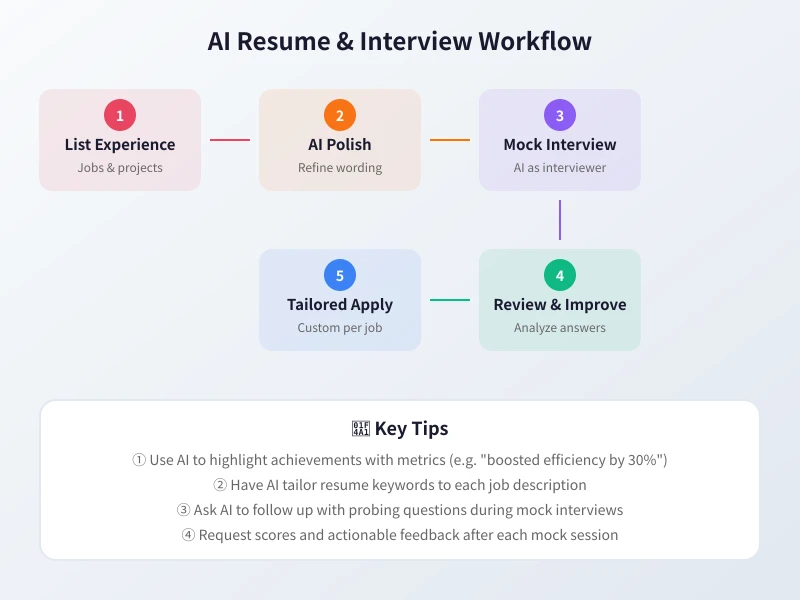
Step 2: Optimize Your Resume with AI
Open ChatGPT, Claude, or another AI tool and send your resume content using this template:
Prompt Template:
Please optimize the following resume content. Requirements:
1. Rewrite work achievements using the STAR method (Situation-Task-Action-Result)
2. Quantify results with specific numbers
3. Keep language concise and professional — remove casual expressions
4. Highlight relevant experience for [target position][Paste your resume content]
Key Tip: Tailor for Each Job Description
Do not use one resume for every application. Before each submission, send the target job description to AI:
Prompt:
Here is my resume: [Resume content]
Here is the target job description: [Paste JD]
Please adjust my resume based on the key requirements in the JD, highlight matching skills and experience, and ensure the resume includes keywords mentioned in the JD.
Step 3: Mock Interviews
After submitting your resume, start practicing interviews while waiting for responses. Have AI play the interviewer:
Prompt:
Please act as an interviewer at [Company] for the [Position] role and conduct a mock interview.
Rules:
1. 3 rounds: technical, project-based, and general
2. 5 questions per round
3. After I answer, give a score (1-10) and specific improvement suggestions
4. If my answer is not detailed enough, ask follow-up questionsMy background: [Brief description of your experience]
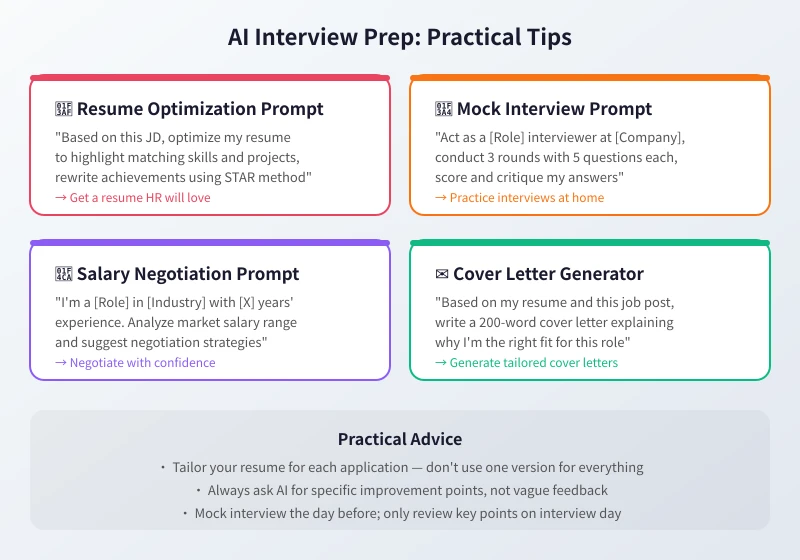
Practice Common Interview Questions
Beyond mock interviews, have AI help you prepare answers for frequently asked questions:
Prompt:
Please help me prepare answers for these interview questions. Requirements: be genuine, include specific examples, keep each answer within 2 minutes:
1. Tell me about yourself
2. What are your strengths and weaknesses?
3. Why did you choose our company?
4. Describe a time you solved a difficult problem
5. What is your career plan?My background: [Your experience]
Step 4: Salary Negotiation Preparation
After receiving an offer, do not rush to accept. Have AI analyze market rates and prepare negotiation talking points:
Prompt:
I am a [Position] in [Industry] with [X] years of experience, based in [City].
Please help me:
1. Analyze the market salary range for this position
2. List 3 key leverage points for salary negotiation
3. Provide negotiation scripts for 3 scenarios (offer is low / meets expectations / exceeds expectations)
Step 5: Write a Cover Letter
Many companies require a cover letter. Have AI generate one quickly:
Prompt:
Based on my resume and this job posting, write a 200-word cover letter.
Requirements:
1. Opening: state the position and how you found it
2. Middle: 2-3 core strengths matching the job requirements
3. Closing: express sincerity and enthusiasmResume: [Resume content]
Job description: [JD content]
Practical Tips Summary
- Tailor your resume for each application — do not use one version for everything
- Always ask AI for specific improvement points after mock interviews — do not settle for vague feedback
- Mock interview the day before; only review key points on interview day — no cramming
- Prepare 3-5 project stories using the STAR method — apply them flexibly during interviews
- Use data to back up salary negotiations — do not name a number based on gut feeling
Final Thoughts
AI is not about fabricating credentials — it is about telling your real story more effectively. Whether you land the offer ultimately depends on your actual abilities and preparation. But using AI well can boost your preparation efficiency by 3-5x.
Good luck with your job search — go get that offer!
Related Articles
AI Resume Writing: From Zero to Professional in 5 Steps
Learn how to use AI to write a professional resume. Five simple steps from basic information to polished final draft. Perfect for job seekers who want to stand out.
Productivity ToolsAI Note Organization: Build a Personal Knowledge System in 5 Steps
Learn how to use AI for note organization. Build a personal knowledge system in 5 steps. Perfect for knowledge workers and students.
Productivity ToolsAI Side Hustle Planning: Find Your Second Income Source
Want to earn extra income through a side hustle but don't know where to start? AI can help you analyze your skills, match directions, make plans, and track progress. Find your ideal side hustle within a month, even with zero experience.
Comments are not yet available, stay tuned