AI Shopping Assistant: Make Every Purchase Worth Your Money
Every time you open a shopping app, facing dozens of brands and hundreds of models, do you often fall into "choice paralysis"? Reading reviews until your eyes blur, comparing prices until your head hurts, and in the end you either buy randomly or just give up. Actually, AI can help you sort things out quickly — telling you what to buy, where to get the best deal, and what pitfalls to avoid. This article uses 4 real scenarios to teach you how to turn AI into your personal shopping consultant.
Why AI Is Great for Shopping Decisions
The essence of shopping decisions is information processing: you need to collect product info, compare specs, analyze reviews, and judge value for money. These are exactly what AI excels at.
Advantages of using AI for shopping decisions:
- Comprehensive info: AI's training data covers massive product reviews, user feedback, and industry reports — far more thorough than you researching alone
- No bias: AI doesn't take promotional fees from sellers and won't recommend the highest-commission product to you
- Clear logic: AI can help transform vague needs ("just something good") into concrete specs
- Fast: What takes you 3 hours to research, AI can summarize in 3 minutes
Step 1: Clearly Define Your Needs
Many people ask AI things like "recommend a good [product]" — vague questions only get vague answers. You need to chat with AI like you would with a knowledgeable friend, telling them your specific situation.
Needs Description Formula
I want to buy [product type], mainly for [use case], budget around [price range], I especially care about [core need], and I don't care much about [compromisable aspect].
Example:
I want to buy a laptop, mainly for coding and occasional video editing, budget $800-$1100, I especially care about screen quality and keyboard feel, and I don't care much about weight (I won't carry it often).
With this kind of description, AI can give you precise recommendations instead of listing options you don't need at all.
Step 2: Get a Recommendation List
Once your needs are clear, ask AI to list candidate products. The key is to have AI include reasons for recommending and caveats.
Recommendation Prompt Template
Based on my needs above, please recommend 3-5 [product type] options that best fit.
For each, please tell me:
1. Brand, model, and approximate price
2. Key advantages (why you recommend it)
3. Main drawbacks (what you might regret after buying)
4. Who it's best suited for
Finally, give me your "if you could only pick one" final recommendation with reasons.
Real Example: Choosing Noise-Cancelling Headphones
Suppose you enter:
I want to buy over-ear noise-cancelling headphones, mainly for office use and commuting, budget $200-$350, I especially care about noise cancellation and comfort, and I don't care much about audio quality (decent is fine).
AI will give you something like:
- Sony WH-1000XM5 (~$300): Industry benchmark for ANC, comfortable, 30-hour battery. Con: doesn't fold, less portable.
- Apple AirPods Max (~$350): Seamless Apple ecosystem integration, excellent sound. Con: heavier, headband pressure after long use.
- Bose QC Ultra (~$280): Best-in-class comfort, top-tier ANC. Con: button controls less intuitive than touch.
- Final pick: Sony WH-1000XM5 — best all-rounder for ANC, comfort, and battery life.
Step 3: Deep Comparison and Avoiding Pitfalls
With a candidate list, the next step is deep comparison. This is the most critical step — it's where many people get tricked by marketing hype.
Ask AI to Make a Comparison Table
Please create a comparison table for the recommended products above. Dimensions: price, key specs, user review keywords, main drawbacks, and target users. Use a table format for easy comparison.
Ask AI to Spot Marketing Tricks
This is a step many people overlook. You can directly ask AI:
What are the common consumer traps and marketing tricks when buying [product type]? List the things I need to watch out for to help me avoid pitfalls.
AI will tell you common pitfalls like:
- Inflated specs: Some brands' claimed battery life and ANC depth differ greatly from real-world use
- Rebrand markups: Same product with a different color or collab costs hundreds more
- Clearance models: Some "deals" are actually old models about to be replaced
- Bundled sales: Seemingly cheap bundles include accessories you don't actually need
Four Real-World Scenarios
Scenario 1: Choosing a Phone (Information Overload)
The phone market launches dozens of new models every year — specs can make your head spin. Use AI to filter quickly:
I want to switch phones, budget $400-$550. I mainly scroll short videos, take photos for social media, and occasionally play games. I've been using Android and don't want to switch to iPhone. Please recommend 3 models, focusing on camera and gaming performance, and skip specs I don't care about.
Scenario 2: Choosing Home Appliances (Technical Complexity)
Buying a fridge or washing machine involves complex specs, high prices, and no returns. Let AI explain technical terms:
I want to buy a double-door fridge, budget $500-$800. Family of three, kitchen space is 32 inches wide. Please first explain the difference between "frost-free" and "direct cool", and "inverter" vs "fixed speed", then recommend specific models.
Scenario 3: Choosing a Gift (Emotional Decision)
Gift selection values "thoughtfulness" over "specs" — AI can help here too:
My girlfriend's birthday is next week, budget around $70. She likes crafting, coffee, and cats. She doesn't like overly practical things (like kitchenware). Please recommend 5 thoughtful gift options, each explaining why it suits her.
Scenario 4: Choosing a Service (Decision Anxiety)
Choosing gym memberships, insurance, or financial products — AI helps you organize your thinking:
I want to join a gym. There are 3 gyms near me. Please list the key factors I should compare (like distance, equipment, classes, contract terms, etc.) and give me a decision checklist I can fill out to make my choice.
Practical Tips and Things to Watch Out For
Have AI Play Different Roles
Analyze the same product from different angles for a more complete picture:
- "Please speak as a 3-year user and share the real experience with this product"
- "Please analyze this product's pros and cons as a professional reviewer"
- "Please tell me the most common complaints about this product as a customer service rep"
Limitations of AI Shopping
AI isn't perfect — you need to judge these situations yourself:
- Latest product info: AI has a knowledge cutoff — brand-new releases may have incomplete info
- Personal experience: Comfort, feel, scent — these subjective sensations AI can't experience for you
- Local prices: Price differences across regions and channels may not be accurate in AI's data
- Return policies: Warranty and return terms should be verified with the actual seller
Recommended Decision Process
The best shopping decision flow:
- Use AI to clarify needs — turn vague "want to buy something" into concrete specs
- Use AI to narrow choices — filter from dozens of options to 3-5
- Try in person — try on, try out, touch and feel to confirm
- Use AI for final price comparison — confirm where to buy at the best deal
A Great API Platform Recommendation
If you want to integrate an AI shopping assistant into your own app or mini-program, you can use the Ciyuano platform. One API Key gives you access to DeepSeek, ChatGPT, Claude, and more:
- Visit Model List to see all available models
- Create your key at the API Key Management page
- Set API endpoint to
https://www.ciyuano.com/v1, enter your Key, and you're ready
Summary
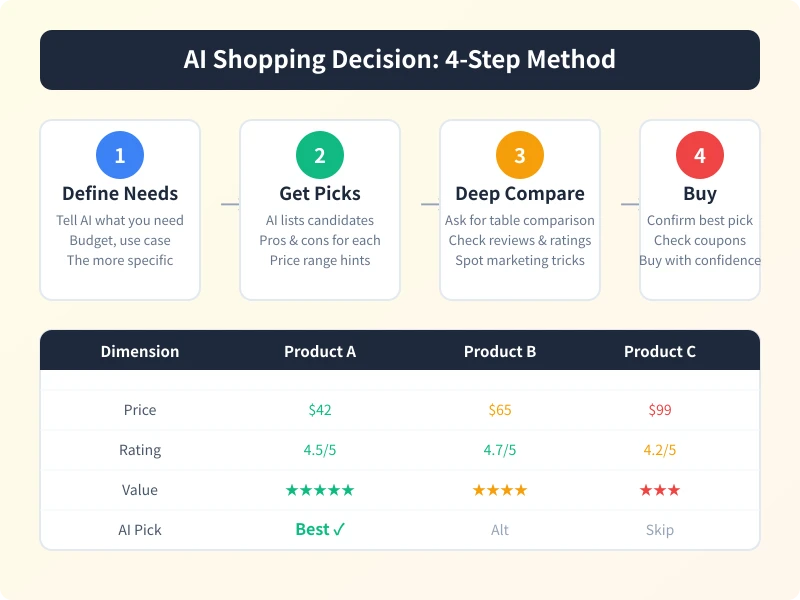
The core of AI shopping decisions isn't letting AI make the choice for you — it's helping you figure out what you actually want. Remember this flow:
- Define needs: Use the formula to turn vague ideas into concrete criteria
- Get recommendations: Have AI list candidates with reasons
- Deep comparison: Make tables, check reviews, spot tricks
- Make the call: AI provides info, you make the final decision
Next time you're agonizing over a purchase, stop scrolling through reviews yourself — chat with AI for 5 minutes first, and it can save you hours of decision anxiety.
Related Articles
AI Resume Writing: From Zero to Professional in 5 Steps
Learn how to use AI to write a professional resume. Five simple steps from basic information to polished final draft. Perfect for job seekers who want to stand out.
Productivity ToolsAI Note Organization: Build a Personal Knowledge System in 5 Steps
Learn how to use AI for note organization. Build a personal knowledge system in 5 steps. Perfect for knowledge workers and students.
Productivity ToolsAI Side Hustle Planning: Find Your Second Income Source
Want to earn extra income through a side hustle but don't know where to start? AI can help you analyze your skills, match directions, make plans, and track progress. Find your ideal side hustle within a month, even with zero experience.
Comments are not yet available, stay tuned