AI Translation Tool Practical Guide: Efficient Translation, Polishing, and Proofreading All in One
Why Do You Need AI Translation Tools?
Traditional translation methods fall into two categories: machine translation (e.g., Google Translate) is fast but rough in quality, while human translation is high-quality but expensive and time-consuming. AI translation tools combine the advantages of both—fast speed, high quality, and the ability to adapt flexibly to context.
Whether you need to translate an email, polish an English paper, or write multilingual descriptions for cross-border e‑commerce products, AI can help you get it done in minutes. This article will walk you through 4 of the most common translation scenarios, teaching you how to efficiently handle various translation needs with AI.
Preparation
You need an AI conversation tool. Here are a few recommendations:
- ChatGPT (OpenAI): The most popular AI conversation tool, strong multilingual capabilities, natural translation style
- Claude (Anthropic): Excellent at long-text translation and professional documents, fluent and authentic expression
- Tongyi Qianwen / Wenxin Yiyan: Domestic large models, strong Chinese comprehension, more accurate when translating Chinese-related content
- DeepSeek: Cost-effective, outstanding performance in specialized domain translation
Choose any one to get started. It’s recommended to use it on a computer for easier copying and organizing of translation results.
Scenario 1: Everyday Conversation Translation
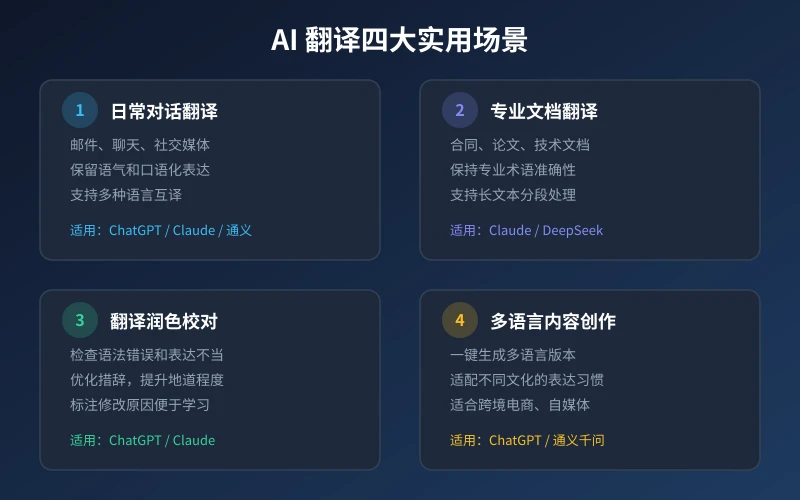
Need to reply to an email in English? Chatting with foreign friends but don’t know how to express yourself? AI can help translate everyday conversations, and it’s more natural and conversational than traditional translation tools.
Steps
- Open the AI tool and paste the content you need to translate into the input box
- Clearly tell the AI the translation direction, e.g., “Translate to English” or “Translate to Chinese”
- Specify the scenario and tone requirements, e.g., “This is a work email for a colleague, tone should be formal” or “This is a chat between friends, should be conversational”
- The AI will provide the translation; if you’re not satisfied, you can continue to adjust
Example prompt:
Please translate the following passage into English. This is a work email replying to a customer inquiry about a quote. The tone should be professional and polite, but not too stiff.
Original: Thank you for your inquiry。We have received your request,We are currently preparing the quotation。We expect to send you the detailed quotation by tomorrow afternoon,Please wait a moment。
The AI will produce a professional yet natural English email, rather than a rigid word‑for‑word translation. For example, it will translate “Please wait a moment” as “Please allow us until then” instead of a literal “Please wait.”
Advanced Tips
- Tell the AI your relationship with the other party (colleague, client, friend), and it will automatically adjust the tone and wording
- Ask the AI to provide 2–3 translation versions for you to choose from, then pick the most suitable one
- If you’re unsure whether a certain expression is natural, just ask the AI, “Is this phrasing natural in English?”
Scenario 2: Professional Document Translation
Need to translate contracts, papers, technical documents, or other professional content? AI can not only translate the text but also understand specialized terminology and preserve the document’s formatting and logical structure.
Steps
- Copy the document content you need to translate into the AI tool
- Tell the AI what type of document it is (contract, paper, technical manual, etc.)
- If there is a specific field, ask the AI to use standard terminology for that field
- If the document is long, you can translate it in segments, keeping the context coherent for each segment
Example prompt:
Please translate the following technical document into English. This is a software API usage guide. Requirements: 1) Keep technical terms in their original English (e.g., API, endpoint, JSON); 2) Preserve the original paragraph structure; 3) The translation must be accurate and professional, suitable for technical readers.
The AI will identify technical terms and keep them in the original language, while translating the explanatory text into professional English.
Advanced Tips
- First ask the AI to list the specialized terms in the document along with their translations, confirm they are correct, and then proceed with the full translation
- For high‑precision documents like legal contracts, have the AI self‑check after translation and point out any potentially ambiguous parts
- If the document has a fixed format (e.g., tables, lists), remind the AI to keep the format unchanged
Scenario 3: Translation Polishing and Proofreading
Already have a translation but feel it’s not natural? Or you’ve written something in English and want the AI to polish it? AI can help check grammar, improve wording, and make expressions more idiomatic.
Steps
- Send your translation or English content to the AI
- Tell the AI your needs: check grammar, polish expression, or both
- Ask the AI to mark the changes and the reasons so you can learn from them
- If satisfied, you can ask the AI to further optimize the tone and style
Example prompt:
Please polish the following English translation. Requirements: 1) Check and correct grammar errors; 2) Replace unnatural expressions with more natural phrasing; 3) Mark each change with the reason in parentheses; 4) Finally provide a complete polished version.
The AI will check your translation sentence by sentence, mark unnatural parts, and suggest improvements. For example:
- Original: "I very like this product" → Revised: "I really like this product" (Reason: very cannot directly modify like; use really instead)
- Original: "According to my opinion" → Revised: "In my opinion" (Reason: according to is used with facts, not opinions)
Advanced Tips
- Ask the AI to provide both a “literal translation version” and a “free translation version,” then compare which suits your scenario better
- If it’s for an exam (e.g., IELTS, TOEFL), tell the AI to polish according to the exam scoring criteria
- Have the AI compile a list of common Chinglish expressions so you can avoid them in the future
Scenario 4: Multilingual Content Creation
If you’re in cross‑border e‑commerce, social media, or need to reach users in different languages, AI can quickly translate a piece of content into multiple languages and adapt it to the expression habits of different cultures.
Steps
- Prepare your original content (can be in Chinese or English)
- Tell the AI which languages you need it translated into
- Specify the purpose of the content (product description, social media post, website copy, etc.)
- The AI will generate versions in each language, adapted to the reading habits of local users
Example prompt:
Please translate the following product description into English, Japanese, and Korean. This is a product detail page copy for a Bluetooth earphone. Requirements: 1) Each language version should be adapted to the reading habits of local consumers; 2) Preserve the marketing style and selling points of the original; 3) If there is a more natural way to say something in the target language, use that more natural expression.
The AI will generate three language versions, each adjusting the expression according to the habits of the target market, rather than mechanically translating.
Advanced Tips
- Ask the AI to incorporate popular local‑market keywords during translation to improve SEO
- Adjust the copy style and length for different platforms (e.g., Amazon, Shopify, independent website)
- Have the AI compare differences in expression between language versions to help you understand cultural preferences in each market
Notes on Using AI Translation
Although AI translation tools are very powerful, there are a few points to keep in mind when using them:
Advantages of AI Translation
- Fast: translates large chunks of content in seconds
- Low cost: most AI tools offer free usage limits
- Flexible adjustments: you can request changes to tone, style, and wording at any time
- Context understanding: better grasp of context than traditional machine translation
Points to Watch
- For important documents (e.g., legal contracts), it’s advisable to have a professional review the translation afterward
- AI may “invent” content not present in the original; always check the translation against the original
- Specialized terminology may not be entirely accurate; consider asking the AI to confirm a glossary first
- When translating long documents, ensure contextual coherence by translating in segments and providing background information
Conclusion
AI translation tools are changing the way we handle multilingual content. Whether it’s everyday conversation translation, professional document translation, polishing and proofreading, or multilingual content creation, AI can greatly improve efficiency. The key is learning how to give clear instructions to the AI—specifying the translation direction, scenario, tone, and special requirements—so you get high‑quality translation results.
We recommend starting with a simple translation scenario, such as using AI to translate an email, and then moving on to more complex document translation and multilingual content creation once you’re familiar with the process. The more you work with AI, the more efficient your translation workflow will become.
Related Articles
AI Speech to Text: Beginner's Guide to Convert Voice to Text in 3 Steps
Learn how to convert speech to text using AI tools. Perfect for meeting notes, content creation, and video subtitles. Three practical scenarios with step-by-step instructions.
TutorialsAI Local Deployment Guide: Run Large Models in 3 Steps for Free
Learn how to deploy AI models locally in just 3 steps. No coding experience needed, completely free, and your data stays private on your own computer.
TutorialsAI Shopping Decision Guide: From Price Comparison to Avoiding Pitfalls
Learn how to use AI for shopping decisions. From price comparison to avoiding pitfalls - make smarter purchasing choices with AI assistance.
Comments are not yet available, stay tuned