Automated Content Generation Workflow: Building a Content Production Pipeline with AI API
Writing articles manually is too inefficient? By building an automated content generation pipeline using AI APIs, you can boost content output efficiency by more than 10x. This article will introduce how to set up a complete automated content production system.
Why Automate Content?
Content creation faces several core challenges:
- High output demand: SEO requires continuous updates, social media needs daily posts
- High labor costs: A full-time writer can produce at most 2-3 high-quality articles per day
- Unstable quality: Fluctuations in human state affect content quality
- Multi-platform distribution: The same content needs to adapt to different platform format requirements
AI APIs can solve these problems: batch generation, stable quality, flexible formats, controllable costs.
Content Generation Pipeline
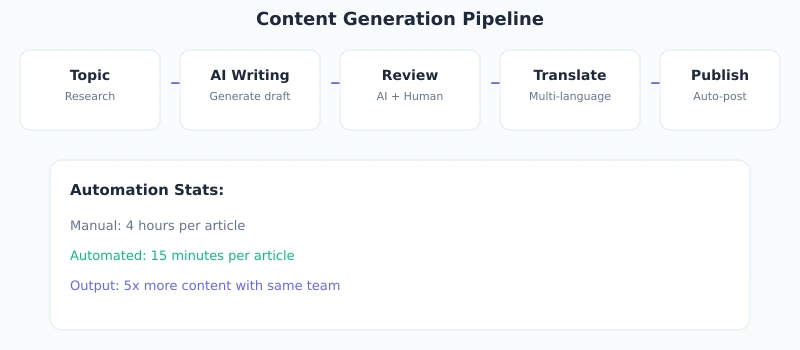
A complete content generation pipeline includes the following stages:
| Stage | Input | Output |
|---|---|---|
| Topic Planning | Keywords / Trends | Article topic list |
| Outline Generation | Article topic | Structured outline |
| Content Writing | Outline + Reference materials | Complete article |
| Quality Review | Draft | Optimized article |
| Format Adaptation | Standard article | Multi-platform formats |
Code Implementation
1. Topic Planning
from openai import OpenAI

client = OpenAI(
    base_url="https://www.ciyuano.com/v1",
    api_key=***
)

def generate_topics(keyword: str, count: int = 10) -> list:
    """Generate a list of article topics based on the keyword"""
    response = client.chat.completions.create(
        model="deepseek-v4",
        messages=[{
            "role": "user",
            "content": f"Generate {count} article titles around the topic 「{keyword}」. Requirements: eye-catching, SEO-friendly, Chinese. Return the title list directly, one per line."
        }],
        temperature=0.8
    )
    return response.choices[0].message.content.strip().split("\n")
2. Outline Generation
def generate_outline(title: str) -> str:
    """Generate an article outline based on the title"""
    response = client.chat.completions.create(
        model="deepseek-v4",
        messages=[{
            "role": "user",
            "content": f"Generate a detailed outline for the following article: 「{title}」. Requirements: include 5-7 main sections, each with 2-3 key points. Output in Markdown format."
        }],
        temperature=0.5
    )
    return response.choices[0].message.content
3. Content Writing
def write_article(title: str, outline: str) -> str:
    """Write a complete article based on the outline"""
    response = client.chat.completions.create(
        model="deepseek-v4",
        messages=[
            {
                "role": "system",
                "content": "You are a professional technical blog writer. Writing style: concise and professional, clear logic, with practical examples."
            },
            {
                "role": "user",
                "content": f"Write a complete article based on the following outline.\n\nTitle: {title}\n\nOutline: {outline}\n\nRequirements: 1500-2500 characters, Chinese, use Markdown format."
            }
        ],
        temperature=0.7,
        max_tokens=4000
    )
    return response.choices[0].message.content
4. Quality Review
def review_article(article: str) -> dict:
    """AI self-review of article quality"""
    response = client.chat.completions.create(
        model="deepseek-v4",
        messages=[{
            "role": "user",
            "content": f"Please review the following article, provide a score and improvement suggestions.\n\n{article}\n\nReturn in JSON format: {{\"score\": 1-10, \"issues\": [...], \"suggestions\": [...]}}"
        }],
        temperature=0.3
    )
    return response.choices[0].message.content
Batch Generation
Combine the above steps into a complete batch generation process:
import asyncio
import json

async def batch_generate(keyword: str, count: int = 5):
    """Batch generate articles"""
    # 1. Generate topics
    topics = generate_topics(keyword, count)

    results = []
    for topic in topics:
        # 2. Generate outline
        outline = generate_outline(topic)

        # 3. Write article
        article = write_article(topic, outline)

        # 4. Quality review
        review = review_article(article)
        score = json.loads(review).get("score", 0)

        if score >= 7:
            results.append({
                "title": topic,
                "content": article,
                "score": score
            })
            print(f"[OK] {topic} (Score: {score})")
        else:
            print(f"[SKIP] {topic} (Score: {score}, requires manual review)")

        # Control rate to avoid API throttling
        await asyncio.sleep(2)

    return results
Use Cases
Batch Generation of SEO Articles
Generate optimized articles in batches for long-tail keywords, producing 50+ high-quality pieces per day.
Automatic Product Description Generation
Product descriptions for e-commerce platforms and feature introductions for SaaS products can be auto-generated using templates + AI.
Social Media Content
Generate format-adapted content for different platforms (Weibo, Xiaohongshu, Twitter) — input once, distribute to multiple platforms.
Email Marketing
Generate personalized marketing emails based on user personas to improve open rates and conversion rates.
Quality Control Strategies
- AI self-review: Let AI score itself; content scoring below 7 requires manual review
- Deduplication check: Compare against existing content library to avoid duplication
- Fact verification: Content involving data and facts needs human verification
- SEO optimization: Check keyword density, heading structure, internal link settings
- Regular spot checks: Randomly sample 10% of content for manual quality assessment
Cost Estimation
| Stage | Token Consumption | Cost per Article |
|---|---|---|
| Topic Planning | ~500 | 0.001 yuan |
| Outline Generation | ~800 | 0.001 yuan |
| Content Writing | ~4000 | 0.006 yuan |
| Quality Review | ~2000 | 0.003 yuan |
| Total | ~7300 | Approx. 0.01 yuan/article |
Using the DeepSeek V4 model, the generation cost per article is about 0.01 yuan, and 50 articles per day costs only 0.5 yuan.
Summary
AI content automation is not about replacing human writing, but about handing over low-value, repetitive content production to AI, allowing humans to focus on creativity and strategy.
Key takeaways:
- Pipeline approach: Break down content production into multiple stages, optimize each independently
- Quality control: AI self-review + manual spot checks to ensure content quality
- Cost management: Choose the right model and control token consumption
- Continuous iteration: Continuously optimize generation strategies based on data feedback
Get started now: Register for Ciyuan Circle, get your API Key, and build your content automation pipeline.
Related Articles
AI API Relay Station's Product Design Philosophy: Simplicity is Justice
Not bothering developers is Ciyuano's most important product principle. Let's talk about how we design an API service that truly respects users' existing knowledge and code.
Product InsightsThe Secret to 10x Improvement in AI Programming Efficiency: Workflow, Not Tools
Most people use AI programming assistants as search engines, but true experts integrate them into a complete workflow.
Product InsightsAI Startup Pitfall Guide: 10 Lessons Learned the Hard Way
10 key lessons summarized from real entrepreneurial experiences, covering technology selection, team building, business model, and financing strategies.
Comments are not yet available, stay tuned