AI Resume and Cover Letter Writing Guide: Four Steps to Craft Professional Job Application Documents
Why Use AI to Write a Resume?
Many people face two major challenges when writing a resume: not knowing how to describe their experience, and not knowing how to tailor content for different positions. Templates found online are all the same, and no matter how much you tweak them, something still feels off. AI can help you organize scattered work experience into professional statements, rewrite each entry using the STAR method, and automatically match keywords based on the target job description.
This article will guide you through 4 core steps to build a professional resume and cover letter from scratch using AI. No writing experience needed – just the ability to describe your own experience.
Preparation
You need an AI conversation tool. Any of the following will work:
- ChatGPT (OpenAI): Strong comprehensive ability, generates the most natural resume language
- Claude (Anthropic): Great at detail optimization, excellent STAR method rewriting
- Tongyi Qianwen / Wenxin Yiyan: Good Chinese understanding, suitable for domestic job applications
- Ciyuano Platform: Aggregates multiple models, allows comparison of different optimization solutions
Pick any one to get started. The web version is recommended for easy saving and repeated editing.
Step 1: Organize Your Work Experience
The hardest part of writing a resume isn't the layout – it's figuring out exactly what you did. AI can help you extract key experiences through guided questions.
Steps
- Open the AI tool and enter the following prompt as an opening.
- Answer the AI's follow-up questions one by one about your work.
- The AI will extract highlights, quantify achievements, and add details you might have overlooked.
- Save the organized experience list as material for later resume writing.
Example Prompt:
I want to write a resume for a Product Manager position. Please help me organize my work experience by asking questions. I have two work experiences. Start with the first one. Ask one aspect at a time – don't ask too many questions at once.
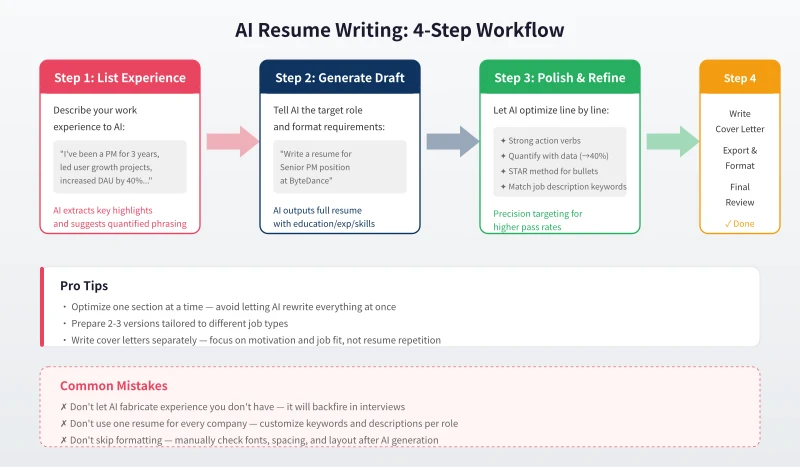
The AI will ask you questions in this order: Company and position info → Main responsibilities → Core projects → Quantified results → Tools and methods used → Team collaboration. After each answer, the AI will help you turn it into a professional statement.
Key Tips
- Use numbers: Telling AI "user growth increased a lot" is not as good as "DAU grew from 50,000 to 200,000".
- Don't be modest: AI may downplay your contributions during polishing, so clearly state your role from the start.
- Provide context: Company size, team size, project duration – this information is important for the AI.
Step 2: Generate the First Draft
With the material ready, have the AI generate a complete resume. The key here is to tell the AI the specific position you're applying for.
Steps
- Send the experience list from the previous step to the AI.
- Tell the AI the target position and company (ideally attach the job description).
- Specify the resume format: concise / detailed / creative.
- The AI will generate a full resume including personal info, education, work experience, and skills list.
Example Prompt:
Based on the experiences I just sorted out, write me a resume. The target position is Senior Product Manager at ByteDance. The job requirements are as follows: [paste JD content]. Use a concise and professional style, highlighting experiences that match the position. Keep the resume within one A4 page.
Resume Structure Suggestions
- Personal Info: Name, phone, email, LinkedIn/personal website (don't include too much irrelevant information).
- Education: School, major, degree, graduation date (fresh graduates can put this first).
- Work Experience: In reverse chronological order, 3-5 bullet points per experience.
- Skills: Only list hard skills relevant to the position.
Step 3: Optimize Each Entry with the STAR Method
The core of a resume is the work experience section. AI can use the STAR method to rewrite each entry to be more persuasive.
What is the STAR Method?
STAR is an acronym for four words:
- S (Situation): What was the background at the time?
- T (Task): What task did you need to accomplish?
- A (Action): What did you specifically do?
- R (Result): What was the final outcome?
Steps
- Send the first draft resume to the AI.
- Ask the AI to rewrite the work experience entries one by one using the STAR method.
- Key checks: Are there quantified data? Are the action verbs strong? Does it match the target position?
- Confirm each entry; ask the AI to rewrite any you're not satisfied with.
Example Prompt:
Please rewrite each work experience entry in my resume using the STAR method. Requirements: Each entry must start with a strong action verb (e.g., "led", "built", "optimized" instead of "responsible for", "participated in"), must include quantified data, and each entry should be no more than 1-2 lines.
Before and After Comparison
Before: Responsible for user growth related work, did a lot of activities.
After: Led the user growth system architecture, planned and executed 12 acquisition campaigns, added 500,000 new registered users in 6 months, reduced customer acquisition cost by 35%.
Step 4: Write the Cover Letter
The cover letter is not a repeat of your resume – it's about explaining why you're a good fit for the role. AI can generate a professional cover letter based on your resume and the target job description.
Steps
- Send the final resume and target job description to the AI.
- Tell the AI the tone: formal / semi-formal / casual.
- The AI will generate a 300-500 word cover letter.
- Review to ensure no content is repeated from the resume.
Example Prompt:
Based on my resume and this position's JD, write me a cover letter. The tone should be professional but not stiff. Highlight my fit for the role and express my understanding of the company and desire to join. Keep it under 400 words. Don't repeat content already in the resume; focus on my motivation and what I can bring to the company.
Cover Letter Structure
- Opening: State the position you're applying for and briefly introduce yourself.
- Body: 2-3 core matching points, supported by specific experiences.
- Closing: Express your desire to join and leave your contact information.
Common Questions and Notes
Can I use the AI-generated resume directly?
It's not recommended. You need to verify each entry: Are the numbers accurate? Is the experience real? Does the wording match your style? AI is for helping you polish your expression, not fabricate experience.
Can I use one resume for all companies?
No. Different companies and positions have different JD focuses. It's recommended to ask the AI to adjust keywords and experience descriptions based on each new JD before submitting. This process is quick – usually done in 5 minutes.
How do I format the resume?
The AI generates plain text content. You can use the following tools for quick formatting:
- Super Resume (wondercv.com): The most popular resume template site in China.
- Canva: Offers many free resume templates with strong design.
- LaTeX: Suitable for technical positions, most professional formatting.
- Word: The simplest – just pick a clean template.
What if I'm a fresh graduate with no work experience?
AI can help you mine the following content: internships, course projects, graduation projects, club activities, competition experiences, self-study projects. Provide these to the AI, and it will present them in a professional way.
How to handle an English resume?
First write the resume in Chinese, then have the AI translate it into English. Note: English resume writing conventions differ from Chinese; the AI will adjust sentence structures and word choices. You can ask the AI to provide both US and UK versions.
Final Advice
AI is a powerful assistant for resume writing, but what ultimately impresses interviewers is your real experience and ability. Spending time polishing your resume is worthwhile – it's the first impression you make on future employers. Use AI to boost efficiency, but don't use it to cover up shortcomings. The real you, combined with professional expression, is the strongest combination.
Related Articles
AI Speech to Text: Beginner's Guide to Convert Voice to Text in 3 Steps
Learn how to convert speech to text using AI tools. Perfect for meeting notes, content creation, and video subtitles. Three practical scenarios with step-by-step instructions.
TutorialsAI Local Deployment Guide: Run Large Models in 3 Steps for Free
Learn how to deploy AI models locally in just 3 steps. No coding experience needed, completely free, and your data stays private on your own computer.
TutorialsAI Shopping Decision Guide: From Price Comparison to Avoiding Pitfalls
Learn how to use AI for shopping decisions. From price comparison to avoiding pitfalls - make smarter purchasing choices with AI assistance.
Comments are not yet available, stay tuned