Practical Guide to AI Fitness and Workout Plan Assistant: Training Plans, Diet Pairing, and Habit Building All in One
Why Use AI for a Fitness Plan?
Many people fail to stick with exercise not because they're lazy, but because their plan is unreasonable. Training plans found online are often generic and don't fit your body condition or schedule. AI can tailor a scientific training program based on your specific details—height, weight, fitness level, available time, and goals.
This article will teach you how to use AI to create and follow a fitness plan through 5 core scenarios. No fitness knowledge required—just tell AI about yourself.
Preparation
You'll need an AI conversation tool. Any of the following will work:
- ChatGPT (OpenAI): Strong overall capabilities, handles complex training planning
- Claude (Anthropic): Excellent at detailed arrangements, often generates more scientific plans
- Tongyi Qianwen / Wenxin Yiyan: Good Chinese understanding, suitable for domestic fitness environments
- Ciyuano Platform: Aggregates multiple models, allows comparison of different plans
Pick any one to get started. The web version is recommended for easy saving and repeated reference.
Scenario 1: Let AI Create a Personal Training Plan
This is the core use case. Tell AI your body data and fitness goals, and it will generate a detailed training plan.
Steps
- Open the AI tool and describe your situation in the input box
- Provide key information: height/weight, fitness level, available time, fitness goals
- AI will generate a complete training plan in seconds
- Review the plan and tell AI what adjustments you need
Example prompt:
Help me create a fat loss training plan. My details: male, height 175cm, weight 80kg, basically no prior exercise experience, can spare 40 minutes daily for workouts, have a pair of dumbbells and a yoga mat at home. Goal: lose 10 jin (5 kg) in 3 months. Please arrange by week, listing specific exercises, sets, and rest times for each day.
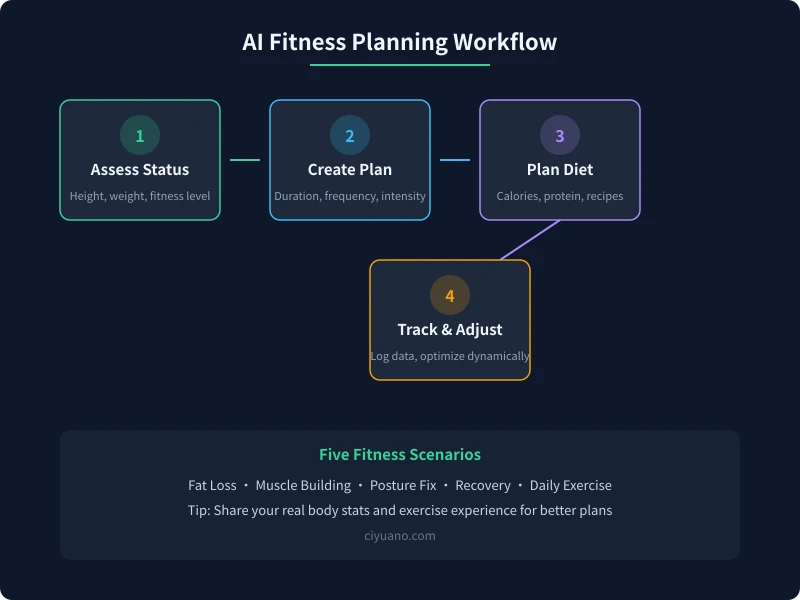
AI-generated plans typically include: weekly training and rest day schedule, specific exercises and sets per day, key tips for each movement, and warm-up/stretching recommendations.
Advanced Tips
- If the intensity feels too high, tell AI "I'm a complete beginner, please lower the intensity"
- If you only have time on weekends, say "I can only work out on Saturdays and Sundays, please arrange concentrated weekend training"
- Have old injuries or physical limitations? Definitely tell AI, and it will avoid risky movements
Scenario 2: Let AI Plan Your Fitness Diet
"Three parts exercise, seven parts diet"—nutrition plays a decisive role in fitness. AI can create a scientific diet plan based on your training goals and food preferences.
Steps
- Tell AI your fitness goal (fat loss / muscle gain / maintenance)
- Provide diet information: daily eating habits, food preferences, allergies/restrictions
- AI will calculate daily calorie and protein needs and give specific meal plans
- Ask AI to structure meals as "breakfast + lunch + dinner + snacks"
Example prompt:
I'm in a fat loss phase, training 40 minutes daily. Please create a one-day meal plan for me. I have breakfast around 8am, lunch at 12pm, and dinner at 6pm. I don't like fish, and I'm not allergic to milk. Please give specific dishes with approximate portions, plus calorie and protein content per meal.
Key Diet Points
- Fat loss phase: Create a calorie deficit (reduce 300-500 kcal per day), ensure protein intake
- Muscle gain phase: Calorie surplus (add 200-300 kcal per day), protein at 1.6-2g per kg of body weight
- Maintenance phase: Calorie balance, balanced intake of three macronutrients
Scenario 3: Let AI Correct Exercise Form
Incorrect form not only reduces effectiveness but also increases injury risk. AI can teach you the proper posture and common mistakes for each movement.
Steps
- Tell AI which exercise you're doing
- Ask AI to describe the correct form in detail: foot position, knee direction, back angle, breathing rhythm
- Have AI list the 3-5 most common mistakes for that movement
- Ask AI to recommend alternative exercises (if a movement feels uncomfortable)
Example prompt:
Please teach me the correct squat form in detail. I'm a beginner, and when I squat my knees cave in and my lower back rounds. Please tell me: 1) Proper stance width and toe angle; 2) Movement path of knees and hips during the descent; 3) How to avoid knee caving; 4) Breathing rhythm. Also, if I can't squat properly, are there safer alternatives?
Scenario 4: Let AI Help You Build an Exercise Habit
The hardest part of fitness isn't starting—it's sticking with it. AI can help you design a habit-building plan.
Steps
- Tell AI your current daily routine and available time
- Let AI find the best time slots for exercise
- AI will design a progressive plan: from 2 sessions per week gradually up to 4-5 sessions
- Ask AI for workout tracking and motivation methods
Example prompt:
I'm an office worker. On workdays I leave home at 8am and return at 7pm. I've tried to exercise many times before but never stuck with it. Please design a habit-building plan for me: 1) Suitable exercise time slots; 2) Start with the easiest intensity and increase gradually each week; 3) How to overcome the urge to skip workouts; 4) Suggestions for workout check-ins.
Key Points for Habit Building
- Lower the starting threshold: At first, only require yourself to "put on workout clothes," not to complete a full session
- Fixed time: Exercise at the same time every day to create a conditioned response
- Track progress: Use AI to create a training log; seeing progress fuels motivation
- Moderate rewards: Give yourself a small reward after each week's goal is met
Scenario 5: Let AI Handle Training Issues
During training, you'll inevitably encounter problems: muscle soreness, weight plateaus, training stagnation. AI can help analyze the causes and provide solutions.
Steps
- Describe the specific problem you're facing
- Provide relevant details: how long you've been training, diet, sleep quality
- AI will analyze possible causes and give adjustment suggestions
- If the problem persists, AI will recommend consulting a professional
Example prompt:
I've been following the plan for a month. I lost 2kg in the first two weeks, but my weight hasn't changed at all in the last two weeks. Training and diet haven't changed. What's the reason? What should I adjust? Also, the outer part of my thighs has been especially sore after workouts for the last 3 days. Is that normal?
5 Tips to Make Your AI Fitness Plan More Effective
1. Provide Honest Body Data
Don't sugarcoat your numbers. Tell AI your true weight and real fitness level. If your BMI is high, say so—AI won't judge you, but it will give a more accurate plan.
2. Plan in Phases
Don't ask AI to create a full 3-month detailed plan at once. Start with a 4-week plan, then adjust based on results. Your body changes, so your plan should change too.
3. Keep Detailed Training Records
After each session, tell AI how it went: which exercises were easy, which were hard, any discomfort. AI will use your feedback to adjust the next week's plan.
4. Use AI as a Coach, Not a Doctor
AI can create plans and answer questions, but it cannot replace a professional physician. If you experience persistent pain, joint discomfort, dizziness, or palpitations during training, stop immediately and see a doctor.
5. Stay Flexible in Practice
AI's plan is ideal. If you're too tired from overtime, lower the intensity. If you're traveling without equipment, ask AI for a bodyweight routine. Being flexible is better than quitting altogether.
FAQ
Are AI-generated fitness plans reliable?
For everyday fitness needs of ordinary people, AI plans are scientific and workable. They're based on exercise science principles and are more personalized than random plans found online. However, if you have special medical conditions (e.g., heart disease, severe obesity, post-surgery recovery), consult a doctor first.
Can I rely solely on AI without a personal trainer?
For beginner-level fitness goals (fat loss, general conditioning), AI is sufficient. But if you're aiming for competitive performance or have complex physical issues, consider working with an in-person trainer. AI can serve as a supplement to a trainer.
Should I buy supplements recommended by AI?
In most cases, no. A regular diet can meet most people's nutritional needs. Supplements like protein powder or creatine recommended by AI are "icing on the cake," not necessities. Get your diet right first, then consider supplements.
How long until I see results?
Generally, you can expect improved fitness after 4-6 weeks of consistent training, and noticeable body changes after 8-12 weeks. But everyone's baseline is different—don't compare yourself to others, focus on your own progress.
Related Articles
AI Speech to Text: Beginner's Guide to Convert Voice to Text in 3 Steps
Learn how to convert speech to text using AI tools. Perfect for meeting notes, content creation, and video subtitles. Three practical scenarios with step-by-step instructions.
TutorialsAI Local Deployment Guide: Run Large Models in 3 Steps for Free
Learn how to deploy AI models locally in just 3 steps. No coding experience needed, completely free, and your data stays private on your own computer.
TutorialsAI Shopping Decision Guide: From Price Comparison to Avoiding Pitfalls
Learn how to use AI for shopping decisions. From price comparison to avoiding pitfalls - make smarter purchasing choices with AI assistance.
Comments are not yet available, stay tuned