AI Legal Assistant Guide: Contract Review, Rights Protection & Document Drafting Made Easy
Can't understand the clauses in your lease? Being mistreated at work but don't know how to fight back? Want to write a demand letter but have no idea how to word it? Hiring a lawyer is expensive, and most people don't know the law — this is the reality for many ordinary people. While AI can't replace a lawyer, it can help you understand contracts, research relevant laws, and draft legal documents, so you're no longer completely lost when facing legal issues. This guide covers three practical scenarios to turn AI into your personal legal advisor.
Three Core Scenarios
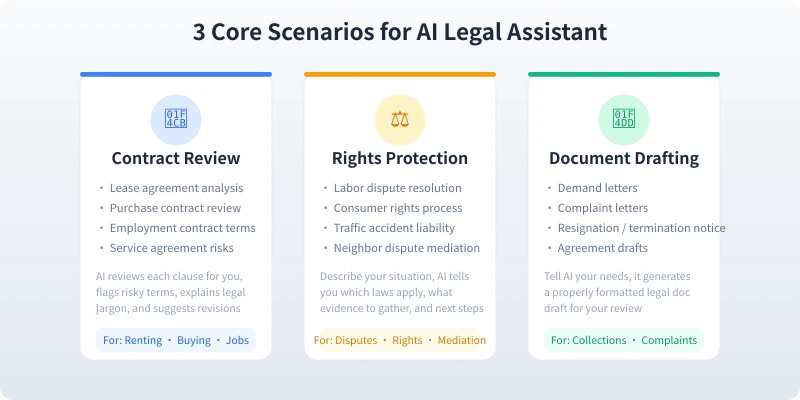
Before we begin, here are the three most practical ways AI can help with legal matters:
- Contract Review: Leases, job offers, purchase agreements — AI reviews each clause and flags potential risks
- Rights Protection: Labor disputes, consumer complaints, neighbor conflicts — AI tells you what rights you have and what steps to take
- Document Drafting: Demand letters, complaint letters, termination notices — AI writes a proper first draft for you
Scenario 1: Contract Review — Let AI Check Before You Sign
Why Review Contracts?
Many people "skim and sign" contracts, only to discover later that they got the short end of the stick. Common pitfalls include:
- Unequal penalty clauses — you pay a fortune for breach, the other party pays nothing
- Verbal promises not in writing — the agent said "we'll handle repairs," but the contract doesn't mention it
- Hidden auto-renewal clauses — you thought the lease ended, but it auto-renewed for another year
- Vague liability terms — when something goes wrong, both sides point fingers
Step-by-Step Guide
Step 1: Share the Contract with AI
Open any AI chat tool (ChatGPT, Claude, Gemini, etc.) and type:
I'm about to sign a lease agreement. Please review each clause and point out any potential risks or areas I should negotiate.
Contract terms:
1. Lease period: July 1, 2026 to June 30, 2027
2. Monthly rent: $1,500, first month + two months deposit
3. Tenant early termination: two months rent as penalty
4. Landlord early termination: 30 days notice, no penalty
5. All facility repairs are tenant's responsibility
6. No notice of non-renewal 30 days before expiry = auto-renewal for one year
AI will return a clause-by-clause analysis, such as:
- Terms 3 and 4 are unequal: You pay two months for early exit, but the landlord owes nothing — negotiate for equal terms
- Term 5 is too broad: Normal wear and tear should be the landlord's responsibility — change to "damage caused by tenant"
- Term 6 auto-renewal: One year is too long — suggest one month or remove auto-renewal entirely
Step 2: Ask Follow-Up Questions
If you don't understand a specific clause, just ask:
Regarding term 5 "all facility repairs are tenant's responsibility" — if the water heater breaks from normal aging, is that still my responsibility? What does the law say?
AI will explain that under most jurisdictions, landlords are responsible for maintenance of major systems unless otherwise agreed, and suggest making the clause more specific.
Step 3: Draft Modification Suggestions
Please draft a formal list of contract modification suggestions I can send to my landlord or agent, covering all the issues we discussed.
Scenario 2: Rights Protection — Know Your Rights Before Acting
Common Situations That Need Rights Protection
You'd be surprised how often you need to know your legal rights:
- Labor disputes: No written contract, unpaid wages, wrongful termination, missing benefits
- Consumer protection: Counterfeit goods, refused refunds, prepaid card businesses closing
- Traffic accidents: Other party at fault but refusing to cooperate with insurance
- Neighbor disputes: Leaking ceilings, excessive noise, shared space violations
Step-by-Step Guide
Step 1: Describe Your Situation
I've been working at a company for 8 months. They never gave me a written contract and never paid into my social insurance. Now they want to fire me and are only offering one extra month's pay. What are my rights? What compensation can I claim?
AI will analyze your situation and tell you:
- No written contract: You may be entitled to additional pay for the months without a contract
- No social insurance: You can demand the company pay back the missing contributions, or use this as grounds to resign with severance
- Wrongful termination: If there was no legal cause for dismissal, you may be entitled to double severance
Step 2: Understand the Process
If I want to file a labor arbitration claim, what's the exact process? What documents do I need? How long will it take?
AI will give you a clear roadmap:
- Gather evidence (pay stubs, attendance records, work communications)
- File an arbitration application at your local labor arbitration board
- The board decides within 5 days whether to accept the case
- A decision is issued within 45 days (may extend to 60 for complex cases)
- If you disagree, you can appeal to court within 15 days
Step 3: Prepare an Evidence Checklist
Please list all the evidence I need to prepare for a labor arbitration case. What if I can't access some of the documents?
Scenario 3: Document Drafting — Let AI Write the First Draft
Common Legal Documents
Everyday life often requires formal documents that most people don't know how to format:
- Demand letters: Formally requesting someone repay money they owe you
- Complaint letters: Filing complaints with consumer protection agencies
- Termination notices: Formally notifying the other party that you're ending a contract
- Resignation letters: Submitting a proper written notice of resignation
Step-by-Step Guide
Step 1: Tell AI What You Need
A friend borrowed $5,000 from me last year and agreed to repay by March this year. It's now past the deadline and they're not responding to calls or messages. Please write a formal demand letter requiring repayment within 15 days, stating that I will pursue legal action if they don't comply.
Step 2: AI Generates the Draft
AI will produce a properly formatted demand letter including:
- Header with sender and recipient information
- Factual description of the loan (amount, date, agreed repayment date)
- Specific payment demand and deadline
- Legal consequences notice
- Formal language and signature block
Step 3: Review, Fill in Details, and Use
Review the AI-generated content, fill in specific names, dates, and amounts. For significant amounts, have a lawyer review it before sending.
Please also draft a labor arbitration application for me based on the information I shared earlier (8 months, no contract, no insurance, fired). My claims should include back pay for the unsigned contract period and compensation for wrongful termination.
Complete Workflow
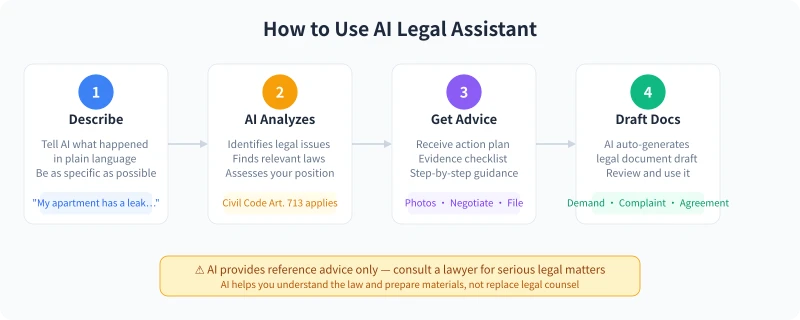
Here's a universal 4-step workflow that works for any legal scenario:
- Describe Your Situation: Tell AI what happened in plain language — the more specific, the better
- AI Analyzes: AI identifies the legal issues, finds relevant laws, and assesses your position
- Get Advice: Receive an action plan, evidence checklist, and step-by-step guidance
- Draft Documents: Have AI generate a legal document first draft — review it and use it
Pro Tips
Be Specific
Don't ask "my company is mistreating me, what do I do?" — instead, explain exactly what happened: how long you've worked there, whether you have a contract, your salary, what the company did. The more specific your information, the more accurate AI's advice will be.
Ask One Thing at a Time
Don't dump all your questions into one message. First ask "what are my rights," then "how do I fight for them," then "help me write the document." One step at a time gives you more organized answers.
Follow Up
If AI's response contains legal jargon you don't understand, just ask: "explain that in plain English" or "give me an example."
AI Is Not a Lawyer
AI can help you understand the law, prepare materials, and draft documents, but it can't replace a lawyer. For large amounts (over $2,000), complex cases, criminal matters, or situations requiring court appearances — always consult a real attorney. Think of AI as your "legal orientation guide," not your "legal representative."
Important Disclaimer
⚠️ Limitations of AI Legal Advice
AI provides reference suggestions based on publicly available legal knowledge and does not constitute formal legal advice. AI may not be aware of the latest judicial interpretations or local regulations, and may not accurately assess the specifics of your case. Always consult a professional lawyer when:
• The amount in dispute exceeds $2,000
• There is potential criminal liability
• You need to appear in court
• Real estate, equity, or major assets are involved
• Personal safety is at immediate risk
Summary
The core value of an AI legal assistant isn't replacing lawyers — it's helping you become "legally literate." Before signing a contract, AI helps you review it. When you face a problem, AI helps you understand your rights. When you need a document, AI drafts it for you. These tasks used to require either grinding through legal texts yourself or paying a lawyer. Now AI handles 80% of the prep work.
Remember one rule: small matters ask AI, big matters hire a lawyer. AI keeps you from being clueless about legal issues, but the final professional judgment should always be left to qualified experts.
Related Articles
AI Speech to Text: Beginner's Guide to Convert Voice to Text in 3 Steps
Learn how to convert speech to text using AI tools. Perfect for meeting notes, content creation, and video subtitles. Three practical scenarios with step-by-step instructions.
TutorialsAI Local Deployment Guide: Run Large Models in 3 Steps for Free
Learn how to deploy AI models locally in just 3 steps. No coding experience needed, completely free, and your data stays private on your own computer.
TutorialsAI Shopping Decision Guide: From Price Comparison to Avoiding Pitfalls
Learn how to use AI for shopping decisions. From price comparison to avoiding pitfalls - make smarter purchasing choices with AI assistance.
Comments are not yet available, stay tuned