AI Sleep Management Assistant: Track Sleep, Improve Routine, and Boost Sleep Quality
Do you really understand your own sleep?
Many people think "poor sleep" simply means going to bed late or having insomnia, but sleep issues go far beyond that. Difficulty falling asleep, waking up frequently during the night, waking up early and being unable to fall back asleep, feeling exhausted even after sleeping for a long time... You may have experienced all these problems without knowing the root cause.
The good news is that AI tools can help you systematically track, analyze, and improve your sleep. You don't need expensive smart bands or complex medical equipment—just a phone and a few handy AI tools.
Step 1: Build a Sleep Diary with AI
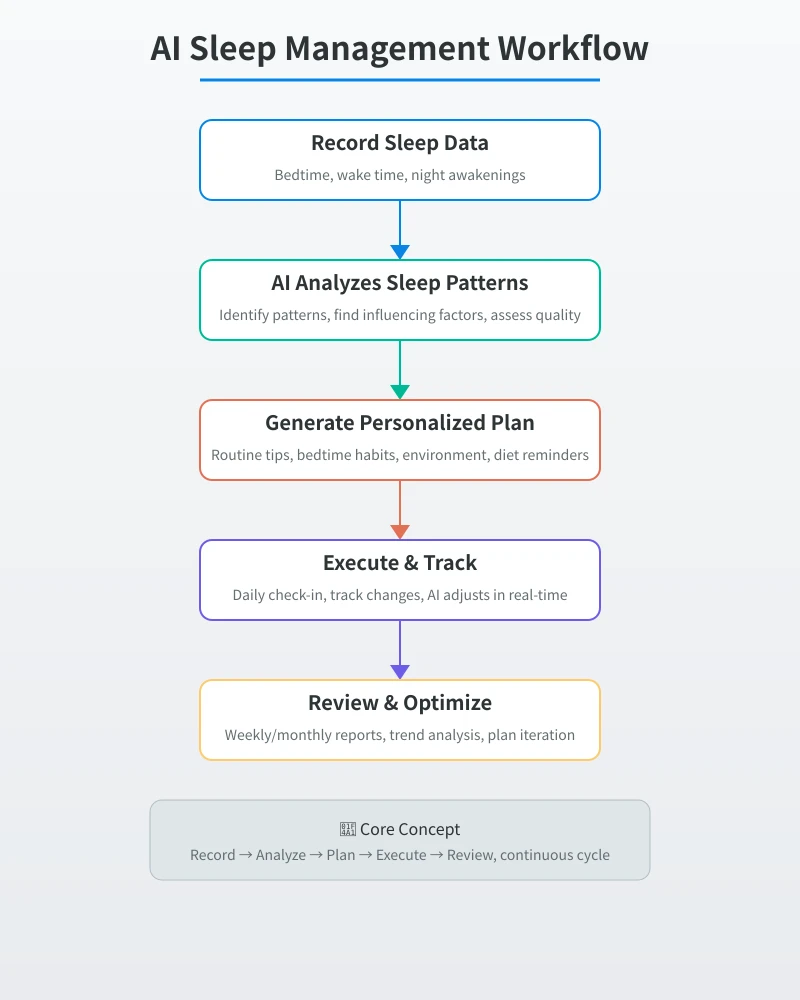
The first step to improving sleep is understanding your current situation. You need to record daily sleep data so that AI can analyze it for you.
What to record
- Bedtime: roughly what time you go to bed and fall asleep
- Wake-up time: naturally or by alarm
- Night awakenings: how many times and roughly how long each time
- Sleep quality: how you feel in the morning, whether you feel sleepy during the day
- Daytime activities: exercise, caffeine, naps, stressful events, etc.
Using ChatGPT as a sleep diary
Open ChatGPT and enter the following prompt:
You are a sleep management expert. Please ask me the following questions every evening to help me record a sleep diary: 1. What time did you go to bed today? 2. How long did it take you to fall asleep? 3. Did you wake up during the night? How many times? 4. What time did you wake up? Naturally or by alarm? 5. Did you have any coffee/tea/alcohol today? What time? 6. Did you exercise today? What time? 7. Was today stressful? Any particular anxiety? After asking, please give me a brief sleep suggestion based on my answers.
Spend 2 minutes each night before bed answering these questions. After a week, you'll have a complete set of sleep data.
Step 2: Let AI Analyze Your Sleep Patterns
After recording a week's data, hand all records over to AI for analysis. You need to pay attention to the following dimensions:
Sleep efficiency
Sleep efficiency = actual sleep time ÷ total time in bed × 100%. Generally:
- Above 85%: Good sleep efficiency
- 75%-85%: Room for improvement
- Below 75%: Needs attention
Factor analysis
Let AI help you identify key factors affecting sleep. You can ask like this:
Here is my sleep record for this week (paste record). Please analyze: 1. What is my average sleep duration and bedtime? 2. Which days did I sleep well and which days poorly? Any patterns? 3. How are factors like caffeine, exercise, and stress related to my sleep quality? 4. Please give me a brief sleep quality score (1-10).
AI will give specific analysis based on your data, such as "On days you drank coffee, you took an average of 20 minutes longer to fall asleep" or "On Wednesday when stress was high, you woke up significantly more often during the night."
Step 3: Create a Personalized Improvement Plan
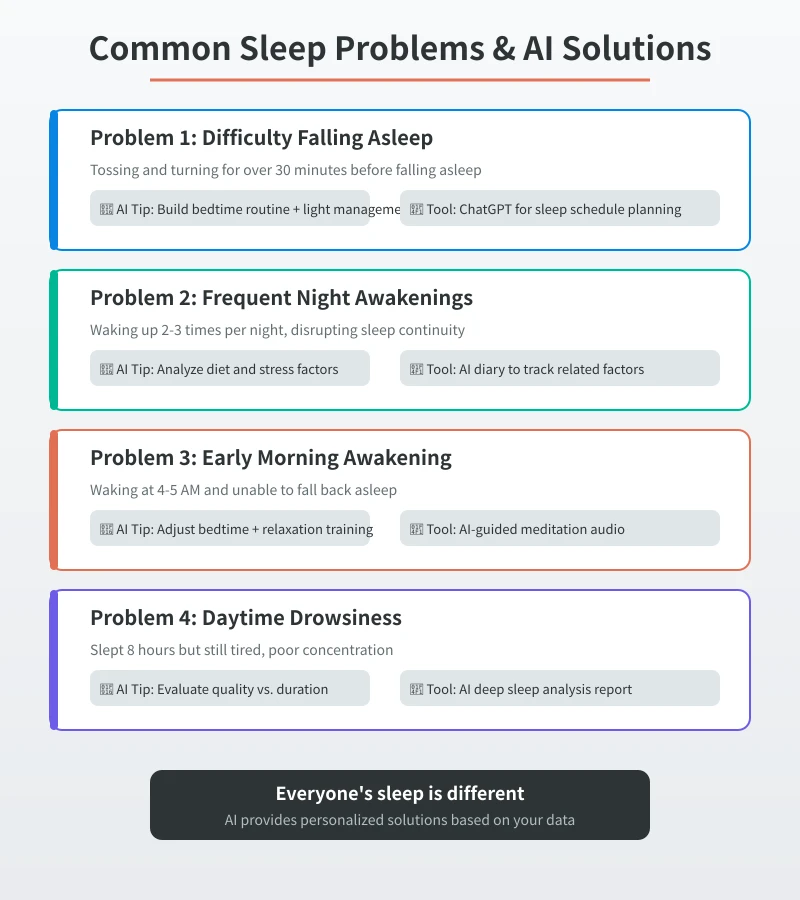
With the analysis results, AI can tailor an improvement plan for you. Here are a few common scenarios:
Scenario 1: Difficulty falling asleep
If you often lie in bed for more than 30 minutes before falling asleep, let AI help you create a bedtime routine:
- Light management: Reduce blue light exposure 2 hours before bed, AI will remind you what time to turn off your phone
- Relaxation activities: AI recommends relaxation methods suitable for you—deep breathing, meditation, soft music
- Environment optimization: Adjust room temperature (18-22°C optimal), block light, use white noise
Scenario 2: Frequent nighttime awakenings
Nighttime awakenings are usually related to the following factors:
- Diet: Eating too much or too late for dinner, or consuming caffeinated drinks
- Stress: Anxiety leads to increased light sleep
- Environment: noise, light, temperature changes
Let AI identify the specific causes based on your diary and give targeted suggestions.
Scenario 3: Waking up early and unable to fall back asleep
Waking up at 4-5 AM is a common problem. AI usually suggests:
- Delay bedtime by 30 minutes, adjust gradually
- Don't check the time or look at your phone when you wake up
- Try "paradoxical intention"—tell yourself "I don't want to sleep," which actually makes it easier to relax and fall asleep
Step 4: Use AI Tools for Daily Management
Besides ChatGPT, there are many AI tools that can help you manage sleep:
Recommended tools list
- Apple Health / Google Fit: Automatically record sleep data (if you have a smartwatch)
- AutoSleep (iOS): Deep sleep analysis based on Apple Watch
- Sleep Cycle: Analyzes sleep stages via phone microphone, wakes you at the optimal time
- Calm / Headspace: AI-recommended meditation and sleep aid audio
- ChatGPT: Ask sleep questions anytime for personalized advice
Set up bedtime reminders
Let AI set up daily reminders for you:
Please set the following bedtime reminders for me: - 8 PM: Stop drinking coffee and tea - 9 PM: Turn off bright lights, use warm-colored lighting - 9:30 PM: Start bedtime relaxation (deep breathing for 5 minutes) - 10 PM: Go to bed and answer sleep diary questions - 7 AM: Wake up and record sleep quality
Step 5: Periodic Review and Continuous Optimization
Sleep improvement doesn't happen overnight; it requires continuous tracking and adjustment. Spend 10 minutes each week letting AI do a review:
Weekly review template
Here is my sleep record for this week. Please make a weekly sleep report including: 1. Average sleep duration, bedtime, and number of awakenings this week 2. What changes compared to last week? 3. Which suggestions were effective, which need adjustment? 4. What is the focus for improvement next week?
Monthly trend analysis
After a month, let AI do a comprehensive trend analysis. You'll discover many patterns you hadn't noticed, such as:
- Weekend sleep quality is significantly better than weekdays
- Falling asleep faster on nights after exercise
- Wednesday and Thursday are the most likely days for insomnia
Notes
Although AI is a great sleep management assistant, there are a few things to note:
- AI is not a doctor: If you have severe chronic insomnia (over 3 months), please see a doctor promptly
- Don't overthink: Occasional poor sleep is normal; don't become more anxious because of bad data
- Data is just a reference: The focus is on how you feel, not the numbers
- Give yourself time: Changing sleep habits usually takes 2-4 weeks to see results
Good sleep is the foundation of health. Use AI as your sleep assistant, and start recording your first sleep diary tonight.
Related Articles
AI Speech to Text: Beginner's Guide to Convert Voice to Text in 3 Steps
Learn how to convert speech to text using AI tools. Perfect for meeting notes, content creation, and video subtitles. Three practical scenarios with step-by-step instructions.
TutorialsAI Local Deployment Guide: Run Large Models in 3 Steps for Free
Learn how to deploy AI models locally in just 3 steps. No coding experience needed, completely free, and your data stays private on your own computer.
TutorialsAI Shopping Decision Guide: From Price Comparison to Avoiding Pitfalls
Learn how to use AI for shopping decisions. From price comparison to avoiding pitfalls - make smarter purchasing choices with AI assistance.
Comments are not yet available, stay tuned