A Practical Guide to AI English Learning Assistants: Master Speaking, Reading, Writing, and Vocabulary in Four Steps
Why Use AI to Learn English?
Many people face the same pain points when learning English: they've bought countless courses and memorized endless vocabulary lists, but freeze up when speaking, get drowsy reading articles, and run out of words when writing. The problem isn't your effort—it's that traditional methods lack a key element: immediate feedback.
AI is exactly what can fill this gap. It can chat with you anytime, help correct your writing, provide sentence-by-sentence translations of articles, and even customize vocabulary lists based on your level. Best of all, it never thinks you're stupid, never gets impatient, and is available 24/7.
This article will teach you how to turn AI into your personal English tutor in four steps.
What You Need to Prepare
- An AI tool: ChatGPT (recommended, with voice features), DeepSeek (great value), or Doubao (Chinese-friendly) all work
- 30 minutes a day: You don't need more—the key is consistency
- A notebook: To record corrections AI gives you and new expressions you learn
No need to buy textbooks, download apps, or sign up for classes. Just AI and a genuine desire to improve are enough.
Step 1: Speaking & Conversation Practice
Speaking is the biggest pain point for Chinese students. We've studied English for over a decade but rarely get the chance to actually speak. AI can act as your conversation partner, ready to practice with you anytime.
How to Get Started
Open ChatGPT (voice mode recommended—tap the microphone icon on the mobile app) and say:
"I want to practice English conversation. Can you be my conversation partner? My level is intermediate. Please correct my mistakes and suggest more natural expressions."
Role-Play Scenarios
Don't just chat aimlessly—setting a specific scenario works much better. Try these:
- Ordering at a restaurant: "Let's role-play. You are a waiter at a restaurant, and I'm ordering food."
- Asking for directions at an airport: "Pretend you are an airport staff. I need help finding my gate."
- Job interview: "Act as an interviewer. I'm applying for a marketing position."
- Casual small talk: "Let's chat about weekend plans. Please correct my grammar."
Key Tips
- Don't be afraid to make mistakes: AI is there to help correct you—the more you mess up, the more it can help
- Ask for slow repetition: If you don't understand, say "Can you say that again slowly?"
- Note down corrections: Every time AI corrects your expression, write it in your notebook and review it regularly
- One scenario per day: Don't overdo it—practice one scenario daily until you're fluent, then move on
Advanced: Shadowing & Imitation
Ask AI to give you a short English dialogue. Listen (or read) it first, then try to repeat it. AI will compare your version with the original and point out differences in pronunciation and word choice:
"Please give me a short English dialogue about ordering coffee. I'll try to repeat it, and you tell me where I can improve."
Step 2: Reading Comprehension Practice
Reading is the best way to expand vocabulary and understand grammar. But many people either look up every word in a dictionary (too tiring) or skim superficially (ineffective). AI can help you find the balance.
Choose the Right Article
Ask AI to recommend articles based on your level:
"My English level is intermediate (CET-4). Please recommend 3 interesting English articles for me to read today. The topics should be about technology or daily life."
AI will recommend articles suited to your level and explain why it chose them.
Paragraph-by-Paragraph Intensive Reading
Once you have an article, use this method for deep reading:
Step 1: Read Through Once
Don't look up words in a dictionary. Just grasp the general meaning. Guess unfamiliar words—it's okay if you can't.
Step 2: Have AI Translate Paragraph by Paragraph
Send the article to AI and say:
"Please translate this article paragraph by paragraph. For each paragraph, also explain any idioms or difficult phrases."
AI will translate each paragraph and explain idioms and tough words.
Step 3: Mark New Vocabulary
Ask AI to list key vocabulary:
"Please list the important vocabulary from this article. For each word, give me the pronunciation, meaning in Chinese, and an example sentence."
Step 4: Answer Questions
Have AI ask questions based on the article to test your understanding:
"Based on this article, ask me 5 comprehension questions. I'll answer them, and you tell me if I'm right."
Recommended Reading Materials
- BBC Learning English: Suitable for intermediate level, topics close to daily life
- VOA Learning English: Slower pace, good for beginner-intermediate
- The Economist: Suitable for advanced level, top pick for business English
- Reddit / Hacker News: Great for learners interested in technology
You can copy any English web page content to AI and have it analyze and explain.
Step 3: Writing Correction Practice
Writing is the best way to test your English level. Many people don't know if their writing is correct—AI can instantly become your English teacher.
Basic: Sentence Correction
Send your English sentence to AI:
"Please check this sentence for grammar errors and suggest improvements: 'I very like English because it is very useful for my job.'"
AI will tell you:
- Error: "very like" should be "like ... very much"
- Improvement: "I like English very much because it's very useful for my job."
- More natural: "I really enjoy English because it's essential for my career."
Intermediate: Paragraph Correction
Write a short English paragraph of 100–200 words on any topic (diary, book review, work email—anything works), then send it to AI:
"Please review my writing. Check for:
1. Grammar errors
2. Unnatural expressions
3. Vocabulary suggestions
4. Overall structure feedback
Please explain each correction in Chinese."
Advanced: Mock Exam Essays
If you're preparing for CET-4/6, IELTS, or TOEFL, ask AI to simulate scoring:
"This is my IELTS Writing Task 2 response. Please score it according to IELTS criteria (Task Response, Coherence, Lexical Resource, Grammar) and give me specific suggestions to improve."
AI will score you on each official criterion and tell you how to improve.
Writing Practice Tips
- Write a little every day: No need for long essays—3–5 sentences a day is fine
- Write first, then correct: Don't look up words while writing; finish first, then let AI fix it
- Compare and learn: Ask AI for a "perfect version" and compare yours with it
- Collect good sentences: Write down natural expressions AI suggests into your notebook
Step 4: Vocabulary Memorization Practice
Memorizing words is unavoidable, but the traditional "abandon, abandon, abandon" chanting is too inefficient. AI can help you remember words in smarter ways.
Generate Personalized Word Lists
Tell AI your needs and have it organize a list:
"I'm preparing for CET-6. Please give me 20 high-frequency vocabulary words that I must know. For each word, provide:
1. Phonetic transcription
2. Chinese meaning
3. A memorable example sentence
4. A mnemonic tip"
AI will give you a list with pronunciations, meanings, example sentences, and memory tricks—more thoughtful than any vocabulary book.
Context-Based Memorization
Don't memorize words in isolation—have AI put them into a scenario:
"Please create a short story using these 10 words: ambitious, collaborate, deadline, efficient, innovative, negotiate, obstacle, strategy, thrive, volatile. Highlight the words in bold."
Reading a short story helps you remember 10 words—far better than rote memorization.
Spaced Repetition Reminders
Ask AI to create a review plan:
"I learned these 20 words yesterday. Please test me on them now. Give me the Chinese meaning, and I'll try to spell the English word."
AI will quiz you to review, and give hints when you get it wrong.
Tool Selection: Which AI Is Best for Learning English?
Different AI tools have different strengths. Choose based on your needs:
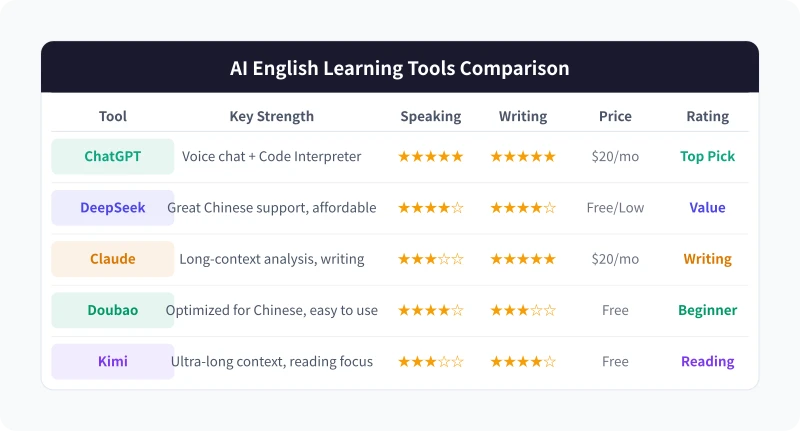
ChatGPT (Top Recommendation)
ChatGPT's voice mode is a killer feature for learning English. You can talk to it directly using voice, and it will correct your pronunciation and grammar. With the Code Interpreter feature, it can also generate word lists, create practice exercises, and even analyze your learning data.
Best for: Speaking practice, comprehensive learning, users who need voice capabilities
DeepSeek (Best Value)
DeepSeek has strong Chinese comprehension, especially suitable for learners who need explanations in Chinese. It's affordable and great for extensive conversation practice.
Best for: Users on a budget, those needing Chinese explanations, text-based communication lovers
Claude (Writing Correction Expert)
Claude's language expression ability is excellent, even surpassing ChatGPT in writing correction. It offers more detailed revision suggestions to help improve your writing quality.
Best for: Writing practice, essay correction, users who need detailed feedback
Doubao / Kimi (Free Domestic Options)
If you don't want to spend money, Doubao and Kimi are good free choices. Their Chinese interface is user-friendly and easy to get started with.
Best for: Beginners trying it out, everyday simple conversations, users who don't want to pay
Create Your Learning Plan
Here is a sample plan you can adjust based on your schedule:
Daily Plan (30 minutes)
- 5 minutes: Vocabulary review—let AI test you on yesterday's words
- 10 minutes: Speaking practice—set a scenario and chat with AI
- 10 minutes: Reading comprehension—read an English passage and have AI explain sentence by sentence
- 5 minutes: Writing practice—write 3–5 sentences and have AI correct them
Weekly Plan
- Monday to Friday: Follow the daily plan
- Saturday: Write a 200-word short essay and have AI do a detailed correction
- Sunday: Review all new vocabulary and corrected mistakes from the week
Monthly Goals
- Master 200 new words (about 7 per day)
- Complete 20 speaking conversation practices
- Intensively read 8 English articles
- Write 4 complete short essays
Frequently Asked Questions
Are AI corrections accurate?
Mainstream AI (ChatGPT, Claude, DeepSeek) has high accuracy in grammar correction, but occasional errors do occur. Suggestions:
- For important expressions (e.g., exam essays), cross-verify with two different AIs
- For AI-suggested "more natural" expressions, do a quick web search to confirm they're commonly used
- When in doubt, ask AI: "Are you sure about this correction?"
Should I talk to AI in Chinese or English?
Switch based on your practice goals:
- For speaking and writing practice: Use English to force yourself to think in English
- For understanding grammar and vocabulary: Ask in Chinese to ensure you truly understand
- Mixed mode: First clarify in Chinese, then practice in English
What if I can't stick with it?
This is the most common problem. A few tips:
- Lower the bar: Even 5 minutes of practice is better than none
- Habit stacking: For example, chat with AI on your commute every day
- Track progress: Compare your writing each week—seeing improvement boosts motivation
- Find enjoyment: Practice topics you're interested in; don't force yourself through boring content
Access Multiple Models via the Ciyuan Circle API
If you want to experience different AI models for English learning simultaneously, you can access multiple models through one API key on the Ciyuan Circle platform:
- Visit the Model List to see all available models
- Create your API key on the API Key Management page
- Set the API endpoint to
https://www.ciyuano.com/v1, enter your key, and you're ready to go
This way, you can flexibly switch to the most suitable model for different learning scenarios. Use ChatGPT for speaking practice, Claude for writing correction, and DeepSeek for daily exercises—all with a single key.
Summary
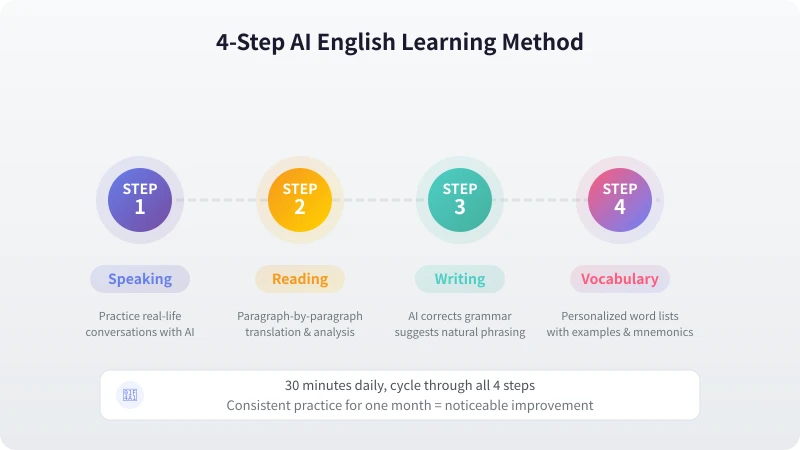
The core of learning English with AI is a four-step cycle: Speaking & Conversation → Reading Comprehension → Writing Correction → Vocabulary Memorization. Practice 30 minutes a day, repeat this cycle, and you'll see significant improvement in just one month.
No need to spend thousands on classes or download a dozen apps—just one AI tool is enough. The key is to start today.
Related Articles
AI Speech to Text: Beginner's Guide to Convert Voice to Text in 3 Steps
Learn how to convert speech to text using AI tools. Perfect for meeting notes, content creation, and video subtitles. Three practical scenarios with step-by-step instructions.
TutorialsAI Local Deployment Guide: Run Large Models in 3 Steps for Free
Learn how to deploy AI models locally in just 3 steps. No coding experience needed, completely free, and your data stays private on your own computer.
TutorialsAI Shopping Decision Guide: From Price Comparison to Avoiding Pitfalls
Learn how to use AI for shopping decisions. From price comparison to avoiding pitfalls - make smarter purchasing choices with AI assistance.
Comments are not yet available, stay tuned