AI-Powered Insurance Buying: A Four-Step Guide from Confusion to Clarity
Why Is Insurance So Confusing?
Open any insurance app and you are greeted by dozens, sometimes hundreds, of products: million-yuan medical plans, critical illness insurance, accident insurance, life insurance, annuities… Each one comes with pages of fine print filled with jargon like exclusions, waiting periods, deductibles, and reimbursement ratios.
What makes it worse is that more expensive does not mean better, and more policies do not mean more protection. Buying the wrong insurance — spending money only to find you are not covered when you need it most — is the biggest risk of all.
The good news? AI can help you sort through the chaos fast. You do not need to become an insurance expert. Just share your situation with an AI assistant, and it will give you professional analysis and recommendations.
The Four Essential Insurance Types
Before you start shopping, familiarize yourself with the four most fundamental types of insurance. Together, they cover the major risks most people face:
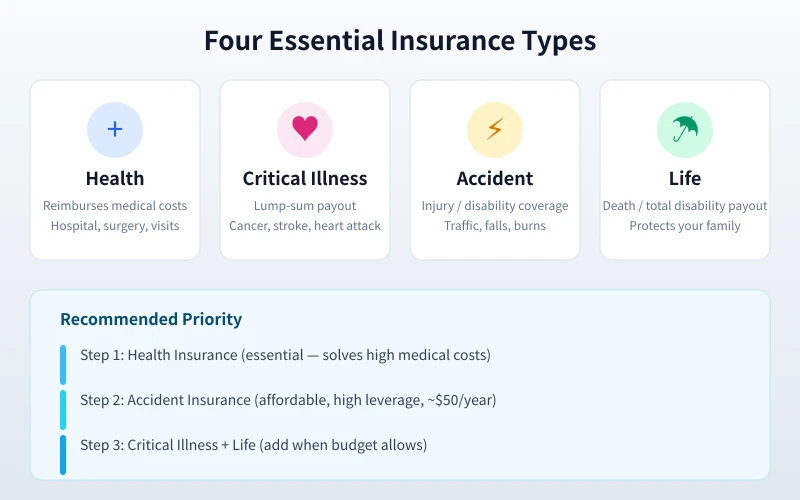
Medical Insurance — Reimburses medical expenses including hospitalization, surgery, and outpatient visits. The most common variety is the million-yuan medical plan, which costs only a few hundred yuan per year yet provides coverage in the millions. This is the most basic form of insurance, and everyone should have it.
Critical Illness Insurance — Pays out a lump sum upon diagnosis of a serious illness. The payout can be used for anything: treatment costs, mortgage payments, or replacing lost income. It is especially important for the primary breadwinner in a family.
Accident Insurance — Covers injuries, disability, or death caused by accidents. Premiums are low and leverage is high — a couple of hundred yuan per year can secure hundreds of thousands or even millions in coverage.
Life Insurance — Pays out in the event of death or total disability. It is primarily a safety net for your family, particularly if you have a mortgage or children. Term life insurance is a must-have.
Step 1: Assess Your Personal Situation
The first step in buying insurance is not looking at products — it is looking at yourself. Gather the following information:
- Age and gender: Risk profiles and premiums vary significantly by age group
- Income and expenses: Determines how much you can afford to spend on premiums
- Family structure: Whether you are married, have children, or support elderly parents
- Debt obligations: Mortgage, car loan, and other fixed liabilities
- Existing coverage: Whether your employer offers supplemental medical insurance, and your social insurance status
- Health condition: Any pre-existing conditions or abnormalities found in health checkups
Organize all of this into a brief summary — you will be sending it to an AI next.
Step 2: Let AI Analyze Your Insurance Needs
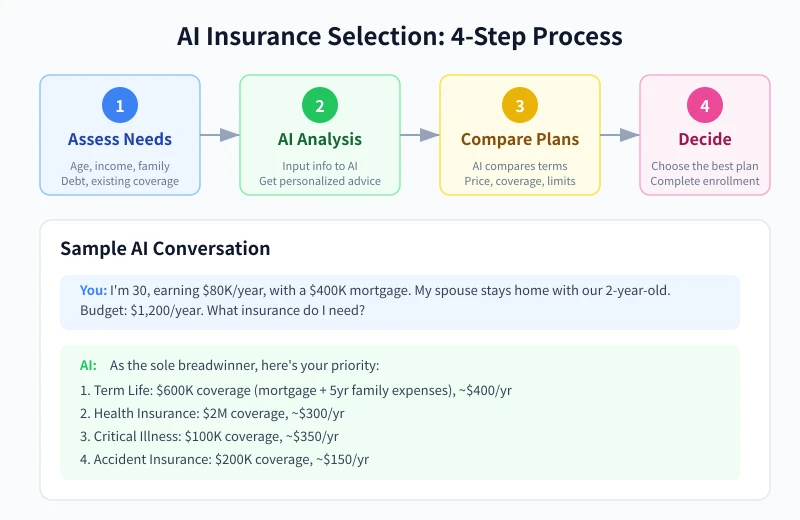
Open any AI chat tool (ChatGPT, DeepSeek, Claude, or others all work), send it your information, and ask it to analyze what insurance you need.
Chat Template
Copy the template below and replace the bracketed sections with your own details:
“Please analyze my insurance needs. Here is my situation:
- Age: (enter your age)
- Gender: (male/female)
- Annual income: (enter amount)
- Family structure: (married/single, children or not, supporting elderly parents or not)
- Debt: (mortgage and car loan amounts)
- Existing coverage: (employer supplemental medical insurance, social insurance details)
- Health condition: (any pre-existing conditions)
- Insurance budget: (how much you are willing to spend per year)
Please tell me: 1. Which types of insurance do I need most? 2. What coverage amount do you recommend for each? 3. What priority order should I follow?”
What AI Will Give You
Typically, the AI will provide the following based on your situation:
- Recommended insurance types and their priority
- Suggested coverage amounts for each type
- A budget allocation plan
- Special considerations (such as underwriting issues related to pre-existing conditions)
Step 3: Use AI to Compare Specific Products
Once you know what insurance you need, the next step is choosing specific products. AI can be a huge help here too.
How to Do It
Method 1: Have AI Interpret Policy Terms
Copy the key policy summaries (usually found on the product detail page) of the products you are considering and send them to AI for comparison. Example prompt:
“Please compare the key policy differences among these three million-yuan medical plans. Focus on: 1. What is the deductible? 2. Is renewal guaranteed? 3. What situations are excluded from coverage? 4. What value-added services are included?”
Method 2: Have AI Answer Your Questions
If you see a product on an insurance app but cannot understand certain terms, simply screenshot or copy the text and send it to AI, asking: “What does this passage mean? How does it affect me?” The AI will explain it in plain language.
Method 3: Have AI Create a Comparison Checklist
Tell AI the names of the products you are considering and ask it to produce a comparison table covering coverage scope, premiums, deductibles, renewal conditions, and other key indicators. This gives you a clear at-a-glance view of which product suits you best.
Step 4: Make Your Final Decision
After receiving AI’s analysis and comparison results, it is time to make your final call. Here are the key decision points:
Decision Checklist
- Is the coverage amount sufficient? Medical insurance should be at least 2 million yuan; critical illness insurance should be 3–5 times your annual income; life insurance should cover your debts plus 5 years of family expenses
- Are the exclusions reasonable? Check what is not covered and whether it conflicts with your actual needs
- Are the renewal terms favorable? For medical insurance, choose products with guaranteed renewal
- Is the premium within budget? Generally, premiums should not exceed 5–10% of annual income
- Can you pass the health disclosure? If you have pre-existing conditions, confirm whether you can still get coverage
Final Confirmation
Before officially purchasing, you can send your final plan to AI for one last review:
“I plan to buy the following insurance package. Please check if there are any gaps or issues: (list your plan)”
AI will do a final check to ensure your plan is complete.
Frequently Asked Questions
Is AI insurance advice reliable?
AI advice can serve as a useful reference, but it cannot fully replace a professional insurance advisor. AI excels at helping you organize your needs, interpret policy terms, and compare products. However, for complex underwriting issues (such as pre-existing conditions), consulting a professional is recommended.
What if my budget is tight?
Prioritize medical insurance and accident insurance first — together they cost only a few hundred yuan per year. Add critical illness and life insurance as your income grows. Remember: having some coverage is more important than having complete coverage.
My employer provides supplemental medical insurance. Do I still need my own?
Yes. Employer supplemental medical insurance usually has limited coverage and becomes invalid once you leave the company. At a minimum, purchase your own million-yuan medical plan as a safety net.
What is the difference between buying insurance online and offline?
The products themselves are no different; online products often offer better value. The difference lies in service: offline agents help you handle claims, while online requires self-service. But many platforms now offer online customer support and claims assistance, so the gap is narrowing.
Conclusion
Buying insurance is not complicated. The key is to clarify your needs and choose the right products. Using AI to assist your insurance decisions helps you quickly understand professional terms, compare product differences, and find the plan that suits you best. Remember the four-step process: Assess Needs → AI Analysis → Compare Products → Make a Decision.
Try it now: open an AI tool, use the template from this article to enter your information, and see what recommendations the AI gives you.
Related Articles
AI Speech to Text: Beginner's Guide to Convert Voice to Text in 3 Steps
Learn how to convert speech to text using AI tools. Perfect for meeting notes, content creation, and video subtitles. Three practical scenarios with step-by-step instructions.
TutorialsAI Local Deployment Guide: Run Large Models in 3 Steps for Free
Learn how to deploy AI models locally in just 3 steps. No coding experience needed, completely free, and your data stays private on your own computer.
TutorialsAI Shopping Decision Guide: From Price Comparison to Avoiding Pitfalls
Learn how to use AI for shopping decisions. From price comparison to avoiding pitfalls - make smarter purchasing choices with AI assistance.
Comments are not yet available, stay tuned