AI Language Learning Guide: Practice Speaking, Check Grammar, Write Essays — All in One Tool
The hardest part of learning a foreign language isn't memorizing vocabulary — it's the lack of a language environment. Hiring a tutor is expensive, self-study is boring, and watching TV shows makes it easy to zone out. Actually, AI tools can already serve as your "personal tutor" — available 24/7, never impatient, and completely free.
Why Is AI More Efficient Than Traditional Methods?
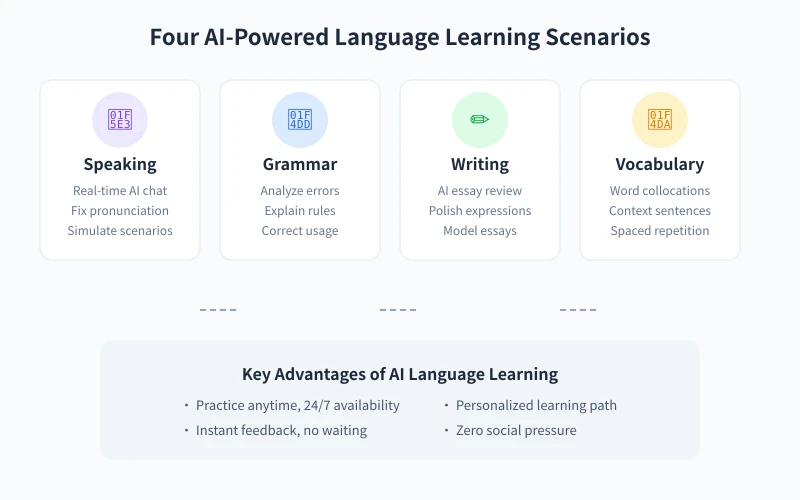
The biggest problem with traditional language learning is slow feedback. You write an essay and wait for the teacher to grade it; you say something and nobody tells you if it's wrong. AI solves this core pain point:
- Instant feedback: Say a sentence and AI immediately tells you if the grammar is correct and if the expression is natural
- Unlimited patience: Ask the same question ten times and AI won't get annoyed
- Personalized learning: AI adjusts difficulty to your level — not too easy, not too hard
- Zero social pressure: Speaking to AI means no embarrassment from making mistakes
Step 1: Choose the Right AI Tool
You don't need specialized tools for language learning — your everyday AI chat tool works fine. Here are some recommendations:
Top Picks
- ChatGPT (GPT-4o): Supports voice conversation for real-time speaking practice, excellent grammar correction, supports almost all major languages
- DeepSeek: Strong Chinese understanding, great for Chinese speakers learning English, Japanese, etc., free to use
- Doubao: By ByteDance, user-friendly Chinese interface, supports voice input, great for beginners
For Specialized Scenarios
- Tongyi Qianwen (Alibaba): Excels at Chinese-English translation and grammar analysis, especially friendly for Chinese native speakers
- Claude: Strong long-text comprehension, great for analyzing articles and reviewing long essays
Tip: Just pick one you're comfortable with. The tool isn't the key — consistency is.
Step 2: Practice Speaking with AI
Speaking is where most people struggle. AI can serve as your conversation partner for practice anytime, anywhere.
How to Do It
- Open ChatGPT (or your chosen AI tool)
- Enter the following prompt to set the role and scenario:
You are my English teacher and we are chatting at a café. Please use simple English to talk with me, saying only 2-3 sentences at a time. If my sentence has a grammar error, first acknowledge what I said well, then correct it using this format:
✅ You said: [my original sentence]
💡 More natural way: [improved sentence]
📖 Explanation: [brief explanation of why]
Now, please start the conversation.
- AI will start a simple topic in English (like weather or hobbies)
- Reply in English — it doesn't have to be perfect, just be bold
- AI will point out your errors and suggest improvements
- Continue the conversation for 10-15 minutes each time
Advanced Tips
- Switch scenarios: Tell AI "Let's switch — now you're a waiter at a restaurant" to practice different topics
- Increase difficulty: Say "Please use more advanced vocabulary and complex sentences"
- Voice mode: ChatGPT supports voice input and output for a more realistic conversation experience
Step 3: Check Grammar with AI
Wrote a sentence and not sure if it's correct? Just send it to AI for a check.
Quick Grammar Check
Send your sentence with a simple instruction:
Please check the grammar of the following English text. Analyze each sentence, provide corrections and grammar explanations:
[paste your sentences]
Compare Two Expressions
Not sure which way is more natural? Let AI compare:
Which is correct: "I very like this movie" or "I really like this movie"? Why? Please explain in simple terms.
Grammar Practice Drills
If you keep mixing up certain grammar points (like tenses or prepositions), ask AI to quiz you:
I always confuse "in", "on", and "at". Please give me 10 multiple choice questions, and after I answer, tell me which ones I got wrong and explain why.
Step 4: Write Essays with AI
AI can review your essays faster and in more detail than a human teacher. Here's the complete workflow:
Write an Essay
- Write a short essay yourself (100-200 words is enough)
- Send it to AI with this prompt:
Please review my English essay and score each dimension (1-10 points):
1. Grammar accuracy
2. Vocabulary richness
3. Sentence fluency
4. Logical coherence
Then provide:
• Sentence-by-sentence correction suggestions
• Overall improvement suggestions
• A revised model essay
- AI will give detailed scores and suggestions
- Revise your essay based on the feedback
- Send the revised version to AI to check for improvement
Learn from Model Essays
Don't know how to start? Let AI write one for reference:
Please write a 150-word English essay on "My Favorite Season". Requirements: use middle school level vocabulary and grammar, but make the sentences natural and fluent. After writing, list the good words and phrases worth learning.
Step 5: Memorize Vocabulary with AI
The biggest fear with vocabulary is "memorize and forget." AI can help you learn words in context.
Generate Word Collocations
I want to learn how to use the word "make". Please list:
1. The 10 most common collocations (e.g., make a decision)
2. Chinese meaning for each
3. A short example sentence
4. Common mistakes to avoid
Daily Vocabulary Review
I learned these 10 words today: abandon, brilliant, consequence, demonstrate, enormous...
Please:
1. Write a short story (under 100 words) using all 10 words
2. Make the story natural — don't force the words in
3. Highlight each target word
This method is much more effective than rote memorization because you understand how words are used in context.
Real-World Scenarios: Learning Plans for Different Goals
Scenario 1: Preparing for English Exams (CET-4/6, IELTS, TOEFL)
- Have AI generate mock tests and grade your answers
- Send past reading comprehension passages to AI for sentence-by-sentence translation and explanation
- Practice the writing section with AI, scored by exam criteria
Scenario 2: Travel Survival
- Tell AI "I'm going to Japan, teach me the 20 most useful Japanese phrases"
- Practice airport, hotel, and restaurant conversations with AI
- Send what you want to say in Chinese, and AI translates it with pronunciation
Scenario 3: Workplace English
- Practice English presentations with AI simulating a business meeting
- Send your email drafts to AI for professional rewriting
- Learn industry-specific terminology and expressions
Scenario 4: Reading Foreign Materials
- Send foreign articles to AI for paragraph-by-paragraph translation and vocabulary explanation
- Have AI summarize key points for quick comprehension
- Ask AI directly about sentences you don't understand — more efficient than a dictionary
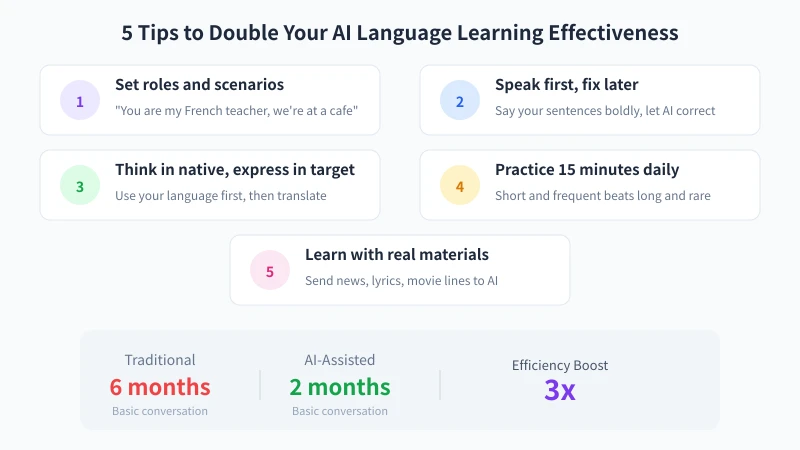
5 Tips to Double Your Learning Effectiveness
Tip 1: Set Roles and Scenarios
Don't just say "teach me English." Give AI a specific scenario, like "You are my French teacher and we're chatting at a Parisian café." AI's responses will be more targeted, and you'll get into the zone more easily.
Tip 2: Speak First, Fix Later — Don't Fear Mistakes
Many people are afraid to speak a foreign language because they might make errors. With AI, there's absolutely no need to worry. Just say your sentences boldly, and AI will correct you. The more mistakes you make, the faster you improve.
Tip 3: Think in Your Native Language, Express in the Target Language
If your level isn't high enough to think directly in the target language, first express what you mean in your native language, then have AI translate it. Gradually transition to thinking directly in the target language.
Tip 4: Practice 15 Minutes Daily
Short and frequent sessions are more effective than long, infrequent ones. Practicing 15 minutes with AI every day is far better than cramming for 3 hours on weekends.
Tip 5: Learn with Real Materials
Send foreign materials you encounter in real life (news, song lyrics, movie dialogue, product manuals) to AI for analysis. Applying what you learn leads to deeper retention.
Frequently Asked Questions
Is AI's grammar teaching always correct?
Mainstream AI tools (like ChatGPT, DeepSeek) have very reliable grammar knowledge, especially for major languages like English, Japanese, and French. But for less common languages or dialects, cross-verification is recommended. When unsure, compare results across multiple AI tools.
Do I need to pay to learn languages with AI?
No. DeepSeek, Doubao, and Tongyi Qianwen are all free. ChatGPT's free tier is also sufficient, just with slower response times. If you want voice conversation features, ChatGPT Plus offers a better experience, but it's not necessary.
Can AI replace a real tutor?
For daily practice and grammar learning, AI is completely sufficient — and often more patient and detailed than most tutors. But if you want to practice real social scenarios (body language, cultural context), you still need real human interaction. Use AI as your main practice tool and occasionally join language exchange events for real-world experience.
Can I use AI to learn less common languages?
Yes. ChatGPT supports almost all major languages, including Japanese, Korean, French, German, Spanish, Portuguese, and more. However, correction capabilities for less common languages may not be as strong as for English. Consider using AI tools from the target language's country (e.g., Japanese AI tools for learning Japanese).
How long should I practice each day?
15-30 minutes per day is recommended. Too short and the effect is minimal; too long and you'll get fatigued. Consistency is key — daily practice is far better than occasional cramming. Think of AI conversation as your daily "language morning exercise." Once it becomes a habit, it won't feel like a chore.
Summary
The core method for learning languages with AI comes down to four words: practice more, speak more. AI tools simply lower the barrier to practice — no scheduling, no cost, no fear of mistakes. But no matter how good the tool is, it can't replace your persistence.
Starting today, spend 15 minutes daily with an AI tool, chatting in your target language. After a month, you'll notice significant improvement in both speaking and writing.
Try it right now. Open your favorite AI tool and type: "Hello, let's practice English. You are my English teacher. Let's start with a simple conversation about hobbies."
Related Articles
AI Speech to Text: Beginner's Guide to Convert Voice to Text in 3 Steps
Learn how to convert speech to text using AI tools. Perfect for meeting notes, content creation, and video subtitles. Three practical scenarios with step-by-step instructions.
TutorialsAI Local Deployment Guide: Run Large Models in 3 Steps for Free
Learn how to deploy AI models locally in just 3 steps. No coding experience needed, completely free, and your data stays private on your own computer.
TutorialsAI Shopping Decision Guide: From Price Comparison to Avoiding Pitfalls
Learn how to use AI for shopping decisions. From price comparison to avoiding pitfalls - make smarter purchasing choices with AI assistance.
Comments are not yet available, stay tuned