AI Model Selection Guide: ChatGPT, Claude, DeepSeek — Which One Should You Use?
Why Does Choosing the Right AI Model Matter?
When most people first encounter AI, they all ask the same question: "Which one should I use?" ChatGPT has the biggest name, Claude has great reviews, DeepSeek is cheap, and Gemini has lots of features — everyone recommends something different, but no one tells you which is best for you.
Choosing the wrong model can be costly: spending money only to find it can't write code well, or running out of free credits before discovering another model is better suited to your use case. This article helps you skip those detours.
Four Major Models at a Glance
Let's quickly get to know the four mainstream models:
- ChatGPT (OpenAI): Largest user base, most complete ecosystem, strong multimodal capabilities
- Claude (Anthropic): Known for safety, excellent at long-form content, natural writing style
- DeepSeek (DeepSeek): Chinese model, strong reasoning ability, extremely competitive pricing
- Gemini (Google): Good search integration, strong multimodal, generous free tier
Capability Comparison: Who Excels at What?
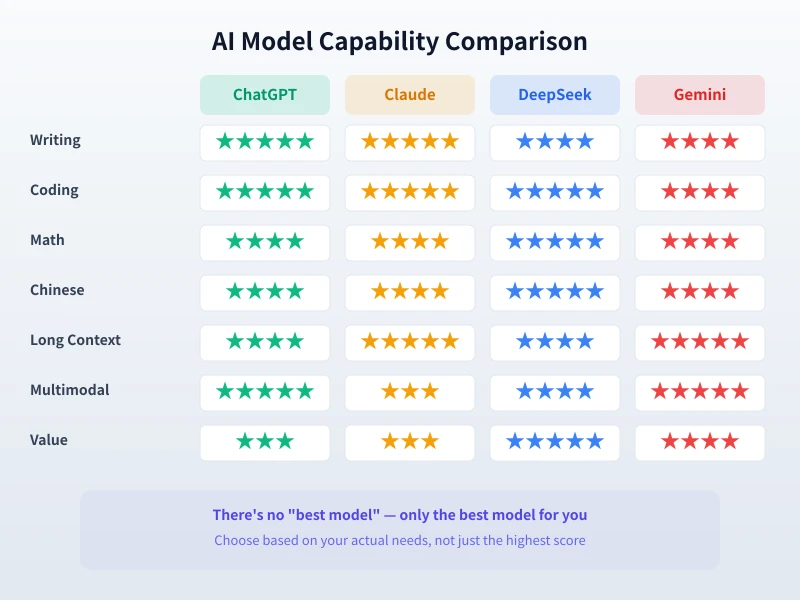
The chart below shows how the four models perform across different dimensions (out of 5 stars):
Quick summary:
- Writing: ChatGPT ≈ Claude > DeepSeek ≈ Gemini
- Coding: ChatGPT ≈ Claude ≈ DeepSeek > Gemini
- Math Reasoning: DeepSeek > ChatGPT ≈ Claude ≈ Gemini
- Chinese: DeepSeek > ChatGPT ≈ Claude ≈ Gemini (native advantage for Chinese models)
- Long Context: Claude > Gemini > ChatGPT ≈ DeepSeek (Claude supports ultra-long context)
- Multimodal: ChatGPT ≈ Gemini > DeepSeek > Claude
- Value: DeepSeek > Gemini > ChatGPT ≈ Claude
Scenario Recommendations: Different Needs, Different Models
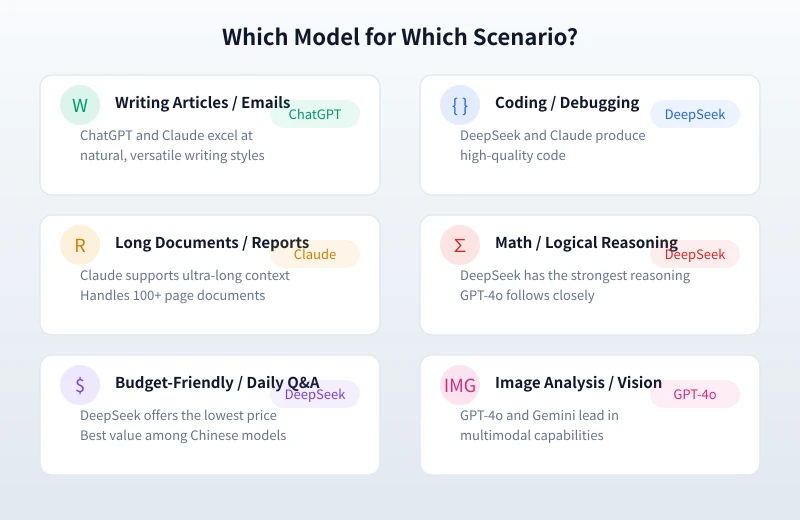
Rather than looking at scores, focus on your actual needs. Here are recommendations for six common scenarios:
Scenario 1: Writing Articles, Emails, or Copy
Recommended: ChatGPT or Claude
These two models excel at writing. ChatGPT is versatile across styles; Claude produces more natural, warm text suited for nuanced expression.
If you're doing content creation, marketing copy, or need AI to polish your writing, these are your top choices.
Scenario 2: Writing Code or Debugging
Recommended: DeepSeek or Claude
DeepSeek offers the best value for code generation with quality matching top-tier models. Claude excels at code understanding, making it great for complex reviews and refactoring. ChatGPT is good for rapid prototyping.
If you're a developer, consider keeping both DeepSeek and Claude, switching based on task complexity.
Scenario 3: Reading Long Documents or Analyzing Reports
Recommended: Claude
Claude supports ultra-long context (up to 200K tokens), able to process 100+ page PDFs in one go. If you regularly handle long documents, academic papers, or legal contracts, Claude is your best bet.
Scenario 4: Math Problems or Logical Reasoning
Recommended: DeepSeek
DeepSeek's reasoning ability ranks first among Chinese models, even surpassing some international models. If you need AI for math, logical analysis, or multi-step reasoning tasks, DeepSeek is the top choice.
Scenario 5: Saving Money or Daily Q&A
Recommended: DeepSeek
DeepSeek has the lowest pricing among all mainstream models — daily use costs almost nothing. If you use AI frequently or have a limited budget, DeepSeek is the value king.
Scenario 6: Image Analysis or Vision Tasks
Recommended: ChatGPT or Gemini
These two models have the strongest multimodal capabilities, supporting image and video input. If you need AI to analyze images, recognize text, or describe photos, prioritize these two.
Price Comparison: How Much Does It Cost?
Here's how the four models compare on API pricing (per million tokens):
- ChatGPT (GPT-4o): Input $2.50 / Output $10
- Claude (Sonnet 4): Input $3 / Output $15
- DeepSeek (V3): Input ¥1 / Output ¥2 (about $0.14 / $0.28)
- Gemini (2.5 Pro): Input $1.25 / Output $5
As you can see, DeepSeek's pricing is 10-50x lower than other models. For daily use, this difference is significant.
Beginner Advice: Start Here
If you're using AI for the first time, here's my recommendation:
Step 1: Try the Free Versions First
ChatGPT, Claude, and Gemini all have free tiers; DeepSeek offers free credits after registration. Try each for a week and see which model's response style suits you best.
Step 2: Lock In a Model Based on Your Primary Need
Think about what you'll use AI for most. If you write a lot, choose ChatGPT or Claude. If you code a lot, choose DeepSeek. If you read long documents often, choose Claude. Don't try to find a "do-it-all" model — master one for your main use case first.
Step 3: Add More Models Later
Once you're comfortable with one model, add another to cover gaps. For example, use Claude as your main tool for writing and occasionally switch to DeepSeek for math problems.
How to Access These Models via Ciyuano?
On the Ciyuano platform, you can access all these models with a single API key — no need to register on each platform separately:
- Visit the Model List to see all available models
- Create a key on the API Key Management page
- Set the API base URL to
https://www.ciyuano.com/v1and enter your key - Switch models by changing the
modelparameter
This way, you don't need to switch between multiple platforms — one entry point for all models.
FAQ
Can I use multiple models at the same time?
Yes. Many AI tools (like Cherry Studio, ChatBox) support configuring multiple models, letting you switch anytime. On Ciyuano, a single API key gives you access to all models.
What's the difference between free and paid versions?
Free tiers usually have usage limits, context length restrictions, or don't include the latest models. Paid versions remove these limits and offer faster response times. If you only use AI occasionally, the free tier is enough; if you use it daily, consider upgrading.
What's the difference between Chinese and international models?
Chinese models (like DeepSeek) have a natural advantage in Chinese understanding and generation, with much lower pricing. International models (like ChatGPT, Claude) are stronger in English and multimodal tasks. If you primarily use Chinese, domestic models are more than sufficient.
Will models leak my data?
Mainstream AI platforms have privacy protection policies and typically don't use user data for model training. However, if you're handling highly sensitive data, consider self-hosted solutions or enterprise versions. Ciyuano supports private deployment, keeping your data fully under your control.
📖 Related Articles
AI 数据分析入门:零基础用 AI 做表格、图表和报告
不会写代码也能做数据分析?本文手把手教你用 ChatGPT、DeepSeek 等 AI 工具,从原始表格到可视化图表再到分析报告,四步搞定数据处理全流程。
AI Home Decoration & Interior Design Assistant Guide: Style Selection, Space Layout, Budget Control Made Easy
Don't know where to start with home renovation? An AI home design assistant can generate floor plans, recommend color schemes, help choose furniture, and create budget lists. This article walks you through 5 practical scenarios to handle your entire renovation process with AI.
AI Fitness Assistant Guide: Workout Plans, Form Coaching & Diet Planning Made Easy
<h2>Why Use AI for Fitness Planning?</h2> <p>Many people want to get fit, but feel overwhelmed by the flood of workout videos and contradictory advice online. Personal trainers are expensive, and training alone risks injury from bad form. The core value of an AI fitness assistant is simple: <strong>it creates personalized plans based on your specific situation and answers your questions anytime</strong>.</p> <p>You need zero fitness background — just tell AI your body data and goals, and it handles everything from workouts to nutrition.</p> <h2>Step 1: Introduce Your Body to AI</h2> <p>AI needs to understand your situation before giving tailored advice. Open your preferred AI tool (ChatGPT, DeepSeek, Claude, etc.) and start with this template:</p> <blockquote> <p>I am a 28-year-old male, 175cm tall, weighing 78kg, with roughly 22% body fat. I have no exercise background and can train 4 days a week for about 1 hour each session. My goal is fat loss and body toning, and I want to see noticeable results in 3 months. Please create a detailed workout plan for me.</p> </blockquote> <p>The more specific your information, the more targeted AI's plan will be. Here are the key details to provide:</p> <ul> <li><strong>Basic data</strong>: Age, gender, height, weight</li> <li><strong>Exercise experience</strong>: Zero / occasional / experienced</li> <li><strong>Available time</strong>: How many days per week, how long per session</li> <li><strong>Training goal</strong>: Bulk / cut / tone / improve endurance</li> <li><strong>Limitations</strong>: Injuries, home training, available equipment</li> </ul> <h2>Step 2: Get Your Personalized Workout Plan</h2> <p>AI will generate a complete weekly training plan based on your input. A good AI-generated plan typically includes:</p> <ul> <li><strong>Weekly schedule</strong>: Which body parts to train on which days, rest day placement</li> <li><strong>Specific exercises</strong>: Exercise names, sets, reps, rest periods</li> <li><strong>Warm-up and stretching</strong>: Pre-workout warmup and post-workout stretches</li> <li><strong>Progressive overload guidance</strong>: When to increase weight or reps</li> </ul> <p><strong>Tip</strong>: If you don't know how to perform an exercise AI suggests, just follow up with "How do I do a barbell squat correctly? Please describe in detail," and AI will break it down for you.</p> <div style="text-align:center;margin:24px 0;"> <img src="/images/blog/2026/06/14/ai-fitness-workflow-en.webp" alt="AI Fitness 4-Step Workflow" style="max-width:100%;border-radius:8px;" /> </div> <h2>Step 3: Learn Proper Form to Avoid Injury</h2> <p>This is the most important step. AI can act as a virtual coach, explaining every exercise in detail. Try asking:</p> <blockquote> <p>Please explain the correct barbell squat form in detail, including stance width, squat depth, knee direction, breathing rhythm, and the 3 most common mistakes beginners make.</p> </blockquote> <p>AI typically covers these dimensions:</p> <ul> <li><strong>Starting position</strong>: Stance width, toe direction, barbell placement</li> <li><strong>Movement process</strong>: Squat depth, knee tracking, weight distribution</li> <li><strong>Breathing rhythm</strong>: When to inhale, when to exhale</li> <li><strong>Common mistakes</strong>: Knee caving, rounding back, heels lifting</li> <li><strong>Alternatives</strong>: What to do if you can't perform the standard version</li> </ul> <p><strong>Safety note</strong>: AI advice cannot replace professional medical guidance. If you have old injuries or chronic conditions, always consult a doctor first. Stop immediately if you feel sharp pain during training.</p> <h2>Step 4: Let AI Plan Your Workout Diet</h2> <p>Training is only half the equation — nutrition matters just as much. Ask AI to create a daily meal plan based on your goals:</p> <blockquote> <p>I'm in a cutting phase, burning roughly 500 calories on training days. Please create a training day meal plan including breakfast, lunch, dinner, and pre/post-workout snacks, totaling around 1800 calories with at least 130g protein.</p> </blockquote> <p>AI will provide specific meal suggestions with food types, portions, and approximate calories. You can ask AI to adjust based on your taste — for example, "I don't eat eggs, what's a good alternative?"</p> <div style="text-align:center;margin:24px 0;"> <img src="/images/blog/2026/06/14/ai-fitness-scenarios-en.webp" alt="5 Practical AI Fitness Scenarios" style="max-width:100%;border-radius:8px;" /> </div> <h2>5 Ready-to-Use Prompt Templates</h2> <p>Here are 5 copy-paste prompt templates covering the most common fitness scenarios:</p> <h3>Scenario 1: Home Bodyweight Training</h3> <blockquote> <p>I have no gym equipment at home and limited space. Please create a 4-day-per-week home bodyweight training plan for muscle toning, 40-50 minutes per session. All exercises must require zero equipment. Describe each exercise in detail.</p> </blockquote> <h3>Scenario 2: Beginner Running Plan</h3> <blockquote> <p>I'm a complete running beginner — I get winded after just 1km. Please create an 8-week beginner running plan with the goal of running 5km continuously. Include weekly training content, pace suggestions, and rest days.</p> </blockquote> <h3>Scenario 3: Post-Workout Recovery</h3> <blockquote> <p>I trained legs yesterday and my quads are extremely sore today — I can barely walk. Is this normal? How many rest days do I need? What can I do to speed up recovery? Can I train again tomorrow?</p> </blockquote> <h3>Scenario 4: Bulking Diet Plan</h3> <blockquote> <p>I'm a 25-year-old male weighing 65kg, looking to build muscle. Please create a 2500-calorie daily meal plan with 150g protein, listing specific foods and portions using common Chinese ingredients.</p> </blockquote> <h3>Scenario 5: Injury-Friendly Training</h3> <blockquote> <p>I have a mild meniscus injury in my right knee — my doctor said no squats or running. Please design an upper body and core training plan that's easy on the knees, 3 days a week, 45 minutes per session.</p> </blockquote> <h2>Tips and Best Practices</h2> <ul> <li><strong>Start gradually</strong>: Don't ask for an advanced plan right away — begin with the basics</li> <li><strong>Give feedback</strong>: Tell AI how you felt after training so it can adjust your plan</li> <li><strong>Ask follow-ups</strong>: If you don't understand an exercise, keep asking — AI won't get impatient</li> <li><strong>Log your data</strong>: Record weights and reps each session, then share with AI for analysis</li> <li><strong>Combine with videos</strong>: When AI describes an exercise, search for video demonstrations to follow along</li> <li><strong>Listen to your body</strong>: AI's suggestions are guidance — how your body feels is the ultimate standard</li> </ul> <h2>Conclusion</h2> <p>An AI fitness assistant isn't meant to replace a personal trainer — it's designed to give everyone access to scientific training guidance, regardless of budget. Its core strengths are <strong>personalization, 24/7 availability, and infinite patience</strong>.</p> <p>Remember: the best workout plan is one you can stick to. Start today — open your AI tool and type your first fitness question.</p>
💬 Comments are not yet available, stay tuned