A Practical Guide to the AI Family Education Assistant: Picture Book Reading, Homework Help, and Parent-Child Activities All in One
Coming home from work to help with homework, not knowing what to do with the kids on weekends, buying piles of picture books but not knowing how to tell them—this is probably the daily reality for most parents. While AI can't replace your companionship, it can help you prepare materials, design activities, and solve problems, making your parenting journey much easier. This article uses three practical scenarios to teach you how to turn AI into a helpful assistant for family education.
Three Core Scenarios
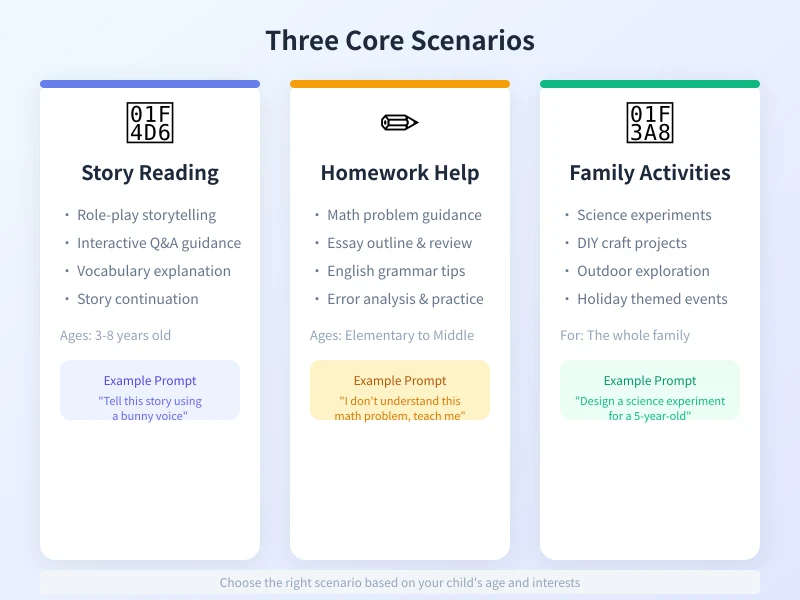
Before we start, let's understand the three most practical directions of AI in family education:
- Picture Book Reading: Let AI tell stories with different voices and styles, and also interact with questions and continue the plot
- Homework Help: When encountering difficult problems, let AI guide thinking step by step instead of giving the answer directly
- Parent-Child Activities: Science experiments, crafts, outdoor exploration—AI helps you come up with ideas and plans
Scenario 1: Picture Book Reading – Bringing Stories to Life
Why Use AI to Read Picture Books?
You might think "Everyone can read a picture book," but in practice, you often encounter these problems:
- After two books, you run out of words and don't know how to expand the content
- When your child asks "why," sometimes you really can't answer
- You've told the same story 20 times and it's no longer fresh
- You don't know how to guide your child to think based on the story
AI can solve these pain points—it can tell stories in different ways, answer your child's endless "whys" at any time, and extend the story into new activities.
Steps
Step 1: Tell AI the basic information
Open any AI conversation tool (ChatGPT, Doubao, Kimi, etc.) and enter:
I have a 4-year-old daughter who loves animals. Tonight I want to tell her the picture book "The Very Hungry Caterpillar". Please help me tell this story in a lively and interesting way, add interactive questions, and design a small activity after the story.
AI will return a complete storytelling plan, including:
- Voice suggestions for different characters (the caterpillar's voice can be soft and tiny)
- Questions to ask your child on each page ("What do you think the caterpillar will eat next?")
- Extension activity after the story (make a caterpillar out of colored paper)
Step 2: Follow up during interaction
During the storytelling, your child might have sudden ideas. You can tell AI at any time:
My child asked why the caterpillar eats so much and whether it will get a stomachache. Please explain in a way a 4-year-old can understand.
Step 3: Continue the story
After finishing the picture book, if your child still wants more:
Please continue the story after the caterpillar becomes a butterfly, letting it fly to our city for an adventure, adding places familiar to the child (community garden, kindergarten).
Activities for different age groups
- Ages 2-3: Let AI tell stories with simple reduplicated words and onomatopoeia ("The caterpillar crawls and crawls, munch munch eats the apple")
- Ages 4-5: Add role-play, let AI design an interactive script like "You play the caterpillar, Mom plays the butterfly"
- Ages 6-8: Let AI guide the child to create their own story, using "What if..." to spark imagination
Scenario 2: Homework Help – Guide Thinking, Not Just Give Answers
The Right Way to Help with Homework
Many parents, when using AI for homework help, directly take a photo and ask AI for the answer. Although this is fast, the child learns nothing.
The right approach is: let AI be a "guide" to lead the child step by step in clarifying their thinking.
Steps
Math Problems: Guide Thinking
When your child encounters a math problem they can't solve, ask AI like this:
My child is in the second grade and can't solve this problem: "Xiaoming has 15 candies. After giving some to Xiaohong, 8 candies are left. How many did he give to Xiaohong?" Please don't give me the answer directly; use questions to guide him step by step to figure it out himself.
AI won't directly say "7 candies"; instead, it will guide like this:
- "How many candies did Xiaoming have at first?" (15)
- "How many are left now?" (8)
- "So how many are missing? Can you count with your fingers?"
- "Right! What is 15 minus 8?"
Essay: Understanding the Topic and Outline
My child is in the third grade and needs to write an essay about "My Good Friend," about 200 words. He doesn't know what to write. Please ask him a few questions in a conversational way to help him find writing material, and then help him create a simple outline.
AI will ask the child like a chat:
- "Who is your best friend? How did you meet?"
- "What does he/she have that you think is especially amazing?"
- "What fun things have you done together?"
Then it will help organize the outline based on the answers.
English: Situational Dialogue
My child is learning English and just learned fruit vocabulary. Please design a role-play game of "buying fruit at a fruit shop" with simple English dialogue and Chinese translation, so I can practice with my child.
Consolidating Mistakes
For problems your child got wrong, you can ask AI to generate a few similar practice questions:
My child often makes mistakes in "two-digit subtraction with borrowing." Please create 5 similar practice questions with increasing difficulty, each with a verification method.
Scenario 3: Parent-Child Activities – AI Helps You Come Up with Ideas
Don't Know What to Do on Weekends?
Every weekend, "what to do with the kids" becomes a challenge. AI can design various fun activities based on your home conditions.
Steps
Simple Science Experiment
Please design a science experiment suitable for a 5-year-old at home. Materials should be common household items (no need to buy specifically). The experiment should show a visible change and take less than 15 minutes. Explain the principle in language a child can understand.
AI might recommend a "baking soda volcano" experiment:
- Materials: Baking soda, white vinegar, food coloring, a cup
- Steps: Put baking soda in the cup → add a few drops of food coloring → pour in white vinegar → watch the "volcano erupt"
- Principle (child version): "Baking soda and vinegar are two good friends. When they meet, they 'argue' and make lots and lots of bubbles."
Handicraft
Please design a toy-making plan using waste cardboard boxes, suitable for a 4-year-old and dad to complete together. Difficulty should not be too high, and the finished product should be playable.
Outdoor Exploration
We're going to the park tomorrow. Please help me design a "Nature Exploration Task Card" suitable for a 6-year-old, containing 5 small tasks (find leaves, listen to birds, etc.) with a bit of scientific knowledge.
Holiday Activities
The Dragon Boat Festival is coming. Please design a Dragon Boat Festival activity plan suitable for the whole family, including a short story, a small game, and a simple craft, with a total duration of 1 hour.
Tips for Use
Tips to Get Better AI Responses
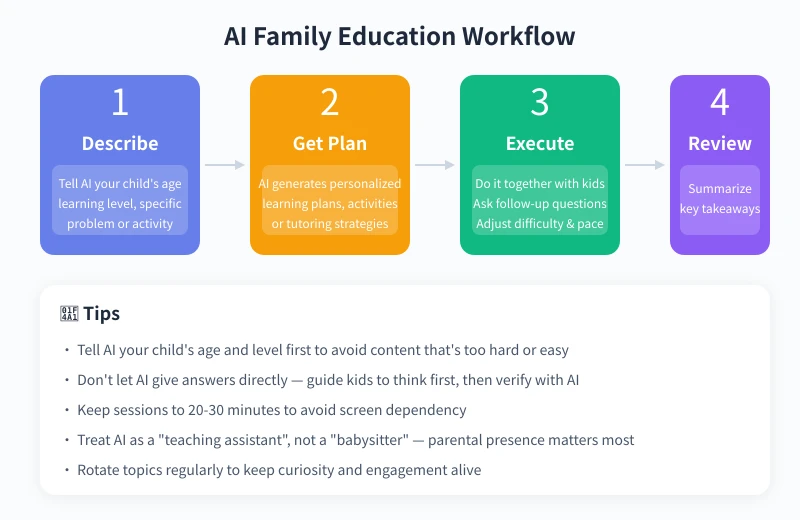
- Specify the age: For a 3-year-old and an 8-year-old, AI provides completely different content
- Mention interests: "My child loves dinosaurs" – AI can incorporate dinosaur elements into any activity
- Set a role: "Please act as a kindergarten teacher" – AI's tone will be more friendly and patient
- Control duration: Tell AI "keep the activity under 15 minutes" to avoid it being too long for the child to sit still
Precautions
- AI is an assistant, not a replacement: AI provides plans, but execution relies on you and your child doing it together
- Control screen time: After each interaction with AI, try to arrange offline activities, don't stay glued to the screen
- Verify accuracy: AI occasionally "makes up" facts; for science common sense, you can search to confirm
- Protect privacy: Do not enter your child's full name, school, home address, or other personal information into AI
- Encourage children to ask themselves: For older children (ages 6+), teach them to ask AI questions on their own
Recommended Tools
The following are AI tools suitable for family education scenarios:
- Doubao: Produced by ByteDance, good Chinese comprehension, free to use, suitable for daily companion reading
- Kimi: Produced by Moonshot AI, supports long texts, suitable for reading longer picture books or stories
- ChatGPT: Produced by OpenAI, high-quality answers, suitable for in-depth tutoring
- Ernie Bot: Produced by Baidu, optimized for Chinese scenarios, suitable for traditional cultural content like ancient poems and idioms
Recommendation: Use Doubao or Kimi for daily companion reading (free and convenient), and ChatGPT for deep learning tutoring.
Summary
The core of AI in family education is not to have AI teach your child for you, but to help you prepare better "companionship materials":
- Picture Book Reading: AI helps you think of interactive questions, continue stories, and vary the way you tell them, giving old stories a fresh twist
- Homework Help: AI guides thinking instead of giving answers, helping children learn "how to think" rather than "what to copy"
- Parent-Child Activities: AI designs experiments, crafts, and exploration tasks, solving the problem of "what to do with the kids on weekends"
Remember: AI is your parenting "advisor," not a "nanny." The best education is always the devoted companionship of parents.
Related Articles
AI Speech to Text: Beginner's Guide to Convert Voice to Text in 3 Steps
Learn how to convert speech to text using AI tools. Perfect for meeting notes, content creation, and video subtitles. Three practical scenarios with step-by-step instructions.
TutorialsAI Local Deployment Guide: Run Large Models in 3 Steps for Free
Learn how to deploy AI models locally in just 3 steps. No coding experience needed, completely free, and your data stays private on your own computer.
TutorialsAI Shopping Decision Guide: From Price Comparison to Avoiding Pitfalls
Learn how to use AI for shopping decisions. From price comparison to avoiding pitfalls - make smarter purchasing choices with AI assistance.
Comments are not yet available, stay tuned