AI Pet Care Assistant Guide: Feeding, Health, and Training Tips Made Simple
AI Can Help With All Your Pet Care Worries
First time owning a cat and not sure how many meals a day to feed? Your dog suddenly has diarrhea and you are not sure whether to go to the vet? Your parrot keeps plucking its feathers and the more you search online the more anxious you get?
These scenarios are incredibly common. In the past you might ask friends, browse forums, or watch short videos — scattered information that is not always reliable. Now with AI you can ask anytime and get advice tailored to your specific pet.
Important note: AI provides reference advice and cannot replace a veterinarian. In emergencies (poisoning, injury, difficulty breathing) seek immediate veterinary care.
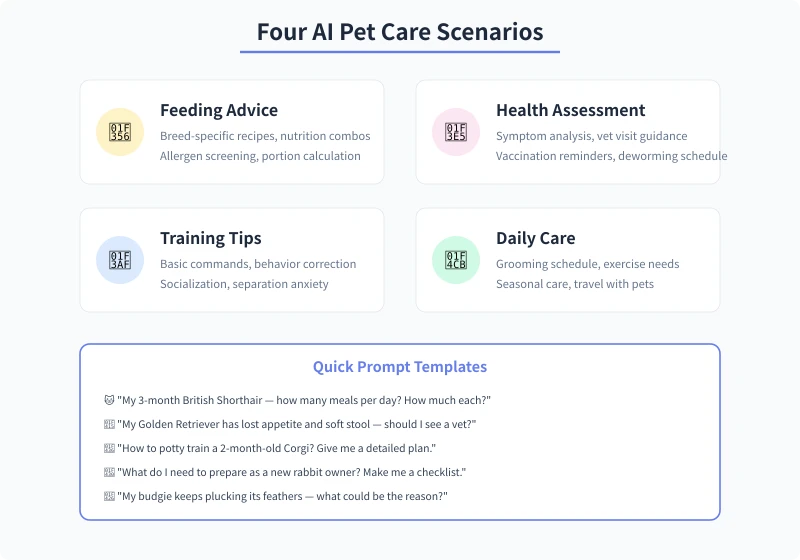
Scenario 1: Feeding Advice
Different breeds and ages have very different dietary needs. AI can create a personalized feeding plan based on your pet.
Questions You Can Ask
- "My 3-month-old British Shorthair — how many meals a day and how many grams per meal?"
- "Can a Golden Retriever puppy eat chicken breast? How do I mix it with dog food?"
- "My cat has soft stool after switching food — how should I transition?"
- "What vegetables and fruits can hamsters eat? Any foods to avoid?"
What AI Can Do For You
- Custom Recipes: Calculate daily calories and portion sizes based on breed, age, and weight
- Ingredient Check: Tell it what you want to feed and it will confirm if it is safe and how to prepare it
- Food Transition Guide: Provide a 7-day transition plan with specific ratios
- Nutrition Supplements: Determine if additional supplements are needed
Scenario 2: Health Assessment
When your pet is unwell the hardest part is deciding whether to visit the vet. AI can help with initial assessment but remember it cannot replace a doctor.
How to Describe Symptoms Correctly
Provide this information so AI can give accurate advice:
- Basic Info: Breed, age, gender, spayed/neutered status
- Symptom Details: When it started and specific manifestations
- Accompanying Symptoms: Any other abnormalities besides the main symptom
- Recent Changes: Any food changes, moving house, contact with other animals
Common Question Examples
- "My 2-year-old neutered male cat has been urinating frequently but only a few drops each time, still eating normally — should I see a vet?"
- "My 4-month-old Corgi puppy has no energy the day after vaccination — is that normal?"
- "My rabbit has smaller and less frequent stools but is still eating — what could be wrong?"
AI Assessment Logic
AI will advise based on symptom severity:
- 🟢 Monitor: Mild abnormality likely caused by diet or environmental changes
- 🟡 Suggest Vet Visit: Symptoms persist or worsen, professional examination needed
- 🔴 Immediate Vet Visit: Suspected poisoning, injury, difficulty breathing, or other emergencies
Scenario 3: Training Tips
Pet not listening, chewing things, having accidents indoors — AI can provide training solutions for all of these.
How to Ask Training Questions
- "How do I potty train a 2-month-old Corgi? Give me a detailed plan."
- "My cat keeps scratching the sofa — how do I correct this behavior?"
- "My dog pulls hard on the leash during walks — how do I train loose-leash walking?"
- "My new cat and resident cat are fighting — how do I help them get along?"
Training Help AI Can Provide
- Step-by-step Plans: Break training into daily specific steps
- Positive Reinforcement: Teach you to use rewards instead of punishment
- Behavior Analysis: Identify the root cause behind the behavior (anxiety? boredom? territorial?)
- Progress Adjustment: Tell it how training is going and it will adjust the plan
Scenario 4: Daily Care
Beyond feeding, health, and training, AI can help with many everyday tasks.
Practical Question Examples
- "What do I need to prepare as a new rabbit owner? Make me a shopping list."
- "Should I shave my cat in summer? How do I keep it cool?"
- "I want to take my dog on a road trip during the holiday — what should I prepare?"
- "Is heavy shedding in cats normal? How can I reduce it?"
- "There is a pregnant woman at home — can we still keep the cat? Any precautions?"
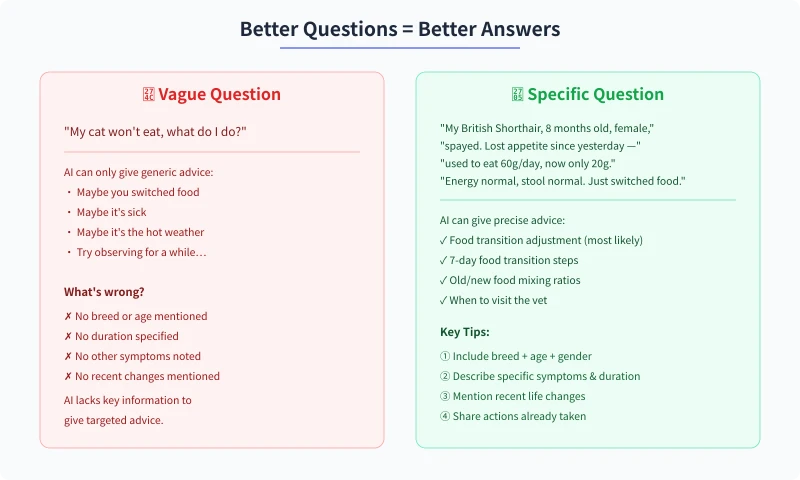
Key Tips for Writing Good Questions
The quality of AI answers depends on the quality of your questions. Remember four key points:
① Be Clear About "Who"
Breed, age, gender, spayed/neutered — this basic information determines the direction of AI advice. A 3-month-old kitten and an 8-year-old senior cat with the same symptom could have completely different causes.
② Describe Specific Symptoms
Do not just say "not feeling well." Where exactly? When did it start? Getting better or worse? The more specific you are the more accurate AI can be.
③ Provide Background Context
Any recent food changes? Moving? New guests? Contact with other animals? This context is often the key to the problem.
④ Share What You Have Already Done
Already gave probiotics? Already fasted? Tell AI so it avoids repeating suggestions and can give next-step advice based on actions you have already taken.
Recommended AI Tools
These tools are all suitable for pet care questions:
- DeepSeek (Recommended): Free, excellent Chinese understanding, detailed answers — visit chat.deepseek.com
- Doubao: By ByteDance, great mobile experience, convenient for quick questions
- Kimi: Excels at long text processing — recommended if you want to upload test reports for analysis
- ChatGPT: Strong overall capability but requires an overseas phone number to register
Advanced Usage: API Integration
If you want an AI assistant that truly "knows" your pet you can connect via the Ciyuano platform API. Write your pet basic info into the system prompt so you do not need to repeat it every time:
- Visit Model List to choose a suitable model
- Create a key at API Key Management
- API endpoint:
https://www.ciyuano.com/v1
Final Reminders
AI is a great helper but not a miracle worker. Go directly to the vet in these situations:
- Your pet was hit by a car or fell from a height
- Ingested toxic substances (chocolate, lilies, rat poison, etc.)
- Difficulty breathing, heavy bleeding, seizures
- Refused food and water for more than 24 hours
- Anything that feels off — trust your instincts
Owning a pet is a wonderful journey. With AI as your "on-call advisor" you do not have to panic when problems arise — ask anytime, learn anytime. But the most important thing is to observe and spend time with your little companion.
Related Articles
AI Speech to Text: Beginner's Guide to Convert Voice to Text in 3 Steps
Learn how to convert speech to text using AI tools. Perfect for meeting notes, content creation, and video subtitles. Three practical scenarios with step-by-step instructions.
TutorialsAI Local Deployment Guide: Run Large Models in 3 Steps for Free
Learn how to deploy AI models locally in just 3 steps. No coding experience needed, completely free, and your data stays private on your own computer.
TutorialsAI Shopping Decision Guide: From Price Comparison to Avoiding Pitfalls
Learn how to use AI for shopping decisions. From price comparison to avoiding pitfalls - make smarter purchasing choices with AI assistance.
Comments are not yet available, stay tuned