AI Search & Deep Research Guide: Find and Organize Information Efficiently with AI
Ever typed a keyword into a search engine hoping to learn about a new field, only to get a page full of ads and irrelevant links? This guide teaches you how to do deep research with AI — from framing questions to generating reports. A practical, step-by-step approach that anyone can follow.
Why Use AI for Research
Traditional search engines and AI search each have their strengths, but in research scenarios, AI has clear advantages:
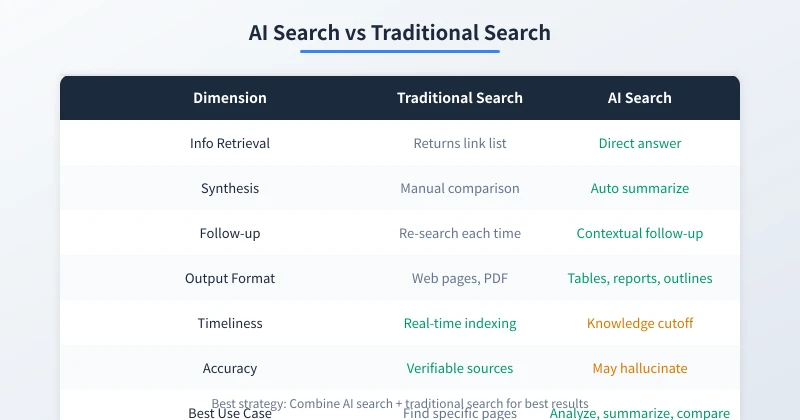
- Direct answers: No need to click through links — AI synthesizes information and gives you conclusions
- Auto-summarization: When facing large volumes of data, AI extracts key insights for you
- Contextual follow-up: Ask follow-up questions without starting over each time
- Flexible output: Choose tables, outlines, reports, or any format you need
Tip: AI search and traditional search are complementary, not replacements. The best strategy is combining both — AI helps you quickly build a cognitive framework, while traditional search verifies specific data and sources.
Four-Step Research Workflow
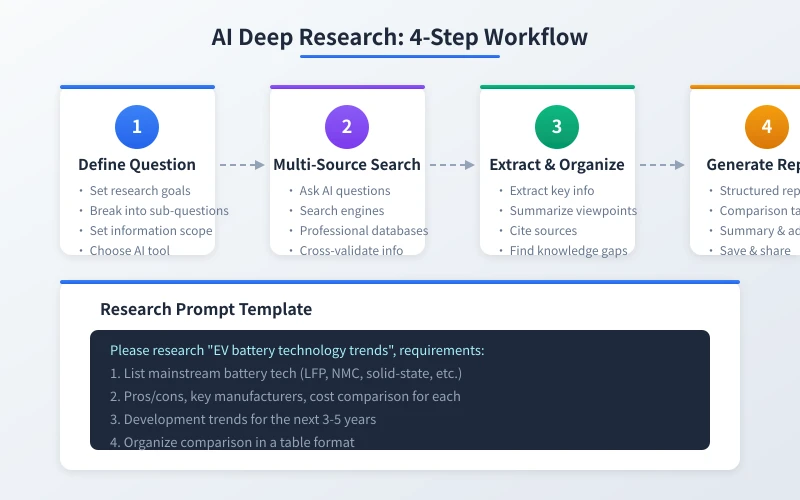
Step 1: Define Your Research Question
Many people jump straight to asking AI "tell me about XX" and get shallow, generic answers. Good research starts with good question framing.
Steps:
- Write down your core question in one sentence
- Break it into 3-5 sub-questions
- Set scope: time range, geographic focus, industry boundaries
- Choose the right AI tool
Example: If you want to understand the "new energy vehicle industry," dont just ask "how is the new energy vehicle industry" — break it down:
Core question: What are the trends in Chinas NEV market for 2025-2026?

Sub-questions:
1. Current market landscape — who are the major players?
2. Battery technology direction (solid-state, sodium-ion, etc.)
3. Autonomous driving tech routes and regulatory progress
4. Charging infrastructure development
5. Market competition after subsidy phase-out
Step 2: Multi-Source Information Retrieval
Dont rely on a single source. Here is a recommended retrieval strategy:
| Source | Best For | Watch Out |
|---|---|---|
| AI Chat Tools | Quick framework building | Knowledge cutoff dates |
| Search Engines | Latest data and news | Distinguish ads from organic results |
| Academic Databases | Papers, patents, reports | Requires domain expertise |
| Social Media | Real user feedback and trends | Fragmented info, cross-validate |
Tips for asking AI:
Round 1: Build framework
"Introduce the basics, key players, and tech routes of [field]"

Round 2: Deep dive
"You mentioned solid-state batteries — explain the principles, manufacturing challenges, and key companies"

Round 3: Get data
"Can you provide 2025 global EV battery market share data?"

Round 4: Comparative analysis
"Compare CATL and BYD battery technologies in a table"
Step 3: Extract and Organize
Once you have enough information, let AI help you organize it. The core principle is "separate signal from noise."
Organization prompt template:
Based on our conversation, help me compile a research summary:

1. Key conclusions (3-5 points)
2. Critical data points (cite sources)
3. Comparison of different viewpoints
4. Unverified information (needs further checking)
5. Your assessment and recommendations
Important: AI may "hallucinate" — fabricating non-existent data or citations. For critical data points (market share, specific numbers), always cross-verify with search engines or professional databases.
Step 4: Generate the Research Report
The final step — have AI output the organized information as a structured report:
Based on the above research, generate a formal report:

Format:
- Title: [Topic] Research Report
- Include: Executive Summary, Body (sections), Data Tables, Conclusions and Recommendations
- Body: 1500-2000 words
- Tone: Professional but accessible for non-specialists
Practical Research Prompt Templates
Template 1: Industry Research
Help me research the [industry name] industry:
1. Overview: definition, market size, growth trends
2. Competitive landscape: Top 5 players and their core strengths
3. Tech trends: key technology directions for the next 3 years
4. Investment opportunities: sub-sectors worth watching
5. Risk factors: main challenges facing the industry
Organize key data in tables.
Template 2: Product Comparison
Compare these products: [Product A], [Product B], [Product C]

Dimensions:
- Core features
- Pricing plans
- User reviews
- Pros and cons
- Best use cases

Organize in a table format with final recommendation.
Template 3: Technology Research
Research [technology name] technology:
1. Basic principles (explain in plain language)
2. Development history (key milestones)
3. Current applications
4. Advantages and limitations
5. Future roadmap
6. Recommended learning resources
Advanced Tips
Tip 1: Role-Playing for Better Answers
Assign an expert role to AI for significantly better responses:
You are a senior industry analyst specializing in market research and competitive analysis. Analyze [topic] from a professional analyst perspective.
Tip 2: Ask AI to Cite Sources
In research, information reliability is critical. Ask AI to cite its sources:
Answer the following and cite sources for each key data point:
- If from a public report, note the report name and publisher
- If speculative, clearly mark as "speculation"
- If uncertain, mark as "needs verification"
Tip 3: Use Socratic Questioning to Dig Deeper
Dont settle for the first answer. Use follow-up questions to go deeper:
- "Why did this trend emerge?"
- "What are the counter-arguments to this conclusion?"
- "Does this conclusion still hold in [specific context]?"
- "What risk factors might I be overlooking?"
Tip 4: Batch Research for Efficiency
If you need to research multiple similar topics, design a unified template and batch execute:
Here are 5 topics I need to research:
1. [Topic A]
2. [Topic B]
3. [Topic C]
4. [Topic D]
5. [Topic E]

Use a consistent format for each:
- Overview (100 words)
- Key data (table)
- Strengths and risks
- One-line conclusion
Recommended Tool Stack
| Tool Type | Recommendations | Use Case |
|---|---|---|
| AI Chat | CiyuanQu, ChatGPT, DeepSeek | Framework building, synthesis |
| Search Engines | Google, Bing | Latest data, news verification |
| Academic Search | Google Scholar, Semantic Scholar | Papers, patents, technical reports |
| Note-Taking | Notion, Obsidian | Save and organize research |
Common Mistakes
| Mistake | Correct Approach |
|---|---|
| Fully trusting AI answers | Cross-verify critical data |
| Questions too broad | Break into specific sub-questions |
| Using only AI as source | AI + search engines + databases |
| Not verifying AI citations | Ask AI to cite sources and manually verify |
| Asking everything at once | Progressive layering, dig deeper each round |
Summary
Deep research with AI comes down to four steps:
- Define the question: Break big questions into small ones — the more specific, the better
- Multi-source retrieval: AI builds the framework, search engines fill in data
- Extract and organize: Let AI summarize, but verify critical data yourself
- Generate the report: Choose the right format for your needs
Next step: Pick a topic you are curious about and try the four-step workflow. You will find that research that used to take days can now be done in hours.
Related Articles
AI 本地部署入门:零基础三步跑起大模型,完全免费
不用注册、不用充钱、完全离线。本文手把手教你用 Ollama 等工具,在自家电脑上部署运行开源大模型,从零开始完成本地 AI 部署的全过程。
TutorialsAI 帮你做购物决策:从比价到避坑的完整实操指南
买手机、买耳机、买电脑,AI 真的能帮你选对吗?本文用五个实操步骤,手把手教你让 AI 完成价格对比、参数解析、口碑筛选和避坑提醒,小白也能 10 分钟搞定购物决策。
TutorialsAI 语音输入与语音转文字:零基础 5 分钟上手,解放双手的写作新方式
打字太慢?说话比打字快 3 倍。这篇文章手把手教你用 AI 语音输入工具,从选择工具、开始录音到转文字、编辑导出,五大步骤、六大场景,让你从此"说话即写作"。
Comments are not yet available, stay tuned