A Practical Guide to AI Shopping Price Comparison and Decision Assistance: Master Smart Consumer Choices in Four Steps
Every time you open a shopping app, faced with dozens of brands and hundreds of models, do you often fall into "analysis paralysis"? AI can help you quickly filter, compare, and analyze, turning your "agonizing for hours" into "getting it done in minutes." This article teaches you four steps to make the most of an AI shopping assistant, covering the entire process: product selection, price comparison, review analysis, and decision-making.
Why Use AI for Shopping Decisions?
The pain points of traditional shopping decisions are obvious:
- Information Overload: Dozens of brands in one category, each with a dozen models, and specs that make your eyes glaze over.
- Hard to Distinguish Real Reviews: Buying fake positive reviews and deleting negative ones is an industry norm, making it tough for regular users to tell what's genuine.
- Opaque Pricing: The same product can vary in price by 20%-30% across different platforms.
- Knowledge Gaps: When buying unfamiliar products (like camera lenses or water filter cartridges), you don't know which specifications actually matter.
AI's advantage lies in its ability to synthesize vast amounts of information in seconds, generate comparison plans based on your needs, and help you quickly narrow down your options.
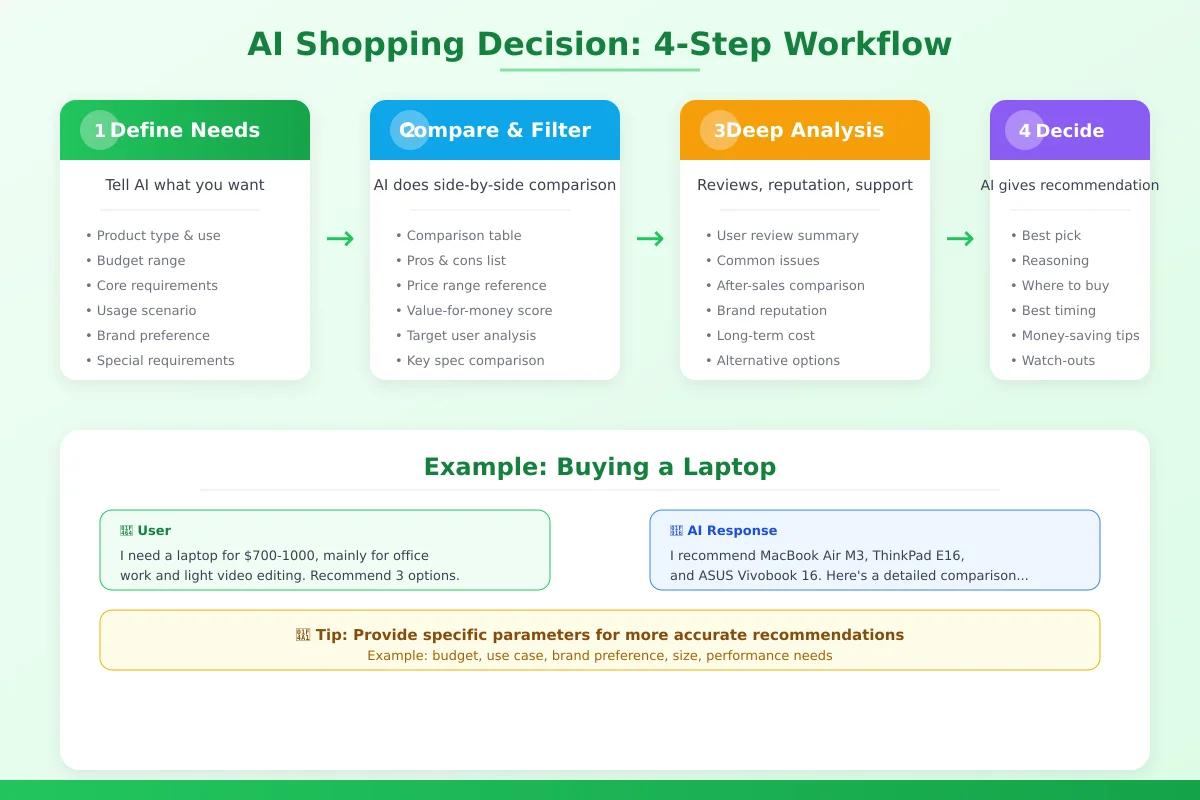
Step 1: Define Your Needs
Before asking AI, think clearly about what you actually need. The more specific the information, the more accurate AI's recommendations will be.
Need Description Template
Structure your question using this template, and AI will give you targeted recommendations:
- Product Type: What do you want to buy? (Phone, laptop, washing machine, course...)
- Budget Range: How much are you planning to spend? (Under 3000 yuan / 5000-7000 yuan...)
- Core Needs: What matters most to you? (Good camera, long battery life, low noise, great value...)
- Usage Scenario: What will you primarily use it for? (Work, gaming, gifting, personal use...)
- Special Requirements: Any hard constraints? (Must be domestic version, needs 5G support, requires a drying function...)
Practical Example
❌ Vague Question: "Recommend a phone for me."
✅ Precise Question: "Budget around 3000 yuan, mainly for taking photos and watching videos, no heavy gaming, want good battery life and an eye-friendly screen. Recommend 3 models and compare them."
See the difference? The latter gives AI clear filtering criteria, allowing it to directly eliminate unsuitable models and give you the most relevant recommendations.
Step 2: Let AI Do a Side-by-Side Comparison
After AI recommends a few options, the next step is to have it perform a detailed horizontal comparison.
Suggested Comparison Dimensions
The focus of comparison varies by product category, but these dimensions are universal:
- Price: Current selling price, historical price range, any ongoing promotions
- Core Specs: Key specifications that directly impact user experience
- Pros and Cons: The strengths and weaknesses of each option
- Target User: What type of user each option is best suited for
- Value Rating: An overall assessment combining price and performance
Questioning Techniques
When asking AI to generate a comparison, you can request it like this:
"Compare these 3 phones in a table, listing price, processor, screen, camera, battery, and weight across 6 dimensions. Finally, give a value-for-money rating and recommend who each is for."
AI will generate a clear comparison table, letting you see the pros and cons of each option at a glance.
Step 3: Deep Dive into Reviews and Reputation
Spec comparisons are just the surface. What truly determines your experience is the real feedback from long-term use.
Let AI Analyze User Reviews
You can copy reviews you see on e-commerce platforms and paste them to AI for a summary:
"I saw that positive reviews for this laptop say the screen is great and build quality is excellent, but negative reviews say the cooling is poor and the keyboard feel is average. Help me analyze if these issues are serious and if there are alternatives."
Key Review Dimensions to Focus On
- Common Praise: What advantages are most users agreeing on?
- Common Complaints: What recurring issues are mentioned? Do they affect core usage?
- After-Sales Experience: Is the brand's after-sales service reliable? What is the warranty policy?
- Long-Term Use: What are the reviews like after six months or a year of use? Are there any "horror stories"?
Identifying Fake Reviews
Tell AI you suspect some reviews might be fake, and it will help you analyze suspicious patterns: identical review content, clustered posting times, overly technical language, etc. Cross-validating with reviews from multiple platforms makes the conclusion more reliable.
Step 4: Make the Final Decision
After completing the first three steps, you can ask AI to give its final recommendation.
Let AI Make the Final Recommendation
Tell AI what you're struggling with and let it help you decide:
"I'm torn between these 3: A has the best camera but costs 500 yuan more, B offers the best value but the brand isn't well-known, and C is a big brand but has average specs. I mainly take photos for social media and occasionally play games. Which one do you recommend?"
Additional Questions
After making a choice, don't forget to ask AI these practical questions:
- Best Purchase Channel: Which platform has the lowest price and best after-sales service?
- Purchase Timing: Buy now or wait for a promotion (618, Singles' Day, brand anniversary)?
- Money-Saving Tips: Are there any coupons, discount events, or trade-in offers?
- Accessory Recommendations: What accessories do you need to go with it (phone case, screen protector, docking station...)?
5 Practical Shopping Scenarios
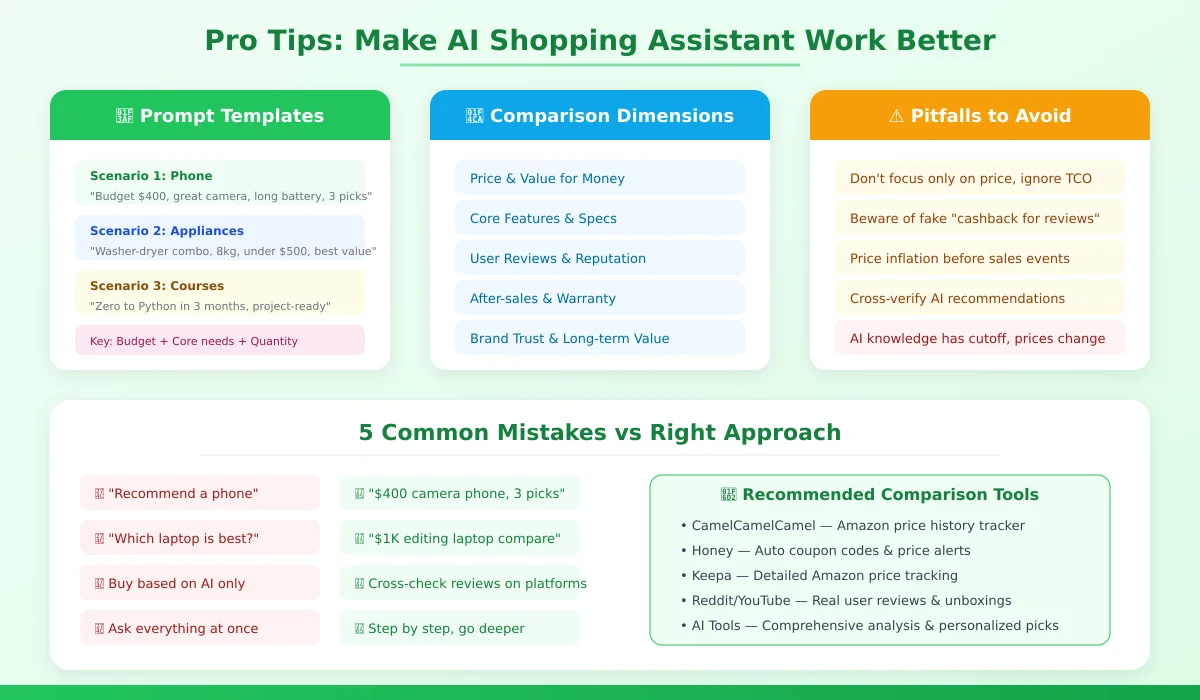
Scenario 1: Buying a Phone
Example Question: "Budget 2000-3000 yuan, good camera, long battery life, snappy performance. Mainly for Douyin and WeChat. Recommend 3 models and compare."
AI will: Create a comparison table listing processor performance, camera specs, battery capacity, screen quality, and tell you which has the best camera, which has the best battery life, and which is the best all-rounder.
Scenario 2: Buying Home Appliances
Example Question: "I want to buy a washer-dryer combo, 10kg capacity, budget under 4000 yuan, needs to be quiet, and will be placed on the balcony."
AI will: Compare motor type, noise decibels, drying method, energy efficiency rating, and help you determine which features are genuinely useful and which are just gimmicks.
Scenario 3: Buying Digital Accessories
Example Question: "I want to buy a docking station for my MacBook Air. Needs HDMI, USB-A, and an SD card slot. Budget under 300 yuan."
AI will: Compare port counts, transfer speeds, thermal design, and compatibility, telling you which brands are well-built and which ones tend to overheat.
Scenario 4: Buying Online Courses
Example Question: "I want to learn Python programming. Complete beginner. Goal is to be able to do data analysis projects within 3 months. Recommend suitable courses."
AI will: Compare course content, learning paths, practical projects, price, and reputation across different platforms to help you choose the best course for absolute beginners.
Scenario 5: Choosing Travel Products
Example Question: "I want to go to Yunnan for 5 days during National Day holiday. 2 people. Budget 8000 yuan. Prefer natural scenery. Compare the pros and cons of independent travel vs. a guided tour."
AI will: Compare itinerary, cost breakdown, flexibility, and potential risks, offering specific advice.
5 Tips to Make Your AI Shopping Assistant More Effective
1. Ask Step-by-Step, Go Deeper Gradually
Don't ask all your questions at once. First, have AI recommend 3-5 models. Pick 2-3 that interest you, then ask AI for an in-depth comparison. This way, AI's responses are more targeted.
2. Specify the Output Format for AI
Tell AI what format you want: "Compare in a table," "List 3 pros and 3 cons," "Rate them on a scale of 1-10." Structured output is easier to compare than large blocks of text.
3. Cross-Validate with Price Comparison Tools
AI's recommendations are a reference, not the final answer. Verify with these tools:
- SMZDM (What's Worth Buying): Real user tips and price trends
- Manman Buy: Historical price lookup to identify fake promotions
- JD/Taobao Price Comparison Plugins: One-click browser comparison
- Xiaohongshu/Bilibili: Real user experiences and review videos
4. Be Aware of AI's Knowledge Recency
AI's training data has a cutoff date. The latest product information and prices may not be accurate. For new releases or price-sensitive items, always check the actual price on the e-commerce platform.
5. Make Good Use of Follow-Up Questions
After AI makes a recommendation, don't rush to a decision. Ask a few more questions: "How does this compare to X model?" "Is the brand's after-sales service reliable?" "Is there a cheaper alternative?" Follow-up questions help you uncover details that AI might have missed in its initial answer.
5 Common Mistakes to Avoid
- Only Looking at Price, Ignoring Total Cost: A cheap product might have expensive consumables, high repair costs, or a short lifespan. Ask AI to calculate the "total lifecycle cost" for you.
- Blindly Trusting AI and Buying Immediately: AI's recommendations are based on a synthesis of training data and may not be perfectly accurate. Always verify the actual price and stock on the e-commerce platform.
- Being Misled by "Positive Review Rewards": Many glowing reviews are bought. Ask AI to analyze the authenticity of reviews, focusing on neutral reviews and those with images/videos.
- Impulse Buying During Sales Events: Many "limited-time deals" during 618 or Singles' Day involve raising prices before a discount. Use tools like Manman Buy to check historical prices and confirm it's a real deal.
- Asking All Questions at Once: Too much information can overwhelm AI. Ask step-by-step, focusing on one dimension at a time for better results.
Summary
An AI shopping assistant isn't meant to make decisions for you. It's meant to help you gather and analyze information more efficiently. The four-step process is simple:
- Define Needs: Tell AI what you want. The more specific, the better.
- Side-by-Side Comparison: Have AI create a comparison table for a clear overview.
- Deep Analysis: Get AI to analyze reviews, reputation, and after-sales service.
- Make a Decision: Let AI give its recommendation, then verify with price comparison tools.
Remember: AI is your shopping advisor, not your shopping decision-maker. You are the one who ultimately decides what to buy. AI's value lies in saving you the time spent on information gathering and comparison, allowing you to focus your energy on "choosing which one" instead of "finding the information."
```Related Articles
AI Speech to Text: Beginner's Guide to Convert Voice to Text in 3 Steps
Learn how to convert speech to text using AI tools. Perfect for meeting notes, content creation, and video subtitles. Three practical scenarios with step-by-step instructions.
TutorialsAI Local Deployment Guide: Run Large Models in 3 Steps for Free
Learn how to deploy AI models locally in just 3 steps. No coding experience needed, completely free, and your data stays private on your own computer.
TutorialsAI Shopping Decision Guide: From Price Comparison to Avoiding Pitfalls
Learn how to use AI for shopping decisions. From price comparison to avoiding pitfalls - make smarter purchasing choices with AI assistance.
Comments are not yet available, stay tuned