AI Translation Practical Guide: 5 Scenarios to Master Multilingual Communication
Why Use AI for Translation?
Traditional translation tools (like early machine translation) often produce awkward sentences and mistranslated technical terms. Modern AI large language models can understand context and adjust tone and wording based on the scenario. The translation quality is now very close to human-level.
More importantly, AI translation is nearly free and produces instant results — more than enough for everyday translation needs.
Scenario 1: Document Translation
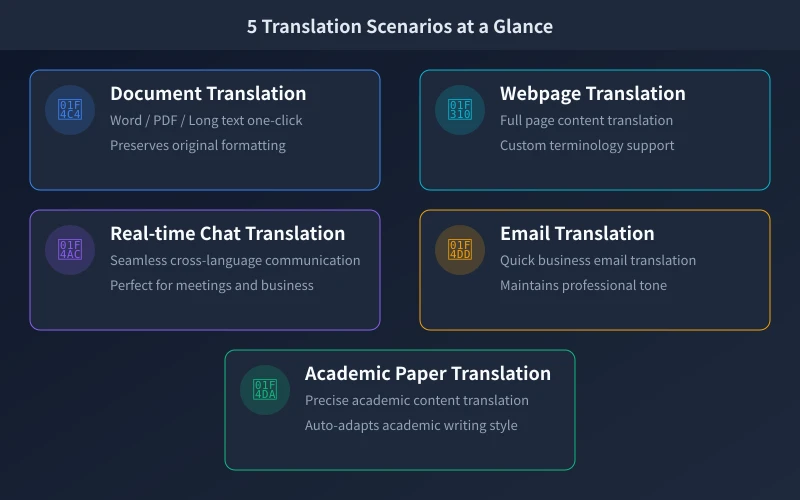
This is the most common need. You have a Chinese report that needs to be translated into English for a client.
Step-by-step:
- Open your preferred AI chat tool (such as ChatGPT, Claude, Gemini, etc.)
- Write a clear request in the input box, for example:
"Please translate the following Chinese document into English. Maintain the original formatting and paragraph structure. Use the following terminology reference: XX=XX, YY=YY" - Paste the document content into the chat box
- The AI will return the translation — review it and you're good to go
Pro tip: If the document is long (over 2000 words), translate it in sections. 500-1000 words per chunk gives the best results.
Scenario 2: Webpage Content Translation
When browsing foreign websites, built-in browser translations often sound stiff. You can use AI for more accurate translations.
Step-by-step:
- Select the text you want to translate on the webpage
- Copy and paste it into the AI chat box
- Example prompt: "Please translate the following webpage content into natural, fluent English. Preserve any links and formatting markers from the original"
- If it involves a specialized field (like medicine or law), mention that upfront
Scenario 3: Real-time Chat Translation
Having a video call with a foreign client, or need real-time communication while traveling abroad? AI can help.
Step-by-step:
- Start a new conversation in your AI tool
- Set the role: "You are my Chinese-English translator. When I speak Chinese, translate to English. When I speak English, translate to Chinese. Keep it conversational."
- Input what the other person says or what you want to say in real-time
- The AI returns the translation instantly
Advanced usage: Some AI tools now support voice input — you can speak directly and get translated responses, making it feel like simultaneous interpretation.
Scenario 4: Business Email Translation
Writing English emails is a pain point for many. AI translation not only gets it right but also helps polish the tone.
Step-by-step:
- Write the email content in your native language first
- Prompt: "Please translate the following email into English. Use a professional and polite tone suitable for business communication."
- If the recipient is a familiar partner, add: "The tone can be slightly more casual."
- Double-check the recipient's name and company name
Scenario 5: Academic Paper Translation
Academic translation demands the highest accuracy. AI can produce a solid first draft, but manual review is recommended.
Step-by-step:
- Provide the subject area and target journal
- Example prompt: "Please translate the following academic abstract into English. The field is computer science. The target journal is IEEE. Use formal academic language."
- Translate sections individually: abstract, methods, results, discussion
- After translation, ask AI to polish: "Please review the following English academic translation and ensure correct grammar and natural expression."
5 Universal Tips to Improve Translation Quality
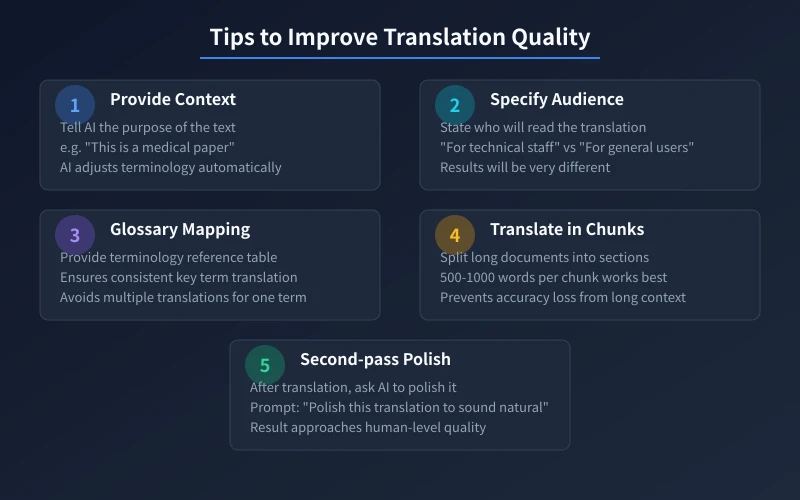
- Provide context: Tell AI what the text is for, and it will adjust its vocabulary automatically
- Specify the audience: State who will read the translation (technical staff vs general users) — the results will be very different
- Terminology reference: Provide a glossary of key terms upfront to ensure consistency
- Chunk long texts: Don't throw an entire long document at AI at once — smaller sections produce better quality
- Second-pass polish: After translation, have AI polish it once more for results that approach human-level quality
Conclusion
AI translation isn't meant to replace human translators. Rather, it offers a fast, low-cost, high-quality alternative for most everyday scenarios. For high-stakes documents like legal contracts, the best approach is AI translation combined with human review.
Master the 5 scenarios and 5 tips above, and you'll be able to handle the vast majority of your translation needs with AI.
Related Articles
AI 本地部署入门:零基础三步跑起大模型,完全免费
不用注册、不用充钱、完全离线。本文手把手教你用 Ollama 等工具,在自家电脑上部署运行开源大模型,从零开始完成本地 AI 部署的全过程。
TutorialsAI 帮你做购物决策:从比价到避坑的完整实操指南
买手机、买耳机、买电脑,AI 真的能帮你选对吗?本文用五个实操步骤,手把手教你让 AI 完成价格对比、参数解析、口碑筛选和避坑提醒,小白也能 10 分钟搞定购物决策。
TutorialsAI 语音输入与语音转文字:零基础 5 分钟上手,解放双手的写作新方式
打字太慢?说话比打字快 3 倍。这篇文章手把手教你用 AI 语音输入工具,从选择工具、开始录音到转文字、编辑导出,五大步骤、六大场景,让你从此"说话即写作"。
Comments are not yet available, stay tuned