AI Trip Planning: A 7-Step Guide from Destination Selection to Itinerary
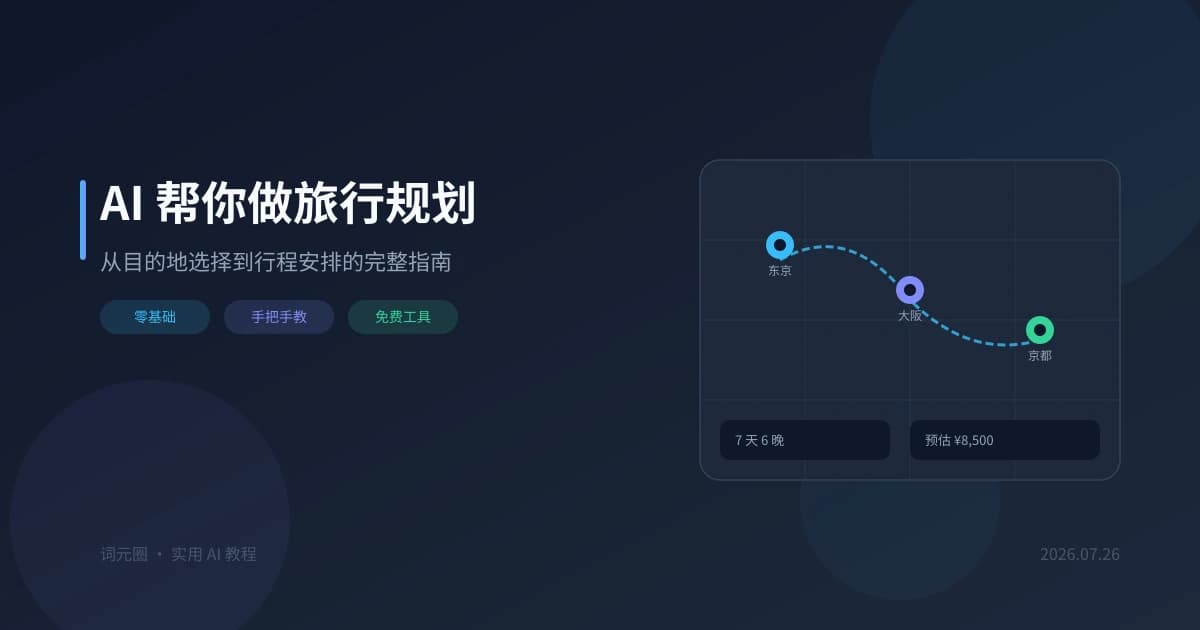
Planning a trip can be overwhelming - too many options, too little time. AI can help you plan the perfect vacation in minutes. Here's your complete guide to AI-powered trip planning.
Why Use AI for Trip Planning?
- Save Time - Research takes hours, AI takes minutes
- Personalized - Tailored to your budget, interests, and style
- Comprehensive - Covers flights, hotels, activities, and more
- Up-to-date - AI has access to current information
Step 1: Define Your Trip Parameters
Start by telling AI what you want:
| Parameter | Example | Why It Matters |
|---|---|---|
| Destination | "Tokyo" or "anywhere in Japan" | Focuses recommendations |
| Budget | "$2000 total" or "$150/night" | Filters options |
| Duration | "7 days" or "one weekend" | Plans pacing |
| Interests | "food, temples, shopping" | Personalizes itinerary |
| Travel Style | "luxury" or "budget" | Matches accommodations |
Step 2: Get Destination Recommendations
If you're not sure where to go, ask AI:
Recommend 5 destinations for a [X-day] trip in [season].
Budget: [amount]
Interests: [list]
Avoid: [things you don't want]
Example Response
- Tokyo, Japan - Great for food and culture
- Bangkok, Thailand - Budget-friendly with great food
- Seoul, South Korea - K-pop, shopping, and food
- Singapore - Clean, safe, and diverse
- Chiang Mai, Thailand - Slower pace, cultural experiences
Step 3: Plan Your Itinerary
Once you have a destination, ask AI to create an itinerary:
Create a [X-day] itinerary for [destination].
Include:
- Morning activities
- Lunch recommendations
- Afternoon activities
- Evening activities
- Rest breaks

Budget: [amount]
Interests: [list]
Sample Itinerary Structure
| Time | Day 1 | Day 2 | Day 3 |
|---|---|---|---|
| Morning | Shibuya Crossing | Senso-ji Temple | Meiji Shrine |
| Lunch | Ramen | Tempura | Sushi |
| Afternoon | Shopping | Akimabara | TeamLab |
| Evening | Izakaya | Bar hopping | Skyline view |
Step 4: Find Accommodations
Ask AI for hotel recommendations:
Recommend 5 hotels in [destination] for [X nights].
Budget: $[amount]/night
Must have: [pool, breakfast, location]
Nice to have: [gym, spa, view]
Step 5: Book Flights and Transport
AI can help you find the best flights:
- Compare prices - AI can check multiple sources
- Find deals - Alert you to price drops
- Optimize timing - Suggest cheapest travel days
Step 6: Pack Smart
Get a personalized packing list:
Create a packing list for a [X-day] trip to [destination] in [season].
Activities: [hiking, beach, city]
Weather: [temperature range]
Special needs: [medications, equipment]
Step 7: Prepare for the Trip
- Documents - Check passport, visa requirements
- Apps - Download translation, maps, ride-sharing
- Money - Check exchange rates, notify bank
- Health - Check vaccination requirements
AI Trip Planning Prompt Library
| Task | Prompt |
|---|---|
| Destination ideas | "Recommend 5 destinations for [criteria]" |
| Itinerary | "Create a [X-day] itinerary for [destination]" |
| Food | "Recommend 10 must-try foods in [destination]" |
| Shopping | "Best shopping areas in [destination] for [items]" |
| Budget | "Estimate total cost for [X-day] trip to [destination]" |
Tips for Success
- Be specific - The more details, the better the recommendations
- Iterate - Refine your itinerary with follow-up questions
- Verify - Always double-check important details
- Save everything - Keep AI responses for reference
AI trip planning makes vacation planning fun and stress-free. Start with a simple prompt and let AI handle the details. Your perfect trip is just a conversation away!
Related Articles
AI Speech to Text: Beginner's Guide to Convert Voice to Text in 3 Steps
Learn how to convert speech to text using AI tools. Perfect for meeting notes, content creation, and video subtitles. Three practical scenarios with step-by-step instructions.
TutorialsAI Local Deployment Guide: Run Large Models in 3 Steps for Free
Learn how to deploy AI models locally in just 3 steps. No coding experience needed, completely free, and your data stays private on your own computer.
TutorialsAI Shopping Decision Guide: From Price Comparison to Avoiding Pitfalls
Learn how to use AI for shopping decisions. From price comparison to avoiding pitfalls - make smarter purchasing choices with AI assistance.
Comments are not yet available, stay tuned