A Practical Guide to AI Travel Planning Assistants: Itinerary Planning, Budget Control, and Food Recommendations All in One
Why Use AI for Travel Planning?
Many people want to travel independently, but the thought of planning gives them a headache—researching attractions, comparing hotels, finding restaurants, calculating budgets. Just the preparation alone can take days. AI can help you compress all of that into half an hour.
You don't need to know how to code or have any specialized knowledge. Just tell AI where you want to go, how many days, and your budget, and it will give you a complete plan. Not satisfied? Adjust anytime—much more efficient than digging through travel guides yourself.
Step 1: Tell AI Your Travel Needs
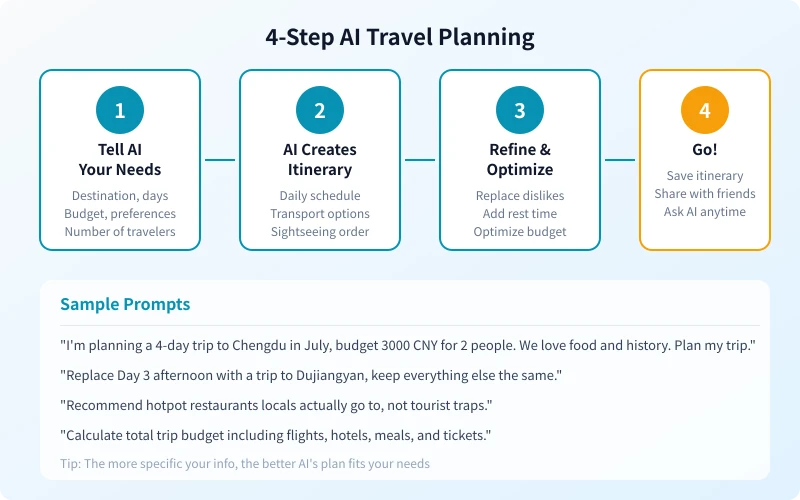
The first step in planning a trip is to give AI your basic information. The more specific the information, the more reliable the plan AI provides.
Key Information You Need to Tell AI
- Destination: Which city or country are you going to?
- Travel dates: What date will you depart? How many days?
- Budget range: Approximately how much do you want to spend in total?
- Number of travelers: Solo, couple, or with kids?
- Personal preferences: Do you prefer natural scenery or cultural history? Adventure or relaxation?
Sample Questions
Domestic trip: "I plan to go to Chengdu in mid-July for 4 days, with a budget of 3,000 yuan, two people, love food and history & culture. Please help me plan a detailed itinerary."
International trip: "I want to go to Tokyo, Japan in early August for 5 days, budget around 10,000 yuan, solo traveler, like anime and shopping, not great with English. Please help me arrange an itinerary."
Family trip with kids: "I want to take my 5-year-old child to Sanya for 3 days during the National Day holiday, budget 5,000 yuan, need activities suitable for young children. Please help me plan."
Step 2: Let AI Generate a Detailed Itinerary
After telling AI your needs, it will give you a day-by-day itinerary plan. A good itinerary typically includes:
- Daily attraction arrangements and visiting order
- Transportation methods and time between attractions
- Recommended restaurants for each meal
- Ticket prices and opening hours for each attraction
- Suggestions for accommodation areas
How to Make the Itinerary Better?
If the AI's plan is too packed or too loose, just tell it to adjust:
"The itinerary is too rushed. Remove one attraction per day and leave more time for rest."
"I'm not very interested in museums. Can we swap them for shopping or cafes?"
"I want to change the afternoon of Day 2 to Dujiangyan, keep the rest of the itinerary the same. Please adjust."
Compare Multiple Plans
You can ask AI to generate two or three different styles of plans for comparison:
"Please give me two options: one more relaxed, one more in-depth. I'll choose."
Step 3: Use AI to Control Travel Budget
The biggest fear when traveling is overspending. AI can help you calculate each expense in advance so you know exactly what to expect.
Let AI Do the Math for You
Send the itinerary to AI and say: "Please estimate the total cost of this trip, including transportation, accommodation, meals, tickets, and shopping, and list the estimated amount for each item."
AI will give you a detailed cost breakdown:
- Round-trip flight/high-speed rail: approx. xxx yuan
- Accommodation (x nights): approx. xxx yuan
- Meals (x days): approx. xxx yuan
- Attraction tickets: approx. xxx yuan
- Local transportation: approx. xxx yuan
- Other (shopping, souvenirs): approx. xxx yuan
- Total: approx. xxx yuan
Money-Saving Tips
If the budget is exceeded, simply tell AI: "I'm over budget by 500 yuan. What are some ways to save money?" AI will give you specific alternatives, such as:
- Switch from flying to high-speed rail
- Recommend more cost-effective hotel areas
- Find free attractions to replace paid ones
- Recommend affordable but tasty restaurants
Step 4: Let AI Recommend Authentic Local Food
One of the most important parts of travel is eating. But many restaurants recommended online are "influencer spots" that locals never visit. How do you find truly good food?
Here's How to Ask AI for Best Results
Avoid tourist traps: "Recommend hot pot restaurants that locals in Chengdu frequent, not the influencer spots that cater to tourists."
Recommend by taste: "I like spicy food and can't eat much seafood. Please recommend Changsha cuisine that suits my taste."
Recommend by scenario: "I have free time from 3 to 5 PM one afternoon. Recommend a place near West Lake in Hangzhou suitable for afternoon tea."
Generate a food checklist: "Please create a must-eat list for Chengdu, including 3 places each for snacks, main courses, and desserts, along with addresses and per-person cost."
Advanced Tips: More Practical Scenarios
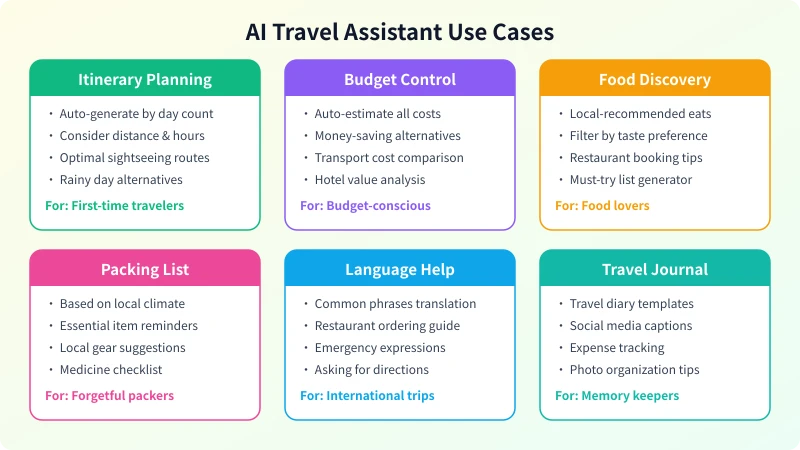
Packing List Generation
"I'm going to Harbin for 3 days in December. The outdoor temperature is around minus 20 degrees Celsius. Please create a packing list including clothing, gear, and medicine."
AI will give you a detailed list based on the destination's climate and your itinerary characteristics.
Language Communication Assistant
International travel often involves language barriers. You can have AI prepare common phrases in advance:
"Please prepare a set of common Japanese travel phrases, including asking for directions, ordering food, shopping, and emergencies, with Chinese phonetic pronunciation."
Travel Journal Template
"Help me write a travel diary template where I only need to fill in a few keywords each day to generate a complete travelogue."
Emergency Response
"What should I do if I lose my passport while traveling in Japan? Please list the specific steps and contact numbers."
Recommended Tools
The following AI tools are all suitable for travel planning:
ChatGPT
Most comprehensive in capability—it handles itinerary planning, budget calculation, and food recommendations well. The free version is generally sufficient.
Kimi
A domestic AI that is especially knowledgeable about travel information within China. Its restaurant and attraction recommendations are more down-to-earth. Supports long texts, suitable for complex itineraries.
Doubao
Developed by ByteDance. Conversations are natural and smooth, making it suitable for gradually refining your itinerary through chat.
DeepSeek
Strong reasoning ability, suitable for scenarios that require multi-plan comparison, budget optimization, and other complex calculations.
Frequently Asked Questions
Are the attraction details recommended by AI accurate?
They are mostly accurate, but specific information (such as ticket prices and opening hours) may change. It is recommended to confirm key details through official channels (such as attraction websites or Dianping) before departure.
Can AI help me book hotels and buy plane tickets?
AI itself cannot directly place orders, but it can help recommend hotel areas, compare price ranges, and provide selection advice. Actual booking still needs to be done through platforms like Ctrip or Fliggy.
Which AI is better for international travel?
ChatGPT is most knowledgeable about overseas information, while Kimi and Doubao are more familiar with outbound travel starting from China (visas, flights, etc.). It is recommended to use ChatGPT for destination information and domestic AI for departure-related matters.
Can I use AI's itinerary directly?
It can be used as a base plan, but it is recommended to fine-tune it based on actual conditions. For example, some attractions may need more time, and some restaurants may require reservations. Treat the AI's plan as a starting point and adjust according to your own pace.
Related Articles
AI Speech to Text: Beginner's Guide to Convert Voice to Text in 3 Steps
Learn how to convert speech to text using AI tools. Perfect for meeting notes, content creation, and video subtitles. Three practical scenarios with step-by-step instructions.
TutorialsAI Local Deployment Guide: Run Large Models in 3 Steps for Free
Learn how to deploy AI models locally in just 3 steps. No coding experience needed, completely free, and your data stays private on your own computer.
TutorialsAI Shopping Decision Guide: From Price Comparison to Avoiding Pitfalls
Learn how to use AI for shopping decisions. From price comparison to avoiding pitfalls - make smarter purchasing choices with AI assistance.
Comments are not yet available, stay tuned