Practical Guide to AI Travel Planning Assistant: Destination Selection, Itinerary Planning, and Budget Control All in One
Spending days researching guides, comparing prices, and planning itineraries before every trip? An AI travel planning assistant can compress the entire process into under 30 minutes—from destination selection to daily itinerary, generated in one click and adjustable at any time.
Why Use AI for Travel Planning
The pain points of traditional travel planning are clear:
- Fragmented information: You have to jump between a dozen apps—Xiaohongshu for guides, Ctrip for price comparisons, Amap for routes, Dianping for restaurants.
- High time cost: A 5-day domestic trip can take 2-3 evenings just to research.
- Hard to customize: Online guides are generic; it's difficult to find a plan that perfectly matches your time, budget, and preferences.
- Poor handling of surprises: Flight cancellations, attraction closures, weather changes—adjusting your itinerary on the fly is chaotic.
AI's core advantage is quickly integrating information and generating personalized plans. You just need to clearly state your requirements, and AI can provide a complete itinerary suggestion within minutes, adjusting in real time based on your feedback.
Four-Step AI Travel Planning Method
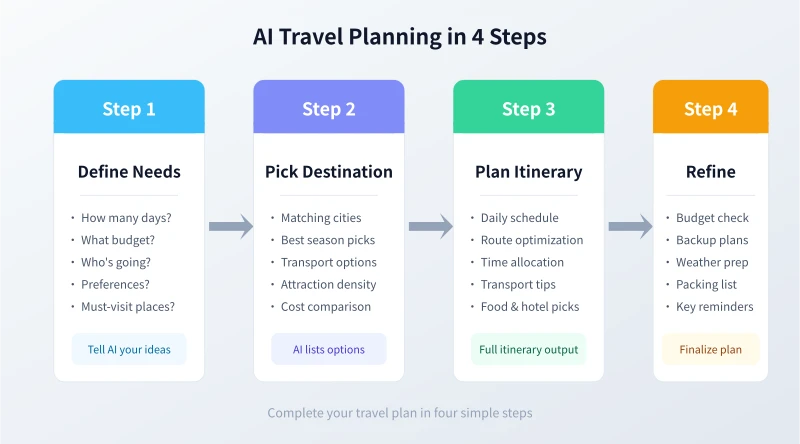
Step 1: Clarify Your Needs
Before talking to AI, think through these questions:
- Time: How many days? Specific dates or flexible?
- Number of people: Solo, couple, with kids, or a group of friends?
- Budget: Rough amount? Including flights or just local expenses?
- Preferences: Natural scenery, cultural heritage, food exploration, or leisure vacation?
- Constraints: Any places you don't want to go, physical limitations, visa issues, etc.?
Telling AI all this information at once is much more efficient than asking piecemeal.
Step 2: Let AI Recommend Destinations
If you haven't decided where to go yet, have AI help you choose. Example prompts:
- "Our family of three, child is 6 years old, we have 5 days off in mid-July, budget around 8000 yuan, want to go to the seaside, departing from Beijing. Recommend 3 destinations and compare pros and cons."
- "Looking for a warm place in December for 4 days, two people, budget 6000, not too popular attractions, any recommendations?"
- "I have 10 days of annual leave, want to travel abroad, passport is blank, budget 15,000, recommend a few destinations with easy visa applications."
AI will typically list 3-5 options and compare them from aspects like transportation, cost, richness of attractions, and suitable audience.
Step 3: Create a Detailed Itinerary
After selecting a destination, have AI generate a daily itinerary. Example prompts:
- "Help me plan a 4-day itinerary for Chengdu, arriving on the afternoon of the first day and leaving on the morning of the last day. Must include Kuanzhai Alley, Giant Panda Base, and Wuhou Shrine. Don't make each day too packed; leave time for meals and rest."
- "5-day independent trip to Tokyo, Japan, staying in Shinjuku. Want to visit Akihabara, Senso-ji, Shibuya, and Disneyland. Help me arrange the daily route, making sure subway transfers are convenient."
A good AI will provide specific arrangements for each day, including: order of attractions, transportation methods, estimated duration, and lunch/dinner suggestions.
Step 4: Optimize and Adjust
After receiving the initial itinerary, let AI adjust based on actual conditions:
- "Day 3 is too packed, help me simplify it—remove XX attraction."
- "Help me calculate the total budget for this itinerary, broken down into four categories: transportation, accommodation, meals, and tickets."
- "If it rains that day, what's the indoor backup plan?"
- "Help me generate a packing list: what to bring to Yunnan in December."
Five Practical Scenarios
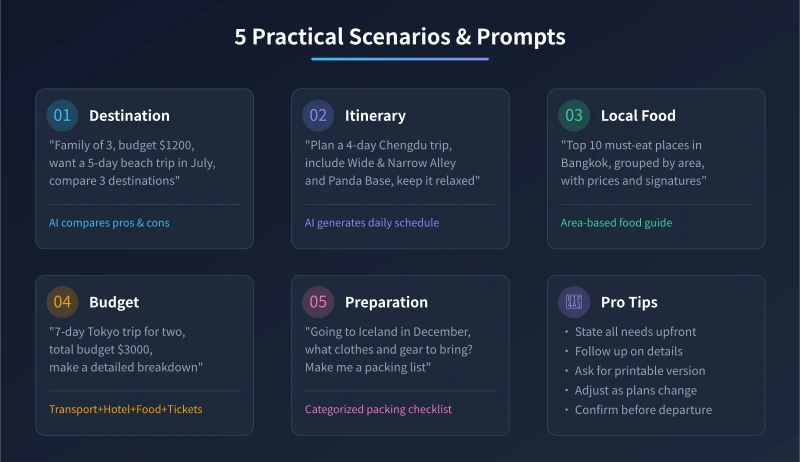
Scenario 1: Difficulty Choosing a Destination
Prompts:
- "Two adults and a 3-year-old child, we have 3 days off during Qingming Festival, departing from Shanghai, want to go for a spring outing and enjoy flowers, budget 5000, recommend 3 destinations and compare them."
- "My friend and I are college students, want to travel on a budget during summer break, budget 3000 per person for 5 days, recommend cost-effective places in China."
Scenario 2: Itinerary Route Optimization
Prompts:
- "How to arrange these 8 attractions to save the most time? Group them by geographic location—visit attractions in the same area each day."
- "I only have 2 days in Paris, arriving in the afternoon of the first day and leaving on the evening of the second day. Help me arrange the most essential route."
Scenario 3: Customized Food Guide
Prompts:
- "Recommend 10 must-try restaurants in Changsha, grouped by area (Wuyi Square, Taiping Street, Pozijie), with per-person cost and signature dishes."
- "I'm staying in Shinjuku, Tokyo. Any good izakayas nearby? Budget under 200 yuan per person."
Scenario 4: Budget Planning
Prompts:
- "7 days in Bangkok + Pattaya, Thailand, total budget for two is 15,000 yuan. Help me create a detailed budget table including flights, hotels, transportation, meals, and tickets."
- "Help me compare the cost difference between independent travel and a group tour, destination is Osaka, Japan, 5 days."
Scenario 5: Pre-Trip Packing List
Prompts:
- "Going to Harbin at the end of December, help me list a packing list including warm clothes, electronics, and medicine."
- "What do I need to prepare for Japan? Visa materials, essential apps, transportation cards, currency exchange—help me organize a checklist."
- "Taking a 2-year-old baby to Sanya, what do I need to bring? List by category."
Recommended Tools and Usage Tips
Recommended Tools
| Tool | Advantages | Best Suited For |
|---|---|---|
| ChatGPT | Strong comprehensive capabilities, supports web search | Complex itinerary planning, budget calculation |
| Kimi | Chinese-friendly, supports web page parsing | Domestic travel guides, food recommendations |
| DeepSeek | Strong reasoning ability, free | Budget comparison, route optimization |
| Claude | Good at handling long text | Multi-day itineraries, travel journals |
Usage Tips
- State all needs at once: Tell AI your time, number of people, budget, preferences, and constraints together to avoid back-and-forth questions.
- Break it down step by step: First have AI recommend destinations, then ask for the itinerary after deciding, and finally request the budget and list.
- Request formatted output: Ask AI to output the itinerary in a table or timeline format—much clearer than plain text.
- Ask for details: Follow up on uncertain points, e.g., "Does this attraction require advance booking?" "Is there a subway station nearby?"
- Have AI generate a printable version: Finally, ask AI to compile a complete travel handbook containing itinerary, budget, checklist, and emergency contact information.
Real Example: A Complete AI Travel Planning Session
Below is a demonstration of an actual planning process:
Round 1 (Clarify Needs):
User: "My girlfriend and I have 6 days off in mid-March, departing from Guangzhou, budget 10,000 yuan. We want a place with sea and great food, not too cold, and don't want to be too exhausted."
AI Reply: Recommended three options: Xiamen, Sanya, Weizhou Island, each with transportation, temperatures, estimated costs, and reasons for recommendation.
Round 2 (Finalize Itinerary):
User: "Choose Xiamen. Help me create a 6-day itinerary that includes Gulangyu Island, Zengcuoan, Zhongshan Road, and Nanputuo Temple. Don't pack each day too full, and recommend specific restaurants for lunch and dinner."
AI Reply: Generated a daily itinerary table with attraction order, transportation methods, dining suggestions, and estimated costs.
Round 3 (Add Details):
User: "Help me calculate the total budget. Also, what indoor alternatives are there if it rains? And help me list a packing list."
AI Reply: Provided a budget table, rainy-day alternatives, and a packing list.
The entire process took about 15 minutes, resulting in a complete travel handbook.
Important Notes
- Verify information: AI-recommended attractions, restaurants, and prices may be off. Before your trip, verify with platforms like Dianping and Ctrip.
- Real-time information: AI training data has a cutoff date. Attraction opening hours, ticket prices, etc., may change. Confirm again before departure.
- Transportation schedules: Do not fully rely on AI for real-time information like flights and train schedules; use official platforms.
- Hotel bookings: AI-recommended hotels are for reference only. Compare prices across multiple platforms when actually booking.
- Safety first: AI doesn't know your health condition. For special activities like high-altitude or diving, always consult professionals.
Conclusion
AI travel planning assistants are the antidote to "choice paralysis" and "research anxiety." The core process is four steps: Clarify needs → Choose destination → Plan itinerary → Fill in details. Remember:
- The more detailed your requirements, the more tailored AI's plan will be.
- Asking step by step works better than asking everything at once.
- AI provides reference plans; verify key information yourself.
- Before departure, have AI generate a complete handbook to consult anytime during the trip.
Next time you travel, try tossing your needs to AI. You'll find that planning a trip can actually be an easy thing.
Related Articles
AI Speech to Text: Beginner's Guide to Convert Voice to Text in 3 Steps
Learn how to convert speech to text using AI tools. Perfect for meeting notes, content creation, and video subtitles. Three practical scenarios with step-by-step instructions.
TutorialsAI Local Deployment Guide: Run Large Models in 3 Steps for Free
Learn how to deploy AI models locally in just 3 steps. No coding experience needed, completely free, and your data stays private on your own computer.
TutorialsAI Shopping Decision Guide: From Price Comparison to Avoiding Pitfalls
Learn how to use AI for shopping decisions. From price comparison to avoiding pitfalls - make smarter purchasing choices with AI assistance.
Comments are not yet available, stay tuned