AI-Powered Travel Planning: From Itinerary to Budget Management
Why You Need AI for Travel Planning
Before every trip, do you spend days researching guides, comparing prices, and arranging itineraries? Checking dozens of flight websites, scrolling through countless hotel reviews, and repeatedly calculating travel times — you're already exhausted before you even leave.
AI tools can compress all these tedious tasks into just minutes. You simply tell AI your needs, and it generates a complete travel plan: from itinerary to budget estimation, from restaurant recommendations to tips for avoiding tourist traps. No need to be a travel expert or have extensive self-guided travel experience.
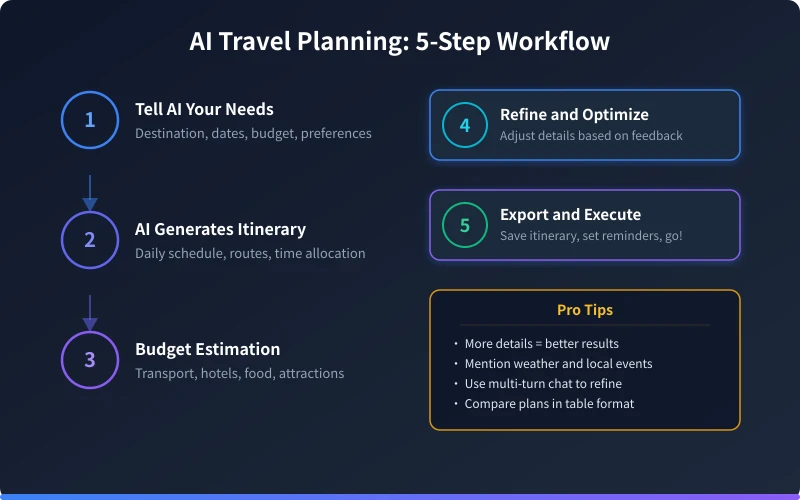
Step 1: Tell AI Your Travel Needs
Open ChatGPT, Claude, or any other AI tool, and input the following information so AI can understand your situation:
I'd like you to help me plan a trip. Here are my requirements: - Departure city: [Your city] - Destination: [Where you want to go] - Travel dates: [Specific dates], [X] days total - Number of travelers: [Number], any elderly or children? - Total budget: [Amount] USD (including transport, accommodation, food, attractions) - Travel style: [Relaxation / Cultural exploration / Food tour / Outdoor adventure / Shopping] - Special needs: [e.g., wheelchair access, vegetarian restaurants, kid-friendly] - Existing bookings: [Yes/No] Please create a detailed travel plan for me.
The more detailed your requirements, the more precise AI's plan will be. If you haven't decided on a destination yet, you can simply say "I want to use my 5-day vacation to go somewhere warm, within a $700 budget" — AI will suggest several suitable destinations for you.
Step 2: Let AI Generate Your Itinerary
Based on your needs, AI will generate an itinerary that includes:
- Daily schedule: What time to depart, which attractions to visit, and how long to spend at each
- Transportation: The best way to get between attractions — subway, bus, or taxi
- Dining recommendations: What to eat, where to go, and approximate costs
- Accommodation suggestions: Which area is most convenient, recommended hotels or hostels
If you're not satisfied with AI's first draft, you can continue the conversation to make adjustments:
Good overall, but Day 2 is too packed. Please help me:
- Remove that museum (not really interested in museums)
- Add a local market or night market in the afternoon
- Change dinner to a more unique restaurant
Also, please mark the daily transportation methods in more detail.
Step 3: Let AI Estimate Your Budget
Travel budgets are often the most stressful part. Have AI create a detailed budget breakdown:
Based on the itinerary above, please estimate the total cost of this trip, broken down into: 1. Transportation (round-trip flights/train + local transport) 2. Accommodation (nightly rate × number of nights) 3. Meals (breakfast, lunch, dinner + snacks and drinks) 4. Tickets and activities 5. Shopping and souvenirs 6. Emergency fund Please present in table format with a total. If it exceeds my budget, tell me where I can save money.
Step 4: Let AI Help You Avoid Pitfalls
The biggest difference between an experienced traveler and a beginner is knowing how to avoid "traps." Let AI serve as your travel consultant:
For this destination, please tell me: 1. What are the common tourist traps or scams? 2. Which attractions look great but are actually disappointing? 3. What's the local cost of living? What's worth buying vs. what's overpriced for tourists? 4. Are there any cultural taboos or etiquette rules to be aware of? 5. What's the weather like? Any special gear I should bring? 6. Any useful local apps or tools you'd recommend?
AI will summarize a pitfall-avoidance guide based on the experiences of countless travelers. This information is usually scattered across various travel blogs and guides — AI gathers it all for you at once.
Step 5: Export and Execute
Once your plan is finalized, have AI organize it into an easily accessible format:
Please organize the final plan into the following formats: 1. A concise daily itinerary (easy to view on phone) 2. A checklist of all booking information (hotels, tickets, anything that needs advance reservation) 3. A packing list (based on destination weather and itinerary, tell me what to bring) 4. Daily reminder highlights Please use clear formatting so I can save it to my phone's notes app.
You can also have AI generate a travel budget tracking sheet to record actual expenses during your trip and compare them against your budget.
Advanced Tips: Make AI Your Travel Companion
AI is also useful during your trip:
- Real-time adjustments: Plans changed? Tell AI "It's raining today, help me adjust the afternoon schedule" — it will instantly provide alternatives
- Translation assistant: When traveling abroad, let AI translate menus, signs, and conversations
- Food exploration: In a new place, ask AI "What do locals eat around here? No tourist restaurants"
- Emergency handling: When problems arise (lost items, illness, transport delays), AI can quickly provide solutions
Useful AI Travel Planning Prompt Templates
Here are some practical prompt templates you can copy and use directly:
Template 1: First-time Planning Please help me plan a [X]-day trip to [destination]. I'm departing from [city], budget [amount]. I'm interested in [interests]. Please provide a detailed daily itinerary, budget estimate, and things to note. Template 2: Itinerary Optimization Here's my current itinerary (paste itinerary), please help me optimize: [describe what needs adjusting] Template 3: Budget Control My travel budget is [amount]. Please help me plan a [X]-day trip to [destination] within this budget, prioritizing [what matters most to you].
The core idea of AI travel planning is simple: you handle the requirements and final decisions, AI handles research and plan generation. Think of AI as your personal travel assistant — it saves you tons of time and energy, so you can focus on enjoying the journey itself.
Related Articles
AI Speech to Text: Beginner's Guide to Convert Voice to Text in 3 Steps
Learn how to convert speech to text using AI tools. Perfect for meeting notes, content creation, and video subtitles. Three practical scenarios with step-by-step instructions.
TutorialsAI Local Deployment Guide: Run Large Models in 3 Steps for Free
Learn how to deploy AI models locally in just 3 steps. No coding experience needed, completely free, and your data stays private on your own computer.
TutorialsAI Shopping Decision Guide: From Price Comparison to Avoiding Pitfalls
Learn how to use AI for shopping decisions. From price comparison to avoiding pitfalls - make smarter purchasing choices with AI assistance.
Comments are not yet available, stay tuned